
Resources


Court Expenditure |
|
|
The Courts Service’s gross budget has risen from €137 million in 2019 to €214 million in 2026. That represents an increase of €77 million, or 56%, compared with 2019. Ireland’s per capita spend on the courts in 2022 was €38.23, which was 25% less than the European average of €50.70. Ireland’s 2022 figure was also below that of England & Wales (€47.20), Denmark (€48.20), and Finland (€58.10). Ireland’s per capita spend on the courts has been lower than the European average every year since 2010. Traffic light indicator: Red |
|

Average Case Disposition Time |
|
|
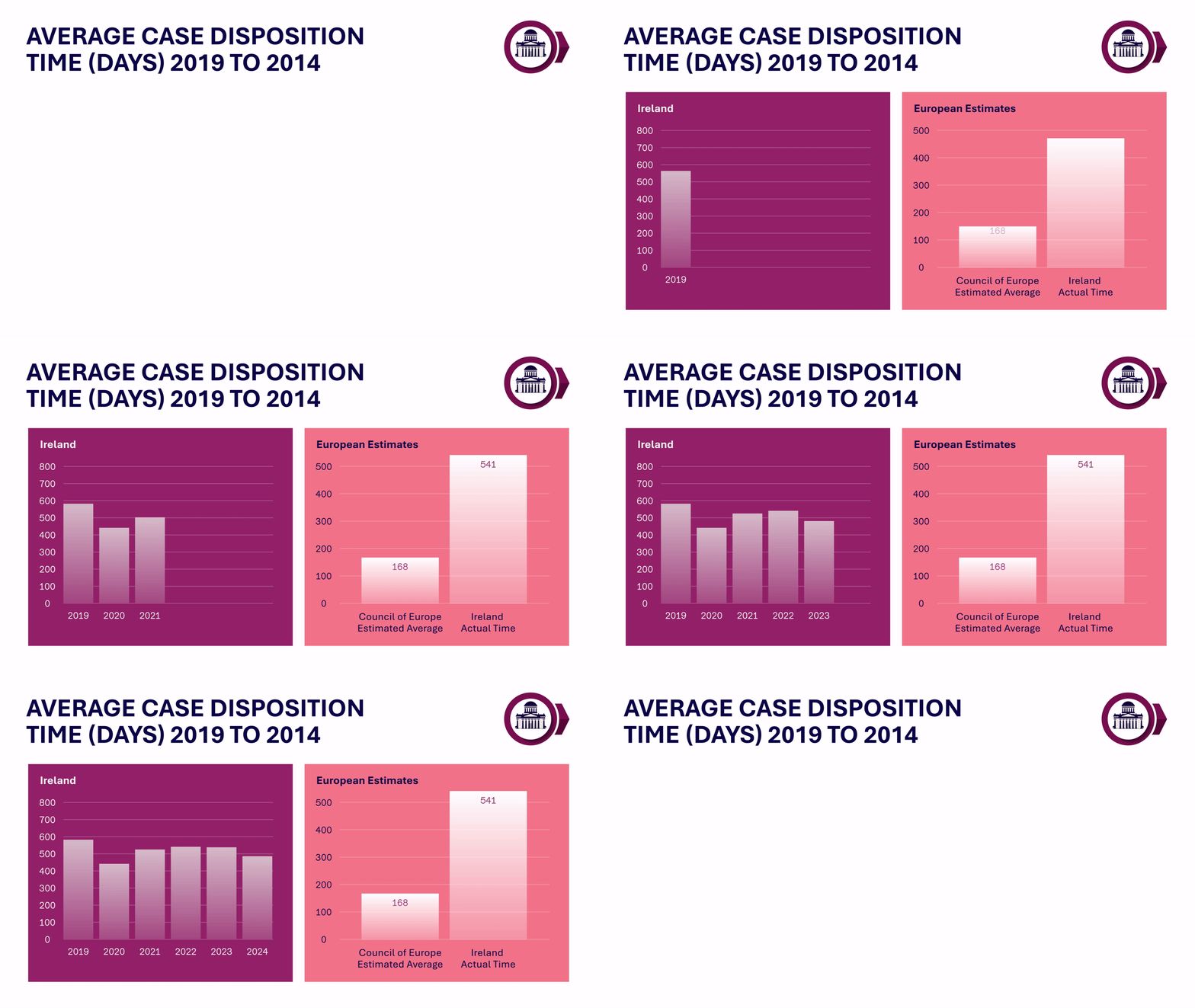
Ireland’s case disposition times, which refer to the average length of court proceedings, are longer than European benchmarks. The data indicate that, in 2022, Ireland’s average of 541 days was more than three times the average European estimate of 168 days. In 2024, Ireland’s average case disposition time was 486 days (16 months), the second-shortest recorded between 2019 and 2024. The longest was 590 days in 2019. This means that the overall average disposition time in the Irish courts reduced by 104 days (approximately three and a half months) from 2019 to 2024. Gaps in court level data limit a full assessment of Ireland’s performance under this indicator. Traffic light indicator: Red |
|
Caseload per Judge |
|
|
Ireland has consistently had fewer judges per 100,000 compared with other European countries. According to the Council of Europe, in 2022, Ireland had the lowest number of judges per 100,000 inhabitants among Member States – a finding reaffirmed in the 2025 EU Justice Scoreboard. Between 2023 and 2024, average caseloads decreased in both the District Court and Circuit Court. The District Court recorded a 6% reduction, while the Circuit Court saw a smaller 3% decrease in caseloads per judge. Caseloads generally increased in the Superior Courts in the period reviewed. The Supreme Court experienced the highest percentage increase, with annual caseloads per judge up 32% from 2023 to 2024. The Court of Appeal recorded a 7% increase, while the High Court recorded a 9% increase in civil matters, but a 7% decrease in criminal matters. Traffic light indicator: White |
|
-
6%
reduction in caseloads per District Court judge in 2024. -
32%
increase in caseloads per Supreme Court judge in 2024.
Case Clearance Rates |
|
|
The Irish courts cleared fewer cases than the number of new cases initiated each year from 2019 to 2024. This means that the backlog of unresolved matters increased each year. Based on 2022 Council of Europe data, the 2025 EU Justice Scoreboard identified Ireland as having the lowest clearance rate among EU Member States. Some of Ireland’s courts had clearance rates above 100%. In 2024, for example, the Court of Appeal and the Supreme Court resolved 124% and 104% of new cases, respectively. Civil clearance rates in Ireland provide only a partial view of dispute resolution, since many cases are settled outside formal hearings. Traffic light indicator: Red |
|
Traffic light indicators explainedA key feature of the methodology employed in this paper is the traffic-light assessment tool. This is a simple visual tool to assess and communicate Ireland’s performance under each justice indicator. The assessment and analyses are based on empirical data that have been collated from over 100 reputable sources. |
|
 |
Red traffic light: Ireland deviates by more than 10% from the European Union or Council of Europe average. |
 |
Amber traffic light: Ireland deviates by between 3% and 10% from the European Union or Council of Europe average. |
 |
Green traffic light: Ireland is on a par with, or deviates by up to 3% from, the European Union or Council of Europe average. |
 |
White traffic light: Available data are insufficient to make an informed assessment. |
|
Exceptions to this model are made where a deviation is clearly positive or negative. For example, higher public trust in the Gardaí is considered a positive outcome, even if it deviates by more than 10% from the EU average. |
|
Document downloadsThe figures above have been rounded for readability. More precise values are provided under each Justice Indicator in the main paper. You can also download the key findings as a print-friendly PDF. |