‘Defections’ from rules-based order increasing
A conference in the Law Society has heard that Europe’s assumptions about the US as a protector have gone and “are not coming back”.
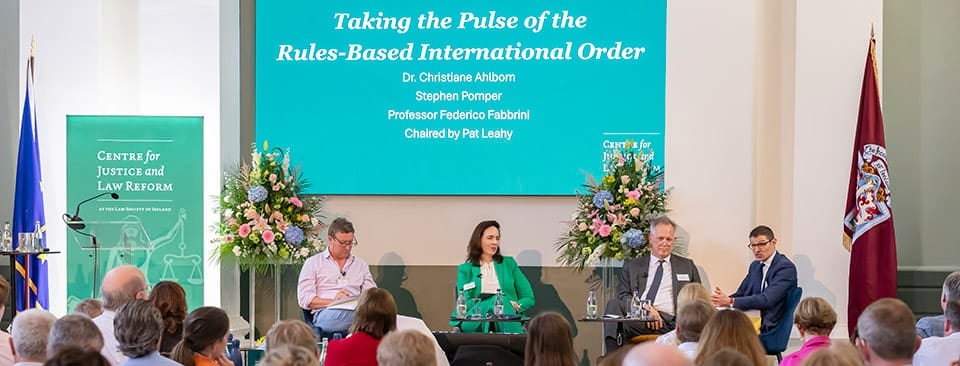
Professor Federico Fabbrini, the founding director of DCU’s Dublin European Law Institute, was speaking at the Law Society’s Centre for Justice and Law Reform Summer School at Blackhall Place (9 July).
The event brought together leading international figures in law, diplomacy, security and politics to examine whether the rules-based international order can survive an age of disruption.
A panel discussion chaired by Irish Times political editor Pat Leahy focused on ‘Taking the pulse of the rules-based international order’.
International order ‘still rules-based’
International-law expert Dr Christine Ahlborn (University of Graz) argued that, while there was a change in the international order, it was still rules-based, pointing to a range of rules covering aviation and other sectors that still operated every day across the world.
She said that article 2(4) of the UN Charter, which calls on states to refrain from the use of force against other countries, was still alive, while the International Court of Justice was dealing with more cases than ever.
The academic told the event that declarations about the death of the rules-based order were particularly prominent in the West, pointing to a view from the global South that there had been a selective focus on the Russian invasion of Ukraine.
Dr Alhborn told the summer school that power was becoming more diffuse and regional institutions more important.
She concluded that international law was being “contested and reinterpreted”, though the changes might not be to the West’s liking, with “more actors on the stage”.
States ‘arming up’
Stephen Pomper (International Crisis Group) argued, however, that we were seeing “tectonic” changes, with increased “defection” from the rules-based order from those that had been most invested in it, such as the US.
He said that there had been an erosion of support for previous core principles such as non-intervention, adding that states could no longer rely on international rules to provide protection, and were “arming up” as a result.
Pomper added, however, that small and medium-sized countries were not yet ready to write off the rules-based international order completely.
Ukraine ‘turning point’ for EU
Professor Federico Fabbrini, the founding director of DCU’s Dublin European Law Institute, told the conference that Russian aggression against Ukraine had been a “turning point” for the EU.
He said that the war had posed a “fundamental challenge” for the EU, which was conceived as a peacetime organisation, and had exposed its “structural shortcomings”.
While the EU had been “an extraordinary success” in preventing war, Prof Fabbrini stated, it had become so successful that it had forgotten “the reality of warfare”.
The EU-law expert described the EU’s response as “unprecedented” and “remarkably flexible”, however, citing its support for Ukrainian forces, the development of new funding mechanisms, and changes in energy policy.
US’s domestic focus
On the effect of US President Donald Trump on international relations, Pomper told the event that he did not see the US “coming back” to its pre-Trump positions.
The US, he argued, would be more focused on domestic challenges than restoring international institutions.
Dr Ahlborn said that the increasing dissatisfaction of the global South with the current system dated from the 1960s and 1970s, independently of Trump or the US, adding that his exit would not bring this process to an end.
Prof Fabbrini said that the current situation was a “decision moment” for Europe, adding that old assumptions about the US as a protector were gone.
“The old days are not coming back, whatever happens; I think trust has been broken,” he concluded.
- For more photographs of the Law Society summer school, go to gallery page.