Nuremberg revisited
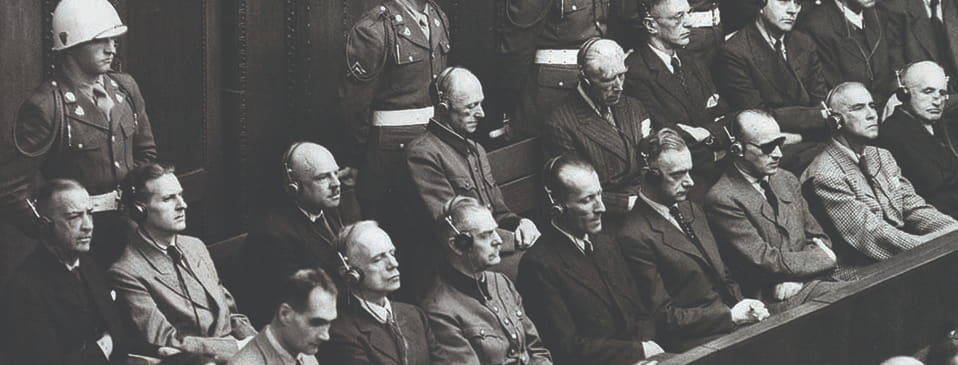
Eighty years on from the Nuremberg Trials, Sam Whitaker notes that, while significant progress has been made on the international legal stage since then, the effectiveness and enforceability of decisions made by international courts are now being called into question
Eighty years ago, on 1 October 1946, the verdicts of guilty were handed down against 19 major Nazi defendants who had been indicted on numerous charges relating to their actions during the Second World War.
The International Military Tribunal at Nuremberg, the first of its kind, led not only to convictions, but also to what is arguably the most wide-ranging legal precedent in international law.
Aside from establishing other core principles relating to a trial under international law, the Nuremberg precedent laid down a principle that is now axiomatic – that any person charged with a crime under international law has the right to a fair trial on the facts and law.
After the Nazi defendants were captured, it was decided that, in addition to the catch-all charge of conspiracy being insisted upon by the American delegation, they would be charged with three categories of crime: crimes against peace, war crimes, and crimes against humanity.
Si vis pacem…
Also referred to as crimes of aggression, crimes against peace can be considered as the main focus of the trials and the charge from which all others flowed. The charge encompassed waging wars of aggression against sovereign nations, striking at the very heart of international law.
That this crime has been prosecuted only a handful of times during the 1940s, and not before or since, is a fact that may come as a surprise to some.
It is obvious that wars of aggression have occurred on many occasions worldwide since Nuremberg, particularly in 2022 when Russia invaded Ukraine.
Crimes against peace, though extant and very much codified, are without a doubt the most difficult to prosecute of the three Nuremberg crimes.
Famously, the International Criminal Court (ICC), established in 2002 under the Rome Statute and a direct descendant of the court at Nuremberg, has been called ‘a giant without limbs’, underlining the reality that it relies on sovereign nations to arrest its suspects.
Focusing on Ukraine as an example, an ICC arrest warrant has been issued against Russian President Vladimir Putin and other Russian officials, specifically for the crime of aggression against Ukraine.
There have been several recent instances in which these suspects travelled safely to and from countries that are signatories of the Rome Statute, in flagrant breach of article 86 therein, which provides that the signatories are under a legal obligation to arrest ICC suspects against whom arrest warrants have been issued when they enter their territory.
The reasoning for this is almost always one relating to diplomatic and political relations between the countries, such as Putin’s 2024 visit to Mongolia (a signatory), whose government claimed that the country’s reliance on Russian energy was critical to its economic survival and that it “always maintains a policy of neutrality in all its diplomatic relations”.
…para bellum
More particularly referred to as ‘crimes against the laws and customs of war’, some examples of war crimes provided in the Nuremberg Charter include murder, slavery, killing and ill-treatment of prisoners of war and hostages, and plunder or destruction of property.
As stated, most of the aforementioned tribunals led to countless war-crimes convictions.
In the aftermath of Nuremberg, a set of principles was laid down by the fledgling International Law Commission of the United Nations. These are officially known as the Principles of International Law Recognised in the Charter of the Nürnberg Tribunal and in the Judgment of the Tribunal 1950 – less officially, the Nuremberg Principles.
These principles, of which there are seven, act as axioms for the implementation of international law, particularly as it relates to the Nuremberg crimes.
The first four principles provide that a person who commits a crime under international law is liable for it, regardless of whether its prohibition is domestically codified, whether they were a head of state or official, or if they were given orders to carry out the crime.
The latter principle, addressing the defence that the accused was simply following the orders of his superior – and which was raised in the first trial for war crimes on record, in 1474 – is now commonly known as the ‘Nuremberg defence’ due to its popularity among the Nuremberg defendants.
This is rarely considered to be a compelling defence, and is never considered a full defence where the order requires the commission of a crime.
However, the fact that the accused would have faced severe punishment and even execution can be a factor in mitigation of sentencing.
Notwithstanding its historical ineffectiveness, the Nuremberg defence has been invoked countless times since, including by Nazi and SS officer Adolf Eichmann in his famous 1961 trial in Israel; and by perpetrators of the My Lai Massacre of 1968.
More recently, debate arose in relation to a soldier’s duty to refuse illegal orders when calls by Democratic members of the United States Congress to obey this recognised rule of international law drew stark condemnation from President Trump, who stated that this amounted to sedition, and even insurrection.
‘Man’s inhumanity to man’
While this poetic description of human-to-human cruelty penned by Robert Burns is well-known, American Supreme Court Justice and Nuremberg prosecutor Robert H Jackson’s suggested term has entered legal dictionaries worldwide.
So-called ‘crimes against humanity’, as defined in the Nuremberg Charter and subsequent international law, include “murder, extermination, enslavement, deportation, and other inhumane acts committed against any civilian population”.
These, it was alleged by Jackson and the prosecutors at Nuremberg, and subsequently proved to the satisfaction of the Nuremberg judges, were carried out on a colossal scale across occupied Europe during the Second World War.
Since Nuremberg, and before the establishment of the ICC in 2002, several international courts and tribunals have prosecuted crimes against humanity, in addition to the other Nuremberg crimes and the crime of genocide, which since Nuremberg and the 1948 Genocide Convention has been prosecuted as its own distinct but related charge.
The International Criminal Tribunal for the former Yugoslavia operated between 1993 and 2017 investigating the crimes committed during the Yugoslav Wars and led to 90 successful convictions of each Nuremberg crime.
The International Criminal Tribunal for Rwanda operated between 1994 and 2015 and investigated the Rwandan genocide, convicting 61 individuals on similar charges.
A slightly different approach was taken in the case of the Khmer Rouge Tribunal.
Officially known as the Extraordinary Chambers in the Courts of Cambodia, this was a hybrid court – it was established as a national court under agreement with the UN, and applied international law and custom and employed international lawyers.
Similarly, the Special Court for Sierra Leone was formed as a hybrid court between the Sierra Leonean government and the UN, charged to investigate and prosecute crimes committed during the Sierra Leone civil war.
Arrest warrants
One of the primary functions of the ICC is to prosecute crimes when the state in which the crime was committed is unwilling or unable to prosecute.
To this end, ICC arrest warrants were issued in November 2024 against Israeli Prime Minister Benjamin Netanyahu and his former defence minister Yoav Gallant for crimes carried out in the State of Palestine, most notably in the Gaza Strip since October 2023.
This drew stark condemnation from Netanyahu as well as his ally President Donald Trump, who signed Executive Order 14203 imposing sanctions, asset freezes, and travel bans on all ICC personnel, and even rights groups who provided evidence to the ICC.
Showing further triumph of diplomacy over legal obligation, Hungarian leader Viktor Orban enthusiastically invited Netanyahu to Hungary the day after the ICC arrest warrant issued against him and initiated the process to withdraw Hungary’s ICC membership ahead of his guest’s arrival the following April.
In January 2025, Polish Prime Minister Donald Tusk invited Netanyahu to Poland on the 80th anniversary of the liberation of Auschwitz and guaranteed safe passage for him.
Thankfully, the list of countries that have expressed their commitment to abide by their international-law obligations is considerably longer than those that have opposed Netanyahu’s arrest.
Those states who have been particularly vocal in this regard are Ireland, Turkey, and South Africa, with the latter nation having issued proceedings in the International Court of Justice against Israel in December 2023, alleging genocide.
Reversing course
Other governments have been non-committal – Italy has called into question the warrant’s legality, and France has pointed out that Netanyahu may enjoy head-of-state immunity.
Hungary has reversed course – on the election of Peter Magyar’s government in 2026, the process to withdraw from the Rome Statute has been halted, and Magyar has expressed his intention to arrest ICC suspects.
The UN Special Rapporteur on the Rights Situation in the Palestinian Territories, Francesca Albanese, has consistently rejected any proposals exempting Netanyahu from arrest and has even gone so far as to warn that obstructing the enforcement of the warrant could be an offence in itself under article 70 of the Rome Statute.
In July, the mayor of New York City Zohran Mamdani called for Netanyahu’s arrest on entering the USA, despite the country not being a signatory.
A YouGov poll published in the wake of this controversy showed that nearly half of Americans are in support of arresting Netanyahu, while less than a quarter believe he is innocent.
Secretary of State Marco Rubio recently expressed his intention to “systematically dismantle” the ICC’s ability to function. The United States and Israel have both publicly denounced the ICC, and even encouraged states to ‘review’ their membership, with Venezuela and Chad notifying the ICC of their intention to withdraw only within the last few months, after discussions with US officials.
Veni, vidi, non vici
While significant progress has been made on the international legal stage since Nuremberg, and numerous convictions have been achieved, the effectiveness and enforceability of decisions made by international courts like the ICC can rightly be called into question.
The most prominent example of this weakness being exploited is the US-led effort to form an alliance against the ICC, which it views as a threat to its national sovereignty and that of its allies whose leaders or citizens are ICC fugitives.
Concern over diplomatic relations between states has given rise to a reluctance to carry out international arrest warrants, in many cases despite a legal obligation to do so.
As seen, some signatories to the Rome Statute have even actively invited ICC suspects to their territory for diplomatic reasons.
Are these politicians and diplomats obstructing the course of justice, or are they merely preventing a breakdown in diplomatic relations between states?
This type of diplomatic breakdown often precedes wars, most notably the First and Second World Wars – but we then must ask ourselves: is it better to let suspects of the world’s worst crimes escape justice, than to risk a Third? If the answer is yes, then perhaps Nuremberg – and its offspring like the Rome-born ICC – came and saw, but failed to conquer.
Sam Whitaker graduated in law from Trinity College Dublin in 2023. He is a trainee solicitor at Ryans Solicitors LLP in Dublin and aims to qualify in December 2026. He wishes to thank Niall Walsh and Peter Connolly (Peter Connolly Solicitors) for reviewing this article.