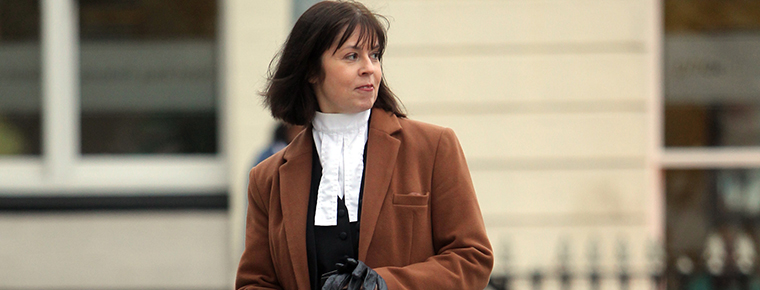
Civil and political rights underpin democracy – judge
The ECtHR is more relevant than ever in turbulent political times, ECtHR Judge Una Ní Raifeartaigh has told a Law Society lecture.
Attendees at this year’s Human Rights and Equality Committee annual lecture, given by Judge Una Ní Raifeartaigh (24 September), were given an insight into the European Court of Human Rights (ECtHR) in Strasbourg and its relevance to Irish solicitors.
A judge of the ECtHR since July 2024, Ní Raifeartaigh was previously a judge in the Court of Appeal and the High Court in Ireland, having practised as a barrister for 23 years.
“As an international court in another country, sometimes the ECtHR might seem remote and it may seem that the human rights area is all a bit esoteric,” she said.
Solicitors as frontline defenders
“But we're all part of this collectively. We're all contributing in different ways, and your role [as solicitors in Ireland] is key to that as you are the frontline defenders of human rights for individuals.”
The ECtHR, also known as the Strasbourg Court, is an international court of the Council of Europe, which was set up after World War II in response to the atrocities committed during that period.
It’s responsible for ensuring that states comply with the European Convention on Human Rights.
“These are civil and political rights which are intimately connected with a functioning democracy – and that was the idea,” Ní Raifeartaigh explained.
“It was meant to be a system that would promote peace and democracy in Europe. In these turbulent political times, it’s more relevant than ever,” she stated.
A recent example, which highlights the intimate connection between these rights and democracy and pluralism, is the 2025 case Bradshaw and Others v the United Kingdom.
This was about Russian interference in British elections and potentially also in the Scottish referendum elections in earlier years.
“Certain MPs thought that the British government should have set up a public inquiry into exploring this misinformation campaign.
“Our court was asked to examine what steps had been taken, and ultimately found that there had not been a violation of the relevant article [Article 3, First Protocol],” Ní Raifeartaigh said.
“There are some excellent passages in that judgment on the connection between human rights, pluralism and democracy. And it really goes back to the basics in terms of the foundational principles of what this convention and this court is all about.”
One point which Ní Raifeartaigh paused to emphasise during her lecture was that ECtHR case law has no direct effect in the Irish legal system.
Entirely separate from CJEU
“The Council of Europe system and the ECtHR is entirely separate from the EU, and it's entirely separate from the Court of Justice of the European Union in Luxembourg,” she said.
“A key corollary of this is that case law does not have direct effect in the same way as EU law – you need to exhaust domestic remedies in Ireland before bringing a case to Strasbourg.
“The ECtHR is supposed to be a fallback for when the national courts fail to do the job properly, or the convention needs interpretation.”
Most Irish cases with human rights dimensions are dealt with in the Irish courts through the prism of Irish constitutional rights. There is a considerable overlap of rights with the European Convention: right to life, right to privacy, right to liberty, and so on. But the rights in each area are far from identical.
“There are quite a few significant Supreme Court cases in which the difference between those rights is discussed, and the Supreme Court has repeatedly told lower court judges how it's important not to try and merge the two.
“There is overlap; they can be similar, but we must not collapse one into the other,” Ní Raifeartaigh said.
National net
“One of the practical consequences of this is that hardly any Irish cases reach the Strasbourg Court, because they’re usually caught in the national net and dealt with in Ireland. Irish cases constitute a tiny fraction of the Strasbourg docket, less than 1%.”
According to 2025 figures, Turkey accounts for 36% of the ECtHR’s docket on its own, with over 21,000 cases. (Over 80% of current Turkish applications stem from measures implemented after the July 2016 coup attempt).
Russia, Ukraine, Romania and Greece make up the top five countries, which together account for 77% of the ECtHR’s case list.
Exhaustion of remedies
“Most of the cases that we get are individuals against the state. One point to bear in mind about the shape of the docket is that cases tend to come to us years after the events in question have taken place, because of the principle of exhaustion of domestic remedies,” Ní Raifeartaigh said.
“The overall themes are ones which reflect the world that we live in and European geopolitics in particular: war, conflict, attacks on the rule of law, democratic backsliding, corruption; technology and artificial intelligence, attacks on media and journalism, protests and assemblies; the persecution and imprisonment of political opposition figures and the oppression of certain groups.”