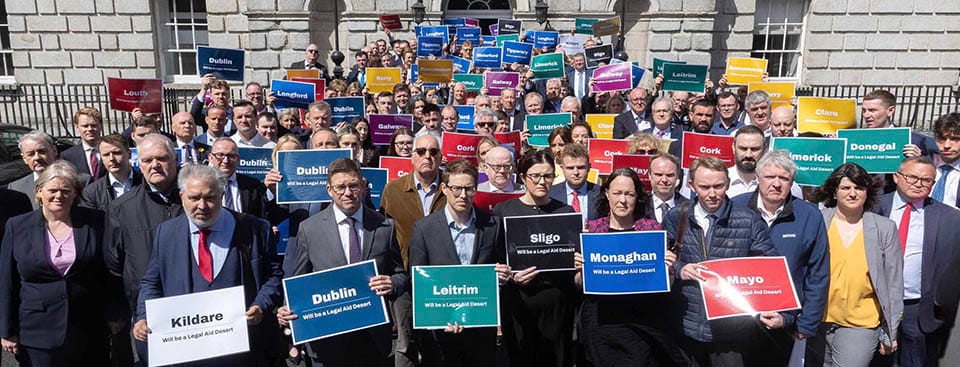
Flat-fee reform spells jeopardy for practices
The Law Society has roundly condemned the 'seriously flawed' Department of Justice review of the proposed criminal legal-aid fee structure. Solicitors have been voting with their feet – withdrawing legal services from the courts from 17 June
The Law Society has said it strongly rejects claims made in the Department of Justice's Review and Reform Proposal of the Criminal Legal Aid Fee Structure for the District Court, which were reported on 17 June.
The document – which the department did not directly share with the Law Society – contradicts recent comments from the Justice Minister, who clearly stated in the Dáil that there was no plan to cut fees, makes multiple critical assertions about solicitors, yet fails to provide data to support them.
Law Society President Rosemarie Loftus, in a statement released on 18 June, said: "This is not evidence-based policy analysis. It is anecdote deployed as accusation.
"Criminal legal aid is not a discretionary spending line. It is the mechanism by which the State honours its constitutional obligation and its international obligations under the European Convention on Human Rights and established United Nations' principles to provide a fair trial to every person facing a criminal charge – regardless of means.
"It is worrying in the extreme that this non-evidence-based analysis is being used to support this flawed proposal from the Department of Justice," she said.
Unfounded allegation
The president added: "The department's document asserts that the higher rate of adjournments in legal-aid cases is down to financial motivation on the part of solicitors. This is a serious and unfounded allegation. The department fails to provide evidence to support this claim.
"The reality is that adjournments are most often driven by statutory requirements and State-side delays. These include delays in providing disclosure, delays in getting DPP directions, delays in serving books of evidence, delays in obtaining probation and restorative justice reports, as well as challenges accessing interpreters.
"Each one of these adjournments is granted by a judge who is independent of either the defence or prosecution in every case, and the State has every right to object to those requests in each case."
Complexity ignored
The Law Society says that the department's comparison of legal-aid versus non-legal-aid cases completely ignores case complexity, rendering the conclusion that solicitors cause delays "analytically meaningless".
Those using criminal legal aid are often vulnerable people struggling with addiction or serious mental-health conditions – homeless people, victims of trafficking, non-English speakers, and people in acute crisis. These cases almost always require additional time, additional appearances, and patient, repeated engagement with a solicitor.
President Loftus concluded: "The Law Society is calling on the Minister for Justice to enter into genuine, structured consultation and engagement with the profession. Criminal defence solicitors perform an essential constitutional function.
"They are entitled to be treated as professionals who act in the interests of their clients – and not blamed for delays that are fundamentally the consequence of inadequate resourcing of the wider criminal justice system."
Genuine consultation
Last February, Justice Minister Jim O'Callaghan announced plans to introduce a flat fee for criminal legal-aid services in the District Courts.
The proposed €455 flat fee would cover a case from beginning to end, regardless of the number of court appearances. This represents approximately a 20% cut. The Law Society has described the proposals as "unworkable", warning that they would lead to an exodus of solicitors from criminal legal-aid work.
At a meeting convened by the Law Society on 9 June, more than 150 criminal-law solicitors from across the country met at Blackhall Place.
Criminal Law Committee chair Shane McCarthy expressed frustration at the department's lack of engagement with the Law Society submission, telling the meeting that the organisation had been presented with a fait accompli.
The department had been invited to send representatives, but declined – a decision President Loftus described as a "discourtesy". Other speakers described the absence of officials as "an insult" and "an absolute slap in the face".
A Department of Justice spokeswoman insisted it remained open to further discussions before the July deadline and characterised the reforms as aimed at improving court efficiency and securing fairer remuneration for practitioners.
McCarthy stated that the Law Society's submission had not been considered in any depth, and that proposals for amendment had been received in an "offhanded fashion". He told the meeting that the current proposal had come as a "complete and utter surprise" and "in no way" represented a reversal of financial-crisis-era cuts.
Egregious wrong
According to the department's own figures, McCarthy pointed out that solicitors were being paid an average of €480 for a criminal legal-aid certificate, whereas the department was now proposing a flat fee of €455.
Speakers expressed particular concern about cases where a legal-aid transfer is made to a different solicitor – under the proposals, only the solicitor representing the defendant when the final order is made would be entitled to the fee.
One solicitor described as "an egregious wrong" a situation in which a solicitor who had started a case would receive nothing.
Mayo solicitor Gary Mulchrone summed up the mood by describing the flat-fee proposals as "practice-threatening". Criminal-law solicitor Dara Robinson told the meeting that the Department of Justice was "fixated" on costs and had no understanding of the critical input solicitors had into the operation of the system.
Committee vice-chair Amanda Connolly called for support from colleagues in other areas of the justice system, warning that criminal lawyers were "easy targets" and were being used as "guinea pigs" for potential similar proposals in civil law or the Circuit Court in the future.
McCarthy pledged to communicate the "palpable sense of anger and frustration" at the meeting to the department: "What we are hearing from practitioners is that these proposals would lead to practitioners no longer taking on District Court legal-aid work, with inevitable consequences for defendants, the courts, and the wider justice system.
"The Department of Justice needs to address the serious concerns of solicitors before pressing ahead with changes that will have lasting and harmful effects."
Withdrawal of services
Some criminal legal-aid solicitors and law firms began withdrawing their services from the courts on 17 June, leaving thousands of criminal cases unable to proceed.
Members of the Southern Law Association resolved to withdraw services in criminal cases indefinitely from 22 June, but subsequently deferred this action to allow notice to be given.
On 19 June, the Law Society's Criminal Law Committee held an online meeting attended by more than 250 criminal-law solicitors, who were told that departmental officials had confirmed the new payments model would proceed as planned from 1 July. The meeting concluded with a clear sense of unity around escalation.
Following a meeting on 22 June, criminal-defence solicitors, acting independently, agreed not to act in new custody cases from midnight that night, while continuing to act in custody cases where already assigned.
They agreed not to attend at garda stations or provide phone advice to those in custody, nor to make themselves available for evening courts, Saturday courts, or special sittings. As a result, no new juries can be sworn in for bail cases, and thousands more cases have been adjourned across the District and Circuit Courts, Central Criminal Court, and Court of Appeal.
Mary Hallissey is a journalist and Andrew Fanning is a freelance journalist at the Law Society Gazette. (Additional reporting by Mark McDermott, editor.)