EU ‘asleep at the wheel’ for China’s rise
A discussion about the impact of strategic rivalry on the international order has been told that Europe was “asleep at the wheel” as China emerged as a global economic power.
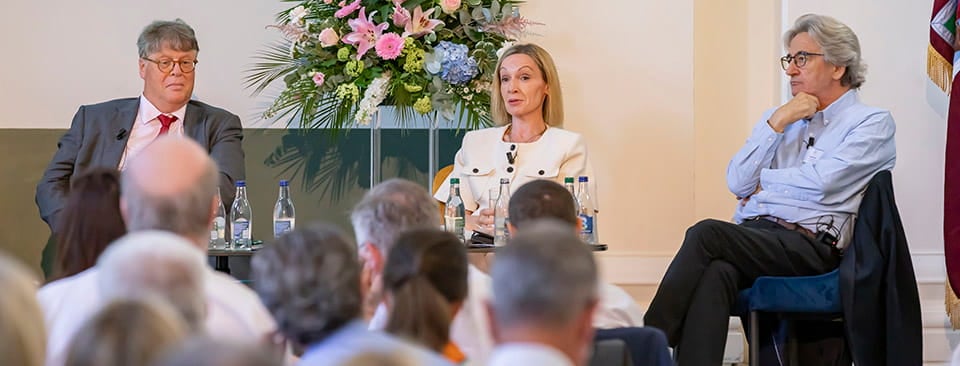
Former minister of state for European affairs Lucinda Creighton (founder and chief executive, Vulcan Consulting) was speaking at the Law Society’s Centre for Justice and Law Reform Summer School at Blackhall Place (9 July).
A session chaired by barrister and former RTÉ journalist Ingrid Miley discussed whether the current rules-based order could survive strategic rivalry.
‘Wheel of misery’
Journalist and author Fergal Keane described himself as a “passionate believer” in the rule of law and “hugely proud” of Ireland’s contribution to it, but added that we lived in a “bubble”.
For too many people in other parts of the world, he stated, the status quo involved “a wheel of misery”, with climate change and other problems driving people to western countries, in turn setting off a migration crisis.
“What do you think is going to happen if we don't have ... principles of the rule of law, a fair shake economically, fair trade?” the journalist asked.
“They’re going to vote with their feet, they're going to come here, and they're going to come here with resentment,” he stated.
‘Experts’ lose prestige
Asked about whether some of the current crises had emerged from a feeling among some of being left behind, Rory Montgomery (former political director, Department of Foreign Affairs) told the conference that politics often followed economics, citing the slow recovery from the economic crash in many countries that led to resentment, a search for people to blame, and a loss of prestige for ‘experts’.
Creighton said that Europe had benefited most from the current rules-based order, adding that part of what was being seen now was a feeling in the US that it had not.
There was a feeling in the US, rightly or wrongly, she said, that it had “paid for European security and paid to bankroll a lot of these international organisations”.
Creighton described Europe as having been “asleep at the wheel” as China’s economy raced ahead, pointing out that it would account for 50% of global manufacturing by 2030.
“They are now innovating themselves,” she stated, adding that China had the “luxury” of not being a democracy and being able to deploy domestic policies that Europe or the US never could, “nor would we aspire to”.
She said that the EU had only recently started talking seriously about a defensive trade policy to cope with Chinese exports, “probably ten years too late”.
‘Strength and might’
Creighton said that, while she respected the incrementalism that had brought the EU this far, it was “not fit for purpose anymore” and needed quicker decision-making.
“We need to rethink the EU,” the former minister stated, adding that the union needed “strength and might” – including contributions from Britain and Ukraine.
Creighton said that she believed that the EU had to, and would, do more on defence, adding that the introduction of joint procurement alone would be a big step.
‘Creative response’
Montgomery believed, however, that the EU’s “hesitation” on China was grounded in “certain realities”.
“Trump tried to put it up to China with tariffs; he got a very bloody nose,” he said.
Montgomery said that the EU’s biggest challenge was whether to confront, let things go, or try a mixture of the existing international order and new structures to manage these new relationships.
The EU was set up to legislate, he told the event, not for crisis, and would have to be “creative” in its response to changes in the international order.
‘Credibility my eye’
Keane told the event that Europe had a well-deserved mistrust of militarism. “The problem is that times change,” he added.
The journalist said that US isolationism would not go away when Trump left, adding that Europe needed to “wise up” in terms of its own defence.
“Who's going to be persuasive enough in Europe to get us to face that reality?” he stated.
Asked if international institutions such as the UN were losing credibility, Keane replied that, they may have had credibility for us in the West. Referring to events in Rwanda in 1994 and in Gaza, however, he stated: “Credibility my eye.”
‘Power of shame’
In a response to a question on sanctions, Montgomery told the conference that Ireland’s position on alumina exports to Russia was “unconscionable”.
Creighton said that, while the International Criminal Court (ICC) had had some success, some countries were “too big to be sanctioned”.
She added, however, that there was still value in the “power of shame”, as democracies were affected by public opinion, and even countries like China feared the possibility of an uprising.
Keane argued, however, described the selective application of justice as “a stinking fact” that could not be accepted.
“Nothing is more corrosive to the idea of justice,” he stated.
Although the ICC’s arrest warrant for Israel’s prime minister Benjamin Netanyahu was unlikely to be carried out, he said, it was “an important marker”.