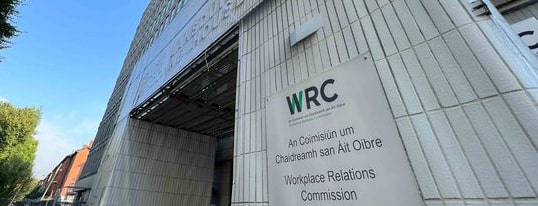
WRC orders reinstatement of sacked worker
The Workplace Relations Commission (WRC) has ordered an employer to re-engage a worker more than 15 months after his dismissal, after finding that his dismissal for gross misconduct was both substantively and procedurally unfair.
The decision in Stephen Loughran v Almac Pharma Services Ireland Limited (ADJ-00059324) is notable because re-engagement is an exceptional remedy in unfair dismissal cases, where compensation is more commonly awarded, Anne O’Connell Solicitors notes.
Loughran, a production operator, was summarily dismissed following a physical altercation with a third-party food delivery driver at the company's Dundalk premises on 7 March 2025.
The incident followed a delayed food delivery which arrived after Loughran's break had ended.
He accepted using offensive language towards the driver but maintained that he had acted in self-defence after the driver struck him.
The company took the view that Loughran had gone beyond self-defence, finding that he had responded with a number of punches while the driver was retreating.
It also considered the offensive language and the potential reputational impact of the incident on company premises.
His dismissal was subsequently upheld on appeal.
However, WRC adjudication officer Breiffni O'Neill found that the company had not reasonably assessed the CCTV evidence.
The adjudicator noted that the entire physical confrontation lasted approximately six seconds and questioned the disciplinary panel's conclusion that Loughran had a realistic opportunity to walk away from the incident.
The WRC also identified a number of significant procedural shortcomings.
In particular, the person who had been involved in the initial evidence gathering and investigation subsequently chaired the disciplinary hearing and made the disciplinary decision.
The adjudicator described him as effectively being “the architect” of the process from beginning to end.
The WRC also found that contradictory evidence had not been properly addressed, allegations had been expanded after the investigation had concluded and there were shortcomings in the appeal process.
The role played by HR was also criticised, with the adjudicator finding that its involvement had largely been limited to note-taking rather than providing an appropriate safeguard against the concentration of investigative and decision-making functions in one individual.
While the WRC accepted that procedural imperfections do not automatically make a dismissal unfair, it found that the defects in this case went beyond minor or technical errors.
They affected the independence, even-handedness and factual integrity of the disciplinary process.
Despite finding the dismissal unfair, the WRC declined to order reinstatement.
It accepted that Loughran's use of grossly offensive language constituted serious misconduct and considered that restoring his full pay and service for the period since his dismissal would not be appropriate.
Instead, the WRC ordered re-engagement in his previous role, or an equivalent position, at the Dundalk site.
The period between dismissal and re-engagement was to be treated as unpaid suspension.
No barrier to return to work
The adjudicator found no objective barrier to Loughran returning to work. The altercation had involved a third-party delivery driver with no continuing presence in the workplace, while other circumstances surrounding the employee's working environment had also changed.
Anne O’Connell Solicitors said the decision demonstrates that an employer's assertion that trust and confidence has broken down will not necessarily prevent the WRC from ordering re-engagement where an employee's return to work is considered objectively possible.
It also provides a significant reminder to employers of the importance of ensuring that disciplinary investigations are conducted fairly, that conflicting evidence is properly examined and that investigative and decision-making functions are appropriately separated.