Sanctions regimes 'have rule-of-law implications'
Attacks on the International Criminal Court (ICC) are part of a much wider challenge to the international rule of law, a seminar at the Law Society heard.
Judge Nicolas Guillou of the ICC attended the seminar Ireland and the EU – an opportunity for Influence: Threats to the rule of law and adopting a commonplace approach to tech regulation (22 September), organised by the Law Society EU and International Affairs Committee.
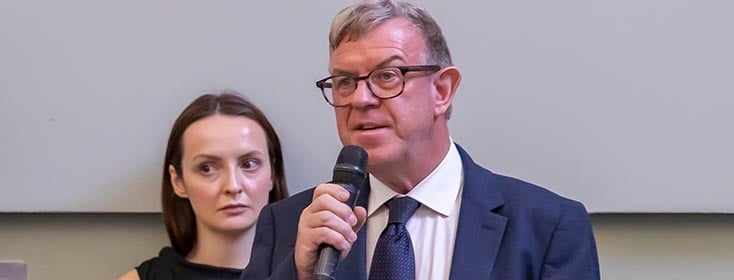
Following his keynote address which examined attacks on the ICC, Judge Guillou was joined in a panel discussion by IHREC chief commissioner Liam Herrick and solicitor Noeline Blackwell.
Air one breathes
Chair Cormac Little SC, William Fry partner and member of the Law Society EU and International Affairs Committee, noted “It's often said that the rule of law is like the air that you breathe. You take it for granted when it's there, and you only miss it when it's gone.”
Liam Herrick said that what Judge Guillou had named was politically motivated attacks on the international legal order, “Not just by Russia, which was a traditional opponent of the international rules-based system, but now also by the United States,” he stated.
Herrick continued: “The fact that the States are organising themselves to attack the safety and autonomy and independence of judges is absolutely outrageous, and it should be named as such.”
The immediate challenge, he said, is to examine what the rule of law requires and what happens when it is under sustained pressure.
Ireland is in a privileged position, with deep public, political and judicial support for the rule of law, Herrick said.
But if the rule of law is genuinely valued, that means investing in legislation, courts and access to justice, as well as being prepared to take political risks when it is attacked.
“If it's something you really value, when you see it being violated or actually full frontally attacked, you have to be able to expend or be willing to expend a bit of capital, take a few risks to show solidarity and stand up to it,” he stated.
“The scale of the immediate challenge can't be understated,” he said.
He warned that if the international legal system is picked apart, the consequences for the wider international system could be “devastating”.
Noeline Blackwell placed the current challenges in a longer historical context.
She questioned the idea that the international rule of law had ever enjoyed a golden age, arguing that the progress seen in human rights during the 1980s and 1990s had been viewed largely through a European and North American perspective.
“I think that we left an awful lot of people behind, and that we weren't building more equal societies”, she said.
“And when you're not doing that, people are very clear where things are unfair and it is hard for them to support the rule of law,’ she stated.
Discontent
Blackwell said the resulting discontent had contributed to the current challenge to established institutions.
Judge Guillou agreed that the credibility of international law ultimately depended on its being applied equally.
The ICC has around 120 member states, many of them from the global south.
If countries outside Europe concluded that international law applied differently when Western allies were affected, the judge warned, confidence in the system would be severely damaged.
He added that the present challenges should not be understood simply in terms of one political leader or one moment.
Structural
The problems were structural.
However, the judge said the answer is not to abandon international institutions because they are imperfect.
The ICC, like the United Nations, had taken decades to build.
The task is to improve the system rather than dismantle it.
The discussion also raised concerns about the rule-of-law implications of sanctions regimes themselves.
For Guillou, the sanctions raise a wider question about the safeguards built into legal systems.
His own experience proves that sanctions regimes created to target a small number of people could expand considerably, while offering fewer procedural protections than ordinary criminal law.
That, he suggested, should prompt lawyers to question the design of such systems.
Even when sanctions are directed at people accused of the worst conduct, basic legal guarantees should not simply be discarded.
Speaking from the floor in reference to the sanctions imposed on Judge Guillou and other members of the ICC, former Financial Services and Pensions Ombudsman Ger Deering pointed out that sanctions can and do affect ordinary businesses.
Deering described a small Irish business importing product from Cuba which found its banking transactions shut down because its Irish bank used a US correspondent bank.
The business was not notified of the sanction and only came to light when suppliers flagged non-payment and issues arose with Revenue over VAT returns.
Devastating impact
“It has a devastating impact both on families and on businesses when it happens”, Deering said.
“I won't say it happens on a daily basis, but it's so much more extensive than people actually realise,” he said.
The panel also considered the relationship between the rule of law and economic and technological power.
Guillou said Europe should remain open to international business but should avoid becoming entirely dependent on a monopoly or duopoly from another country.
Increasing dependence
Increasing dependence on US financial and digital infrastructure is a vulnerability and a competition issue, he said.
If one company controls an organisation's data, cloud services and other essential infrastructure, it could potentially exercise enormous power.
Accordingly, Europe needs to encourage competition in the digital sphere.
Herrick linked this to the EU's current debate about regulatory simplification, warning that pressure to weaken regulation of powerful companies could itself become a rule-of-law issue.
He argued that individual states could struggle to act alone, but that a critical mass of EU states acting together could create considerably greater leverage.