‘Europe has lost banking and digital sovereignty’
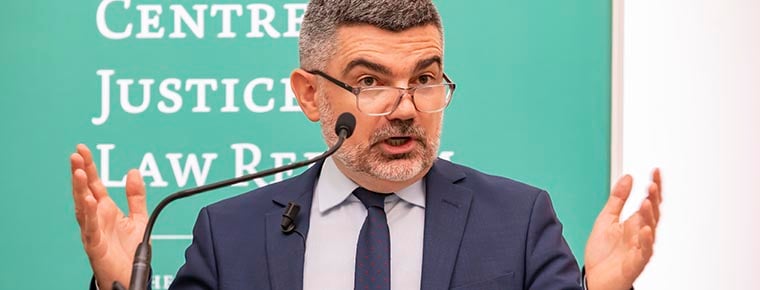
The institutions of international law are under attack, and the rule of the strongest and wealthiest is back Judge Nicolas Guillou of the International Criminal Court has told a Law Society seminar.
And the aim is to “alter the course of justice so that judicial decisions are no longer made on the basis of law and facts, but on the basis of threats and punishment,” he said.
However, the judge said: “I remain optimistic, because if we are under attack, it is because international criminal justice matters, and every day it matters more and more to civil society, and first and foremost, it matters to the victims.”
Lawlessness
He added, “What was once governed by lawlessness, chaos or violence, is gradually being regulated by the rule of law. It's a slow process, but it is happening”.
Judge Guillou was in Blackhall Place to receive the Centre of Justice and Law Reform medal of excellence after which he delivered a keynote address at the event, Ireland and the EU – an opportunity for Influence: Threats to the rule of law and adopting a commonplace approach to tech regulation (22 September), organised by the Law Society EU & International Affairs Committee.
Profound disappointment
Reflecting on the post-1989 optimism for a more peaceful and democratic world, the judge said “Three decades later, the disappointment is profound.”
“Today, we find ourselves in a dangerous world, marked by a return of the rule of the strongest and the rule of the wealthiest.
"A world where boundaries, whether legal or planetary, are being challenged.
“And yet, for nearly a century, we have succeeded in building an international order founded at least in part, on the rule of law,” he said.
The threats now facing that order include states calling for limits on the case law of the ECtHR, countries withdrawing from international organisations “in the name of a return to a mythologised sovereignty”, and the leveraging of domestic law and “economic might” to make direct attacks on organisations dedicated to protecting the vulnerable.
“This upending of the hierarchy of norms calls into question the long-term viability of the international system,” the judge warned.
Acknowledging that the administration of international law has never been easy, he said the challenges today are of a different scale and target evidence, the courts and the judges.
Fake evidence and invented crimes
“In the future, we will probably see attempts to generate fake evidence or to produce evidence with the wrong date or a wrong location,” he said.
“But it could also be to invent crimes that were not committed.”
The pressure on states to stop cooperating with the ICC is not new, the judge said, citing agreements made in the 2000s at the request of the United States to block cooperation in investigations of American nationals.
However, in recent times he said, there has been pressure from “all American embassies all over the world to push countries to leave the International Criminal Court.”
Some countries have left: “we fear that others will follow, especially this week because it's the UN General Assembly,” he said.
Although, as with Hungary, there have been reversals of decisions to leave.
Courts have faced both “very sophisticated cyber-attacks” from different parts of the globe and “espionage attacks”.
Many judges have been subjected to online smear campaigns.
In December 2025, those who made decisions regarding the Ukraine war were sentenced in absentia by a Russian court to up to 15 years’ imprisonment in Siberia.
These judges must accordingly evaluate all travel for the risk of the Russian sentence being enforced.
However, Judge Guillou described the threat “from an old ally of Europe” as probably “the most preoccupying”.
On foot of ICC decisions made regarding Afghanistan and Palestine, nine judges and four prosecutors of the International Criminal Court are now on the United States sanctions list.
The sanctions regime was created with the Americans to deal with terrorists and drug traffickers, the judge said.
“But today, in the middle of this list, between two terrorists of Al Qaeda and Daesh, you have the judges of the International Criminal Court.”
Judge Guillou was placed on the list in August 2025.
This means that the judges, their spouses, and their children, cannot travel to the US, and any US assets are frozen.
But he described the third aspect of the sanction, whereby no US individual or company can provide any service to, or receive any service from, a sanctioned person, “is by far the most important”.
Banking is particularly impacted, even within the Eurozone, because of down-the-line connections to US institutions.
Judge Guillou’s own French bank cancelled all of his means of payment because no alternative exists.
No sovereign means of payment
This, he said, made him realise that “in Europe we do not have any sovereign means of payment, because all our cards are American.”
He gave an example of being invited to speak about the sanctions at the Council of Europe.
They could not reimburse his travel costs because the bank refused to do the transfer.
The impact is also felt in digital life.
“If you look at your cell phone, if you look at all the apps that you use on a daily basis, whether it's Uber, PayPal, Airbnb, whatever, everything is American.”
The judge has given up shopping online, even on European platforms, because, if the delivery company is American, the package cannot be delivered.
Even smart speakers do not work for those under sanction.
Everything stops under sanction
“When you're under sanction, everything stops,” the judge said.
“And this is where you realise the loss of sovereignty that we have at the moment in Europe."
Noting that there has never been a period in history where international law was fully respected, Judge Guillou said the difference now is that it is being openly violated.
He interpreted this to mean that what is contested today is not international law, but progress towards an international rule of law.
He believes the challenges are driven by two dynamics.
Imperial dynamic
The “imperial dynamic” seeks a return to “managing international relations through force, a world where there are overlords and there are vassals.”
The “libertarian dynamic” is “the rule of the richest” and seeks "a return to managing world affairs very exclusively on wealth and financial interests, and this is not done in the interest of the many, but just for the fortune of the few”.
He said that the international rule of law stands in opposition to this dual dynamic and for this reason it is coming under attack.
“They want to destroy the institutions that protect the weak,” Judge Guillou said.
Authoritarian regimes
“A judicial system where judges do what is expected from them, because they are threatened or afraid, is the characteristic of authoritarian regimes,” he continued.
“If we accept this, it will result in a justice system that is no longer independent nor impartial, but it is not the time to give up."
Adding that this is not the first time that the international order has been attacked, the judge said: “We must continue to do our job as lawyers, as judges, detached from political considerations.”
To do this, he went on, lawyers and judges need support from the member states of the ICC: “All the member states need to reiterate support for the court and refuse to be blackmailed by foreign powers.”
He also called for support from the European Union and the enactment of the Blocking Statute.
“It is time to activate it. It will give a clear signal of what Europe stands for.”
He said this was particularly timely considering media reports that the US is contemplating institutional sanctions against the ICC.
Stressing the importance of support from civil society he said: “Your invitation today is a very strong message of support to the court. And I thank you from the bottom of my heart for this invitation.”
Speaking not as a judge of the ICC but as a European, Judge Guillou called for Europeans to stand together to build digital and banking sovereignty, without which he said, there will be no more legal sovereignty.
Describing algorithms as having the potential to destroy democracies, he said, “we cannot, in the 21st century, be prisoners of certain companies that have the power of life or digital death on us.”
Sovereign law as branch of competition law
He also stressed the need for the digital euro and for a European alternative for payments and called for legal innovation, suggesting the invention of new branches of law such as European sovereignty law, which would be a branch of competition law.
“It's up to us to impose what's needed to protect democracies and our rule of law. Regaining sovereignty will take time, but we need to start now,” he said.
"There might be no perfect international rule of law yet,” he concluded, “but we are making it day by day, and it's not the moment to give up.”