Rape shield law ‘failing to protect complainants’
Section 3 of the Criminal Law (Rape) Act 1981 is “not working as intended”, a landmark study has found.
The clause is routinely failing to stop complainants in sexual-offence trials from being cross-examined about their previous sexual experiences, the report finds.
Entitled ‘What's sex got to do with it? Sexual experience evidence in Irish rape trials’, the report calls for what’s commonly referred to as the ‘rape shield law’ to be repealed and replaced with a new, more tightly defined provision.
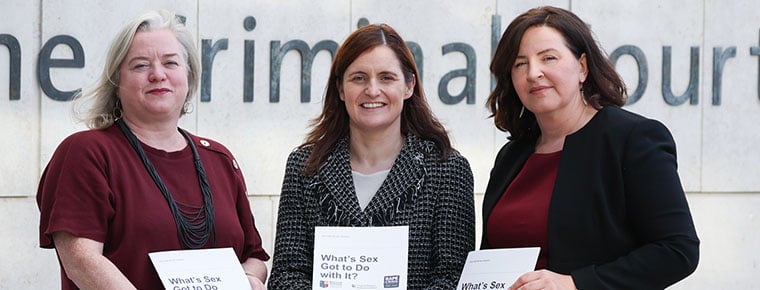
Dr Sinéad Ring, associate professor of law at Maynooth University’s School of Law and Criminology, authored the report, which was launched at Rape Crisis Ireland’s Relevance Symposium at the Central Criminal Court on 1 October.
The first qualitative study of section 3 of the Criminal Law (Rape) Act 1981, it draws on 21 in-depth interviews with barristers, solicitors, policy specialists, court accompaniment workers, and legal aid clerks with direct experience of how the law operates in practice.
“It’s really difficult to research rape trials and prosecutions. There’s very little transparency.
“Doing qualitative research with experts in this way is groundbreaking; this report opens a window into defence and prosecution narratives in rape trials,” Dr Ring said at the symposium.
In 2025, at least an estimated 39% of sexual-offences trials involved a section three application and cross-examination on sexual-experience evidence – a figure the report describes as “surprisingly high”.
Character-based attacks
Although overt, character-based attacks on complainants have declined in recent years, one of Dr Ring’s main findings is that the rape shield still isn’t working to protect the jury from irrelevant evidence.
“Lawyers are continuing to often frame admissibility arguments in ways that reproduce the very inferences section three was designed to exclude.
“They’re often engaging and mobilising discredited rape myths to make those kinds of arguments,” the academic said.
“Sexual-experience evidence is being used in certain cases to exploit culturally potent ideas of ‘real rape’ and the ‘lying complainant’ and thereby to cast complainants as suspicious and as outside the category of a ‘legitimate’ rape victim.”
Honest belief of consent
The study highlights that, in cases where the complainant and the defendant had been in a casual relationship or were merely acquaintances, digital evidence of communications is often used to support a defence of honest belief in consent and/or to undermine the complainant’s credibility.
“People on dating apps and aged under 17 in particular are exposed or at heightened risk of having their private lives, and especially their previous sexual experiences, brought into the court,” Dr Ring said.
“This is at odds with the purpose of the rape shield and the core tenet that consent must be given freely on each occasion with each sexual partner.”
Probative value of text messages
The report also notes that there are issues with the probative value of text and social-media messages.
In cases involving adult complainants in relationships with defendants, sexual-experience evidence was found to be almost always described by lawyers as admissible to provide context.
“The introduction of evidence of prior sexual experiences with the defendant amounts to inferring that consent is irrevocable.
“This is a surprising finding, particularly in light of the legislative clarification of consent as revocable, specific to each partner, and given on each occasion of sex,” the report states.
“In such cases, I think it’s fine to ask about the context of the relationship itself, but why do you have to ask about sexual activity in the relationship?” Dr Ring said.
Distorting fact-finding process
“I think the fundamental issue this report raises is: Are we actually allowing the best evidence to get to the jury, or are we distorting the fact-finding process of the jury with myths and unfounded reasoning and assumptions, about people or about evidence?”
The report makes the following recommendations to reform the law itself:
- Section 3 should be repealed and replaced with a new rape shield provision. ‘Other sexual experience’ should be defined broadly – covering not just sexual acts but references to contraception, pregnancy, sexually transmitted infections, sexual communications and images, other allegations or experiences of abuse, and a lack of sexual experience – and the new provision should apply equally to evidence sought by the prosecution and the defence,
- Judges should only be able to grant leave to introduce such evidence where it has substantial probative value and admitting it is in the interests of justice, weighing factors including the risk of relying on rape myths, the complainant's privacy and dignity, the distress likely to be caused, and the defendant's right to a fair trial,
- The legislation should make clear that evidence is not "substantially probative" merely because it provides context, speaks to the complainant's general character, or is offered as background – closing off the routes most used to introduce it in practice.