Lack of action on judges’ pay body ‘frustrating’
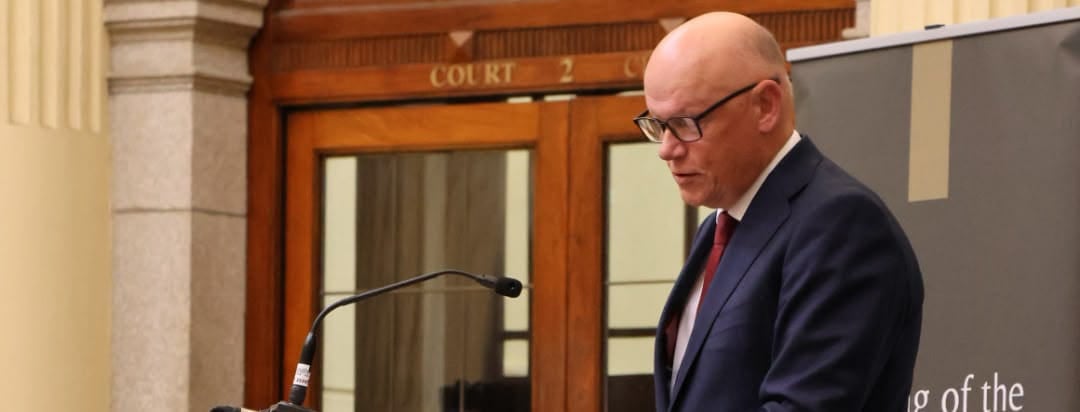
Chief Justice Donal O’Donnell has expressed frustration that a body to examine and provide advice on judges’ employment conditions has not yet been established.
The chief justice was referring to a 2014 recommendation from GRECO, the Council of Europe’s anti-corruption body, that such a structure be set up.
The European Commission has also noted the absence of such a mechanism in its reports on the rules of law.
The chief justice told a ceremony marking the start of the legal year (5 October) that, while the Government had accepted the recommendation, it had never been implemented.
‘Unrestrained power’ over pay
“If there is a concern elsewhere in Government is that this would create a separate system in the public sector for determining judicial pay, that concern should be stated explicitly and discussed with the judiciary,” he stated.
The chief justice said that it had long been recognised that unrestrained power over judges’ pay had the capacity to undermine judicial independence, adding that it was not open to judges to engage in industrial action or collective bargaining.
“It is frustrating that not only has the body recommended by GRECO not been established, but that the failure to establish it has never been explained, let alone justified,” he stated.
In his address, the chief justice noted a decline in respect for human rights, the rule of law, and democracy across the world over the past 20 years.
‘Sobering reflection’
He described the address of ICC President Judge Tomoko Akane to the event as “a sobering reflection” that brought into focus the importance of seeking to protect courts, judges, and court systems against attack
He told the ceremony that countries with strong rule-of-law rankings, such as the Nordic countries, were looking at reinforcing protections for judicial independence, adding that Ireland should consider what it could do in this area to make its constitutional and legal structures “better prepared to weather storms that might come”.
Noting that the Constitution would be 90 years old next year, the chief justice suggested that this might be time to consider whether the rules governing the removal of judges should be reformed.
‘Anomalies’ on removal
Under article 35.4.1 of the Constitution, judges of the superior courts can be removed only for stated misbehaviour, and then on a resolution of both Houses of the Oireachtas.
The chief justice pointed to “obvious anomalies” in the current system – including the requirement for only simple majority to remove a judge, which contrasts with the two-thirds majority needed for impeachment of the President for stated misbehaviour.
“It is incongruous, and arguably incompatible with principles of judicial independence developed recently by both the European Court of Human Rights and the Court of Justice of the European Union – that a government should have the power to remove a judge by exercising its own majority in parliament,” he told the event.
Legal-aid row concern
Chief Justice O’Donnell also said that continuing dispute between solicitors and the Department of Justice over criminal legal aid was “a matter of concern” for him and judges in general, adding that he hoped that it could be brought to a conclusion soon.
Calling for more investment in improving the courts’ communication with the public, he said that a pilot project on the recording and broadcasting Supreme Court hearings was being reviewed.
While he hoped that it would continue, he said that there would be a desire to have “a more user-friendly, easily accessible system” that would be capable of streaming live hearings.
He said that this could not currently happen because of the strain it would put on the IT infrastructure in the Four Courts.