Solicitors meet as flat-fee challenge continues
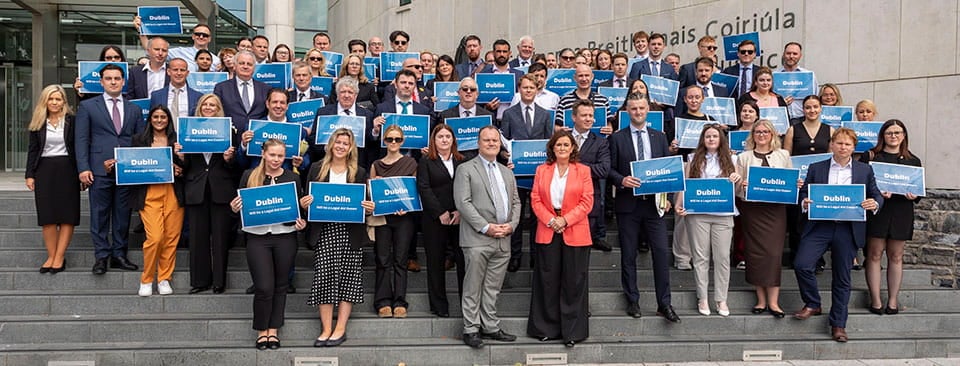
The Law Society held a meeting of criminal-law practitioners today (31 July) to discuss correspondence received from Minister for Justice Jim O’Callaghan earlier this week.
The correspondence emerged after talks with the minister were held on Monday to discuss the flat-fee payment structure for criminal legal aid in the District Court, introduced on 1 July, which has led many criminal-defence solicitors to withdraw their services in protest.
Friday's meeting came as Ms Justice Mary Rose Gearty reserved judgment in a legal challenge to the flat-fee system, taken by solicitor John Quinn from Dublin, which began in the High Court on Thursday.
The High Court also ruled on Wednesday that 11 people before the courts were entitled to "immediate release" over a lack of legal representation arising from the dispute.
Split payment
In a statement on Tuesday, the minister said that the correspondence sent to the Law Society confirmed that the flat fee of €520 would remain.
He added, however, that he had agreed to allow the payment to be split to allow two-thirds to be paid at the start of a case.
He also said that the revised criminal legal-aid scheme allows for a new certificate to issue for an accused person where the charges arising are distinct and separate to any court appearance made by that person previously.
Minister O’Callaghan has asked Department of Justice officials to keep the operation of the scheme in the Children’s Court under review in the coming months, in particular any cases where more than 20 appearances were needed.
This, he said, would inform “any changes that may be required within these limited circumstances”.
Clarification sought
The minister also said that any criminal legal-aid solicitor who had resigned from the panel but wanted to be reinstated arising from the new correspondence would be able to do so “without delay”.
President of the Law Society Rosemarie Loftus said that the correspondence from the minister had been circulated to criminal-law solicitors.
The president added that the Law Society was seeking clarification from the Department of Justice on “a number of matters” before the meeting.
Legal challenge
The legal challenge to the flat-fee system, taken by Dublin solicitor John Quinn, on which a judgment is expected in October, began on Thursday in the High Court.
Quinn is seeking an order quashing the statutory instrument that underpins the new scheme, which came into effect on 1 July.
The solicitor argues that the regulations are incompatible with the Criminal Justice Act, which, he says, provides for legal-aid certificates to be granted for individual offences, not multiple offences.
Quinn’s senior counsel Feichín McDonagh SC said that District Court judges had a statutory duty to assess each individual charge faced by a person and assess whether it met the threshold for granting legal aid, adding that the regulations were taking away that discretion.
'Blunt instrument'
For the Law Society, Shane Murphy SC told the court that the minister was trying to reach into a very complicated system and to change it impermissibly “with a blunt instrument”.
He also said that there could not be a ‘one-size-fits-all' model for children and vulnerable defendants.
For the minister, Eoin McCullough SC said that neither the consequences nor the merits of the dispute were for the court to decide.
He told the court that the legislation did not prohibit a flat-fee system and did not say anything about payments per court appearance.
He argued that, while the District Court had discretion about whether or not to grant someone legal aid, how that legal aid was paid was a matter for the minister.
'Denial of justice'
Meanwhile, the High Court ruled on Wednesday that 11 people before the courts were entitled to "immediate release" over a lack of legal representation.
The Irish Times reported that Ms Justice Mary Rose Gearty made the ruling in cases brought by 11 accused people who argued that their detention was illegal because they did not have a fair hearing at the District Court.
Some of the accused were granted bail by the High Court after initiating their cases.
The court found that the individuals suffered a “fundamental denial of justice” when they were remanded in custody after being left without legal representation in the District Court due to the dispute over criminal legal-aid payments.