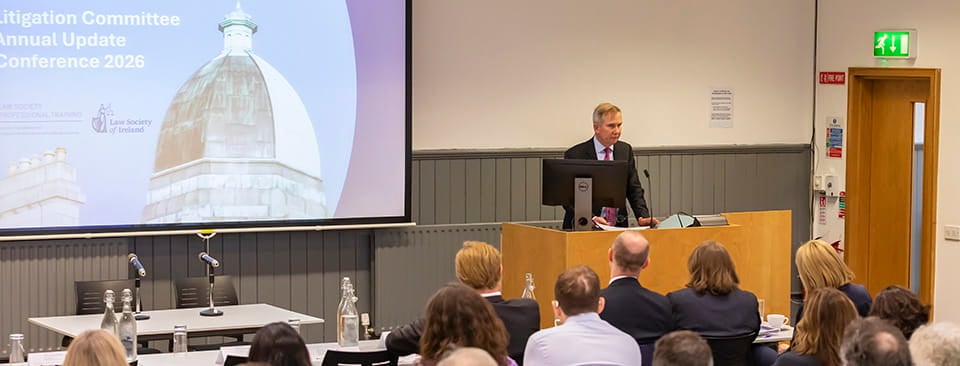
Ruling 'not last word' on mandatory mediation
The President of the High Court has said that a significant judgment on mandatory mediation delivered in the court in May is "not the last word" on the question.
Mr Justice David Barniville was speaking at the annual conference of the Law Society Litigation Committee in Blackhall Place (15 October).
He was referring to Mr Justice Twomey's decision in Burke v O'Connell, in which the judge held that the court had an inherent jurisdiction to order litigants to mediate their disputes – even where one or both of them objected – where there was a prospect of resolution, and where it was proportionate to do so.
Ultimately, the parties agreed to go to mediation before the judgment was delivered.
Describing the judgment as "comprehensive" and "very well-written", Mr Justice Barniville set out the reasons why he believed it might not be the last word on the issue.
2017 act's provisions
He told the event that what Mr Justice Twomey had decided might be obiter – not central to his decision – as it was not necessary for him to make any order in the case.
The High Court President also referred to what he described as two "central" provisions in the Mediation Act 2017. Section 2.1 defines mediation as a confidential, facilitative, and voluntary process, and section 6.2 says that participation in mediation shall be voluntary at all times.
Mr Justice Barniville noted that the court’s attention may not have been drawn to those provisions or, at least, that it was not apparent from the judgment whether any argument had been advanced as to their significance, or as to how they might be reconciled with an inherent jurisdiction to compel parties to mediate.
"There's a real prospect that another High Court judge would take a different view," the president added.
He said that the judgment had been issued on the same day as a practice direction that stressed the voluntary nature of mediation.
Mr Justice Barniville reminded the event that he had previously expressed the view that issue of whether mediation should be mandatory or continue to be voluntary was, ultimately, a policy decision for the Oireachtas.
'Gap' on disruptive behaviour
The High Court President also told the event that there was "something of a gap" in the courts' powers to deal with disruptive behaviour, describing contempt powers as "heavy-handed" and a "complex area of law" that was difficult to navigate.
He said that a Courts Security Bill listed for priority drafting in the Government's autumn legislative programme was aimed at addressing these deficiencies and enhancing the abiiity of the courts to deal with misconduct and disruptive behaviour.
'Progress' on wardship
On wardship, Mr Justice Barniville said that "enormous progress" had been made, with 1,014 people discharged by the end of September and 735 more applications in progress.
A statutory deadline for discharging all 2,000 wards of court had been extended due to several difficulties in complying with the original deadline of the end of April 2026.
The High Court President told the event, however, that those discharged still needed court protection, leading to a big increase in applications under a newly created inherent-jurisdiction list.
He said that 244 new inherent-jurisdiction proceedings had been issued by mid-October, compared with 233 in the whole of 2025, with an 86% annual increase in listings during the court's recent vacation period.
Professional-discipline cases
Mr Justice Barniville also noted a significant increase in disciplinary cases involving 35 statutorily regulated professions, with a 31% annual rise in the first three quarters of 2026.
Referring to a 21% increase in cases under the Solicitors Act, he said one of the factors was a 138% jump in applications made by the Legal Services Regulatory Authority to compel solicitors to comply with its directions.
On the criminal legal-aid dispute between solicitors and the Department of Justice, he echoed remarks made by Chief Justice Donal O'Donnell earlier this month, and called on all parties to do their best "as quickly as possible" to resolve the row.