Spouse leaving family home may be liable for CGT
Spouses who leave the family home may be liable for Capital Gains Tax (CGT) upon profit accrued on the house value during their absence, a family-law conference has heard.
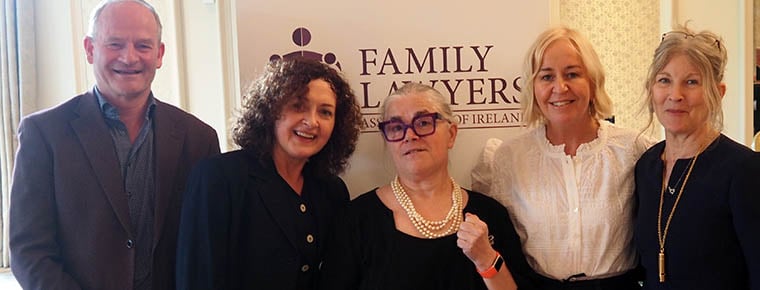
Tom Murray of Friel Stafford Accountants was explaining practical issues arising in family-law matters during his presentation to the annual Family Lawyers Association Circuit Conference in Mullingar (27 April).
Tax implications
Through a series of case studies, he highlighted practical issues arising in family-law matters – including inheritance tax, income tax, and the tax implications of property transactions.
Among these is the potential exposure to Capital Gains Tax where a spouse vacates the family home and the property is sold several years later, with liability arising on the difference between the value at the date of departure and the eventual sale price.
The conference, which was predominantly aimed at solicitors and barristers in the Family Lawyers Association who are on Circuit, was organised by Nuala O'Donohoe BL and chaired by Circuit Court Judge Catherine White.
A session on recent case law was delivered by Alexis Mina BL, focusing on High Court decisions.
Enforceability of settlements
This included notable rulings on the enforceability of settlements, as well as developments in cohabitation cases, an area in which decisions have been relatively limited.
Some of the cases demonstrated the increasing willingness of the High Court to punish material non-disclosure during the proceedings, both in relation to the division of the marital assets and with costs orders.
Ms Justice Nuala Jackson of the High Court addressed the recently launched report and new guidelines concerning the issuing and release of section 32 (voice of the child) reports.
The judge also provided an update on the Government’s implementation plan for the Family Courts Act 2024.
Hubs
The plan includes the establishment of family-law hubs incorporating District Court, Circuit Court, and High Court services in key locations.
While progress is anticipated to be gradual, three locations have been identified as part of the initial phase.
Conference organiser Brendan Dillon, managing partner at Dillon Solicitors, said that although the three locations for these hubs had not yet been confirmed, “we presume it will be the main urban areas.”
The guidelines form part of this implementation framework, with the intention of streamlining processes and clarifying the parameters within which assessors operate.
Section 32 assessors
Sarah Jane Judge BL presented to the conference her recent research conducted with section 32 assessors.
The research examined the role of assessors in meeting children and parents, and making recommendations regarding parenting arrangements.
It highlighted the complexities involved in identifying issues such as parental alienation and coaching, and the potential consequences of addressing such concerns within reports, including the risk of exacerbating family dynamics or impacting the child.
Jane Barron BL addressed discovery in family-law proceedings. The discussion included the practical question of when to conclude investigative efforts and when to continue pursuing disclosure.
Consideration was given to the strategic decision of whether to rely on cross-examination where information is believed to be withheld, as well as the procedural steps involved in seeking necessary discovery to advance a case.
Chair of the FLA Brendan Dillon said that, while conference attendance was invaluable for ongoing learning and discussion of common issues faced in the sphere, collegiality was also fundamental.
Family breakdown has been described as second only to bereavement in terms of stress, he said, “but I sometimes say that, in fact, it might be worse, because at least with the death of a loved one, there's no blame attached to it.”
Objectivity
Dillon added that while it could be an emotionally demanding area of practice, “you can’t completely detach yourself”.
He said it was vital that practitioners maintained objectivity, “because ultimately that’s what our clients need.”
With this in mind, a session on legal-practitioner wellbeing was delivered by Bronagh O’Neill and Mary Duffy of Law Society Psychological Services, focusing on stress recognition and management in family-law practice.