In-house of the rising sun
In January, in-house practitioners came together to discuss the evolving role of the in-house lawyer
The ‘Future of Legal Practice’ summit’ on 9 January focused on the evolving role of in-house lawyers, the diversity of in-house careers, and the practical challenges facing in-house legal teams today.
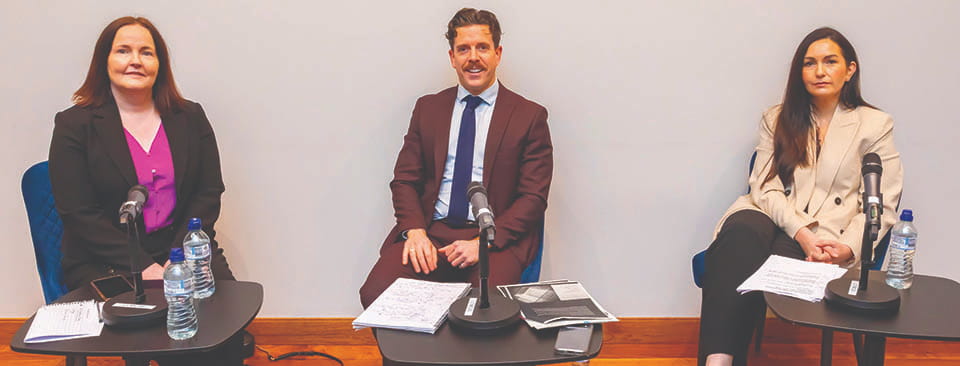
The panel was chaired by Deirdre McDermott (European general counsel with Phoenix Tower International) and featured Jennifer Hartnett O’Connor (group general counsel and head of legal, risk and compliance at ESW), alongside Diarmuid Fahey, (advisory counsel with the Office of the Attorney General, on secondment to the Department of Justice).
Jennifer opened the discussion by asking Deirdre if, in her experience, all in-house roles are the same.
Deirdre said that there is a great variety of in-house roles, depending on whether you work in the private or public sector and, if in the private sector, work for a local, European, US, or other international company.
Roles also differ based on whether you are the sole counsel, or a generalist on a specific specialist team, or lead counsel for a specific region, or whether you work across jurisdictions – among many other considerations.
This variety makes the in-house role an exciting opportunity for solicitors, who can effectively target opportunities in a specific industry, specific role, or specific region and culture that works for them.
Deirdre recommended that those considering an in-house career should consider all the variables that work for them and then target the opportunities that meet those variables.
Public works
Diarmuid added that a public sector in-house role in a government department is very different to an in-house role in the private sector.
There is a work culture that is not solely commercially focused, but driven by policy priorities and the interests of the public at large.
The Office of the Attorney General has a well-developed secondment programme, with most departments having well-established legal units staffed by secondees from the office.
Advisory counsel are trained to be generalists and advise on a broad range of constitutional and legal issues. The type of work varies across departments.
Some departments deal with a high volume of litigation while, in other departments, the legal unit deals regularly with a particular area of law, such as employment, data privacy, criminal, or EU.
Scope to expand
Turning to Jennifer, Diarmuid asked whether there was much scope to expand beyond the general counsel role.
She answered that there can be significant scope to expand, but that this typically depends on factors such as the needs of the organisation, the mandate and trust afforded by senior leadership, and the strength of the underlying legal function.
In her own case, Jennifer joined ESW as sole legal counsel, built out the legal team, and assumed responsibility as group general counsel.
More recently, her remit expanded to include legal, risk and compliance, covering areas such as data privacy, risk, insurance, and sustainability.
She noted that these were not areas she necessarily anticipated as a trainee, but they have become business critical.
The modern GC role, she explained, is not solely about technical legal expertise, but about acting as a trusted business partner who enables decision-making at pace, with proportionate controls, clear governance, and a defensible risk position.
Jennifer shared four key takeaways for those considering an in-house career:
- Learn the language of the business and translate legal advice into practical,
commercial solutions, - Be proactive in identifying gaps and stepping into challenges beyond your formal remit,
- Upskill in adjacent disciplines such as data privacy, cybersecurity, and sustainability, and
- Embrace leadership and the responsibility that comes with influencing strategy and culture.
In turn, Deirdre recommended ‘owning’ your career, having a growth mindset, developing the idea of being a trusted business partner, being open to ‘pivot’, learning your business, developing your influencing skills, consistently upskilling to broaden your scope and position yourself for opportunities, and building
relationships that can last a lifetime.
Key challenges
Diarmuid went on to outline the key challenges facing in-house lawyers today.
Firstly, the role of legal adviser in a government department means continually ensuring adherence to rule of law both domestically and internationally in a continually changing legislative framework.
Often the work can be extremely politically sensitive, and legal advice may be required on an urgent basis to address a developing legal issue that could have a lot of coverage in the media.
Secondly, as an in-house lawyer in a department’s legal unit, you are part of a much smaller team, and it falls on the legal advisor, as file handler, to make important calls and give complex advice directly to officials.
Communication with officials on an ongoing basis is crucial to ensure that the legal unit is collaborated with, and not seen as an obstacle to obtaining Government objectives.
In the public sector, officials are conscious of the possibility of freedom of information requests, and the in-house lawyer must always be conscious of legal privilege and the distinction between legal assistance and legal advice.
Thirdly, recruitment of talented lawyers is an ongoing challenge in the public sector, although there has been an increase in the number of competitions held in recent years.
Private-sector solicitors and barristers are finding legal roles in the public sector increasingly attractive, given the nature of the work, the sense of working for the greater good, and a good work/life balance.
Building on Diarmuid’s comments, Jennifer grouped the challenges facing in-house lawyers into three broad themes.
First is pace and complexity.
In-house teams must constantly interpret fast-moving legal and regulatory change across multiple jurisdictions and translate it into workable operational guidance.
Second is the expanding risk perimeter.
Issues such as data protection, cybersecurity, third-party risk, and technology adoption increasingly sit at the intersection of legal, compliance, and operational resilience, often with high impact and limited reaction time.
Third is the shift in expectations.
In-house lawyers are expected to be strategic enablers rather than gatekeepers, helping the business move forward through proportionate risk management and defensible decision-making, often with lean teams and budget constraints.
Underlying all of this, Jennifer noted, is the professional challenge of maintaining independence, privilege, and sound judgement, while being embedded in the business, particularly when decisions are time-sensitive and reputational risk is real.
The session concluded with a moderated Q&A led by Deirdre McDermott, with students and attendees engaging directly with the panel on career paths in both the public and private sectors, skill development, and the future shape of the in-house profession.