Future proof?
What is a 'future-ready lawyer'? Mary Hallissey reports on a recent In-House and Public Sector Committee panel discussion on just that topic
Time spent on legal contracts may be dramatically reduced with the proper use of AI, a panel discussion organised by the Law Society's In-House and Public Sector Committee has heard.
Speaking at the event on 29 April, Electra Japonas (chief product officer at SimpleDocs and co-founder of oneNDA) said that AI has a role in optimising legal workflows, especially in drafting contracts and providing negotiation strategy.
AI-native firms have the potential to disrupt the traditional law firm model – and they will attract talent.
In-house legal roles have moved from a strategic advisory role to encompass cost-reduction functions, Japonas explained. This will involve a deep understanding of business needs as well as operation models, including contract operations, legal intelligence, and risk architecture.
She said that this deep knowledge of the client organisation is crucial, regardless of whether solicitors are working in the private or public sectors.
In-house legal models are often inherited rather than deliberately designed, Electra said: "We now have a unique opportunity to be very deliberate about how we design our legal culture entering into this next era."
In-house counsel grew as a sector as regulation expanded and new risks came to the fore, she added. It then made sense, commercially and financially, to bring legal advice back inside the business.
Many hats
The post-pandemic era is a new one for general counsel, Japonas continued, with fresh regulation, ESG, and geopolitical risk assessment. This means a greater volume of legal work on desks. In light of that, "we really need to think about the way we work," she commented.
Lawyers may feel constantly under-resourced, and AI tools could assist in this regard. However, scaling legal work must be done deliberately and in a controlled fashion, with a lot of thought about how to design functions.
"Legal still sees itself as an advisor, a risk checker, and a support function – but, to scale, we need to operate at a different level. We need to be a business enabler," Japonas said.
AI presents the chance to codify judgement and scale it, but driving this strategy forward means understanding where the business is going.
Routine matters can be made self-service using AI, but high-risk, high-value matters will require a different approach. "I think AI is going to make us better lawyers," Japonas said, "but if you're going to codify your judgement into an AI tool, an AI playbook, you need to understand why you're doing the things that you're doing."
In your shoes
John Jeffcock (CEO, Winmark) said that managing geopolitical risk and stakeholder expectation is an evolving role for chief legal officers. This means being prepared for second and third-level impacts of global events.
He spoke about the need to audit and update projects to prevent incidents rather than waiting for them to occur. Lawyers must look ahead, adapt and lead, and deliver strategic impact, he said.
In the AI era, a balance is needed between technical and people-management skills. Legal and compliance considerations must be to the forefront in managing AI and other technologies, he added, in the shape of a 'legal master'.
Belt and braces
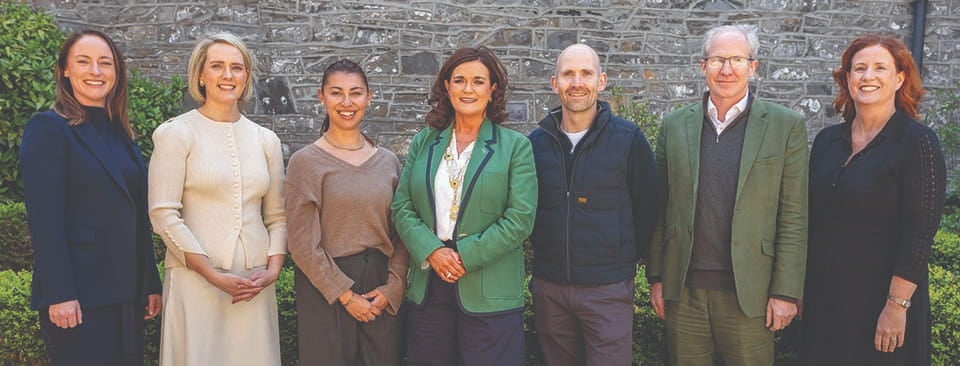
The discussion also heard from Broc Cocoman (associate general counsel, Anthropic), Claire Madden (chief legal officer, Energia Group), and Ciara O'Donovan (discussion moderator and senior legal advisor at the NTMA).
Claire Madden said that, in a complex industry, it's important to talk to peers and to keep scanning the horizon for changes: "Lawyers can be more comfortable with the piece of paper, the question that's in front of them – but actually, you need to step back a little bit to understand what's going on around you," she observed.
Ciara O'Donovan asked about the use of AI tools in legal practice and the challenges of data protection and confidentiality.
Japonas warned against inputting confidential information into a general-purpose model, though protection is higher in enterprise models. AI use still needs an internal policy, she warned.
Broc Cocoman said that tinkering with AI on a personal level can be a useful introduction. However, he commented, "I'm very cautious. Even anonymised, I would not be keen to input clauses coming from me. You need to be really careful that the guardrails are in place."
The change already seen in software engineering work will happen in knowledge work, such as law, he said. However, while AI will replace certain tasks, legal roles will evolve in tandem.
Kid gloves
Junior lawyers should learn from reviewing AI-generated work and from working alongside senior partners – this is essential in developing judgement and critical-thinking skills.
O'Donovan noted that it seemed from the discussion that legal roles were changing, with a move to more activities focusing on strategy, risk-management, and stakeholder engagement.
"Change is difficult; we resist change. But this change, more than likely, will happen," Cocoman added.
AI is good at repeatable, data-heavy work, which is a positive, and is continually improving, such that hallucinations are fewer.
He suggested that companies no longer wanted lawyers in a room with their heads buried deep in documents: "They want us having time to think about the risk. What AI can't do is assess the risk, understand the different stakeholders or the politics of a business, or be able to influence people," he pointed out. Influencing, communication, and people skills – and, even more, business-minded lawyers – will become ever more important in the future, he concluded.
Mary Hallissey is a journalist with the Law Society Gazette.
THE FUTURE-READY LAWYER
Opening the event, Law Society President Rosemarie Loftus said that the in-house sector would only continue to grow, and that the Society would support this momentum.
The committee’s events offered a prime opportunity to meet other solicitors in similar positions, she added.
Committee chair Róisín Magee said that the volume and complexity of regulation in Ireland was something that all in-house and public-sector solicitors were grappling with in a constantly-shifting regulatory landscape. She emphasised that guidance on the use of AI was available at www.lawsociety.ie/artificial-intelligence-ai.