Legal careers no longer have linear trajectory
The legal professions here and in the England-and-Wales jurisdiction have reached a state of equilibrium, Law Society Director of Education T P Kennedy said at the London Irish Network event at Chancery Lane, (3 September).
This had been driven by reciprocal recognition of qualifications, which happened in the early 1990s, he said.
“We have Irish firms in London with large presences, and we have England-and-Wales firms establishing themselves in Ireland,” T P Kennedy said.
This had led to a renewed focus on the deep connection that existed, he added, and a determination to do more to strengthen the bond between the jurisdictions.
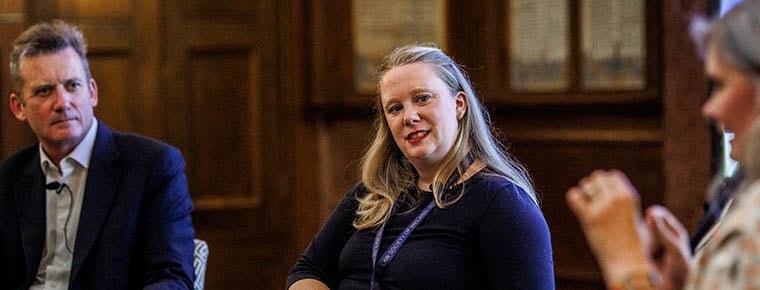
In a panel discussion chaired by Law Society Director General Mark Garrett, Meta international employment counsel Máille Brady Bates said that Irish legal training and education was highly valued in London.
Pride
Brady Bates also noted a renewed pride in their native culture among compatriots in London who now freely celebrated their Irishness.
Director General Mark Garrett pointed out that the export value of the Irish legal market now topped €1.4 billion annually, which was greater than that of Irish whiskey.
Claire Bamber (Debevoise & Plimpton senior advisor, London litigation department) moved to Britain at 13.
“When qualified I often had a sense of being too English to be Irish and too Irish to be English,” she recalled.
“But if I feel anything, then I feel Irish,” she said.
Bamber left corporate law after six years to work for the UN, where she reestablished her sense of Irishness through working productively with Irish peacekeeping forces in places such as Kosovo.
“It felt really good to make those connections again,” she said.
Bamber said that leaving private practice for a career in the UN felt strange and difficult to justify.
“It felt like stepping off a cliff actually, and I wasn’t sure whether there was any safety net on the way down,” she recalled.
Being Irish of itself would not make one successful in a legal career, DG Mark Garrett said.
He advised the room to always be alive to possibilities and work opportunities.
Common travel area
The common travel area was an underrated asset, Joe Beashel (partner and head of Matheson London) commented.
“To rock up and just start working without any hassles is an enormous benefit,” he said.
This contrasts with those who must struggle with work and visa permissions.
Defuse tension
Brady Bates added that the Irish ability to chat, and to defuse tension, was also a skill not to be underestimated.
“I’ve seen that work particularly well with Irish colleagues, in rooms with very senior stakeholders," she commented.
Brady Bates said that the multicultural aspect of a massive city offered a different perspective, which was very valuable to a lawyer.
She observed that legal careers no longer had a linear trajectory but were now much more fluid.
“If you don’t look up from the desk and go out and forge connections then you can lose sight of career progression,” she added
Take the risk
“I would always say, lean into the risk and take the gamble,” she added.
Knowing when a job was at its pinnacle and that it was time to leave was also a key skill, Brady Bates added.
Beashel observed that no one would take a greater interest in one’s career than oneself.
“It’s a great profession and the opportunities are endless,” he said.
This could take vulnerability and genuineness, which can be hard, he added.
Making others look good
Claire Bamber said that she had spent her career making men look good.
“I’ve been really comfortable doing it, and I’ve done it really, really well.
"If I were to have my time again I would probably not do that," she commented.
"I would probably focus more on making me look good," Claire Bamber said, because she feels that she has under-achieved.
-
There are more Gazette.ie photos of the Chancery Lane event on the gallery page.