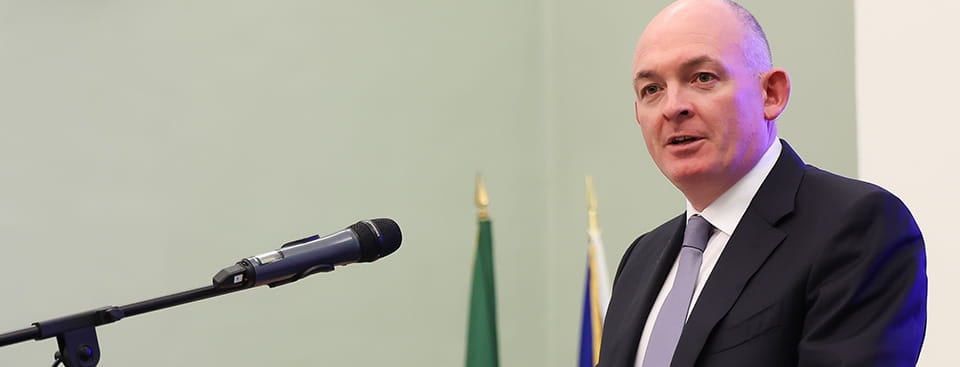
AG warns on risks of ‘frenzied’ talent scramble
The Attorney General (AG) has told newly qualified solicitors that “frenzied” competition for talent among some global law firms risks overlooking the fact that law is “a people business”.
Speaking at a parchment ceremony in Blackhall Place (4 November) at which around 50 graduates were welcomed into the profession, Rossa Fanning SC said that there were lessons for them to draw from the recent collapse of New York law firm Weil, Gotshal & Manges.
The new solicitors were also addressed by High Court President Mr Justice David Barniville and Law Society President Rosemarie Loftus, in her final parchment ceremony in the role.
Power of ‘rainmakers’
The AG noted that the 95-year-old US firm collapsed suddenly after a flurry of defections by ‘rainmakers’ – senior lawyers who bring in large amounts of revenue.
“Competition to recruit lawyers has never been higher in New York or in other labour markets; rainmakers have market power and are driving enormous compensation packages,” he told the ceremony.
He added that, while not all the excesses of the New York M&A market were necessarily to be admired or emulated, the brutal reality was that competitors were willing to pay higher remuneration to Weil's top lawyers, and the firm collapsed as a consequence.
“The moral of the story for individual lawyers at the outset of your career is that you have power – if you have clients who trust you,” the AG told the graduates.
‘Fragile’ entities
“The way in which you will become a sought-after equity partner, or successfully establish your own firm, or become a trusted senior in-house counsel, is if people really trust you to give them legal advice,” he said.
He added that giving clients the right advice – even if they did not want to hear it – was “the test of a good lawyer”.
The AG described law firms as “ultimately fragile entities, built on constantly evolving partnerships, the only asset in which leaves the building every evening”.
He warned that a firm that did not have a genuine partnership, nor a distinct culture that bound its partners, would receive no loyalty from his partners, who would “walk out the door” to a higher bidder.
“Wherever you go, aspire to be the trusted legal advisor and, if you stay in private practice, aspire to work in or to lead a law firm whose values mean something more to you than simply the remuneration that the firm can offer,” the AG urged the newly qualified solicitors.
Fanning concluded by noting that, amid technological change, being a solicitor remained a significant position in society.
“If you get it right, the satisfaction and fulfilment of legal practice will be an enormous thing. The law will never be an ordinary job or an ordinary career for you; it will be a vocation.”
Cultural change
Earlier, the High Court President told the ceremony that solicitors today required greater resilience to deal with changes brought about by the emergence of AI, the influence of social media, and the growing role of ADR (alternative dispute resolution) and mediation.
Mr Justice Barniville said that the growth of ADR reflected a much broader cultural change that had incrementally expanded the solicitor’s role.
“Increasingly, clients expect solicitors to identify the quickest, most cost-effective, and most appropriate route to achieving an outcome.
“In many cases, that may involve mediation or another form of dispute resolution, rather than years of litigation, and, in my view, that represents a very positive development both for clients and for the administration of justice,” he stated.
Loftus ‘calm’ voice for profession
The High Court President also praised what he described as the “professionalism and commitment” that Rosemarie Loftus had brought to the role of Law Society President.
He added that she had been a “calm, assured, and thoughtful” voice for solicitors during a year of “considerable change and uncertainty”.
Noting her important role in the dispute over criminal legal aid, Mr Justice Barnville repeated that he hoped that the issue could be settled soon.
Prizes
As well as the parchment awards, 18 prizes were also presented at the ceremony:
Presentation of Final Examination – First Part prizes
1) Final Examination First Part 2025 - Tort Prize (joint winners):
- Orla Leahy, and
- Nikita Sharepo
2) Final Examination First Part 2021 - Equity Prize:
- Christopher McAnenly
3) Final Examination First Part 2025 - Law of Property Prize:
- Anthony Pal
4) Final Examination First Part 2025 - Criminal Law Prize (joint winners):
- Steven King, and
- Rachel Lee
5) Final Examination First Part 2025 - Constitutional Law Prize:
- Sean Desmond
6) Final Examination First Part 2025 – EU Law Prize:
- Eibhlín Ní Éalaithe
7) Final Examination First Part 2025 - Equity Prize:
- Conor Hanley
8) Final Examination First Part 2025 - Company Law Prize:
- Oscar Ó Sé
9) Final Examination First Part 2025 - Contract Prize:
- Oscar Ó Sé
Presentation of prizes for Professional Practice Courses
10) Professional Practice Course 2022 Skills Prize:
- Jonathan O’Rourke
11) Professional Practice Course 2023 - Business Law Prize
- Caitriona Gildea
12) Professional Practice Course 2023 - Dispute Resolution Prize (joint winner, first place):
- Elaine Dunne
13) Professional Practice Course 2024 - Business Law Prize (joint winner, second place):
- Caroline Keaveny
14) Professional Practice Course 2024 - Business Law Prize (joint winner second place):
- Katelyn Dunleavy Larkin
15) Professional Practice Course 2024 - Dispute Resolution Prize:
- Chantelle McInern
16) Professional Practice Course 2024 - Skills Prize:
- Jessica Caldwell Kenny
17) Professional Practice Course 2024 - Applied Land Law Prize:
- Sam Whitaker
18) Attracta O’Regan Memorial Prize for the Future of Legal Practice 2025:
- Lucy Mockler,
- Rachel Kilkenny,
- Oliver Nyhan, and
- Lloyd Youngson.