Hallmarks of a good dispute resolution clause
Lawyers faced with drafting so-called “midnight clauses” in contracts should use a generative artificial intelligence (GenAI) tool, Law Society event has heard.
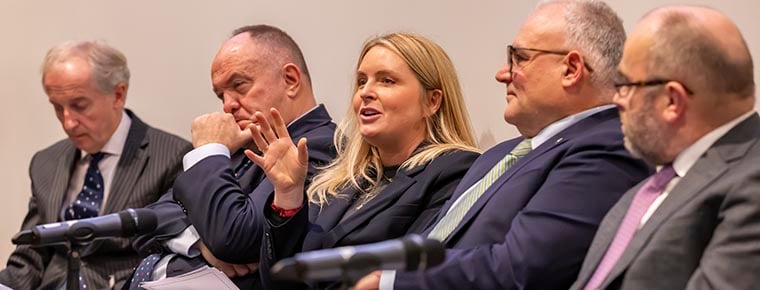
Francesco Rossi, executive vice president of the American Arbitration Association’s International Center for Dispute Resolution (AAA ICDR), was speaking as part of a panel discussion called ‘Putting the Midnight Clause to Bed’, which took place in the Education Building in the Law Society (20 October) as a side event to Dublin International Disputes Week.
As moderator Hannah Shaw (partner at A&L Goodbody LLP) put it, a midnight clause is “the one provision that nobody expects to have to use when they're in the throes of negotiating their deal, and the one then that matters most when everything has gone wrong.
Small hours
“Every lawyer in the room knows the scene: It's the small hours of the morning before signing. The price is agreed.
“The warranties have been long thought out, and somebody looks down to the draft and says there’s no dispute resolution clause,” she said.
“Ten minutes later, maybe at best the clause is lifted from precedent, the other side's lost deal, or occasionally from memory, and then everyone goes home.
“When it's poorly drafted, the fight becomes not about the merits at all, but actually just about where, how, and even before whom you're going to have the fight.”
The GenAI tool Rossi was referring to is the AAA ICDR’s ClauseBuilder AI, which can be used when lawyers choose a model clause to draft their dispute resolution clause.
“ClauseBuilder AI will allow you to go online and, with plain language, type in prompts, and it will create output that has standard contract language.
“It has a menu on the left-hand side that allows you to select all of the things you need on different regions,” he said.
“You can still output it to a Word document and then modify it should you decide you want to.
“It's always a good idea to get the disputes team involved if you've got the time, because they’re the ones that have to live with that dispute clause in the likely event that something blows up.
Rossi also shared his insights on the hallmarks of a well-drafted dispute resolution clause.
“First and foremost, you want to name your process, whether that’s mediation, arbitration or litigation. We see way too many clauses that just talk about dispute resolution; that ‘the dispute shall be resolved’,” he said.
“You want to name your institution and which rules apply. You want the governing law and legal seat; the place of arbitration. Increasingly, in international clauses, you want to name your language.”
If you’re introducing negotiation clauses, mediation clauses or executive discussions, Rossi emphasised the importance of defining the participants for the negotiation.
“You don't want to just say ‘a member of the senior team’ because that's subject to interpretation. You need to name specific individuals,” he said.
Shaw said she had faced this exact “nightmare”. “We would spend maybe eight weeks back and forth with letters where the parties actually couldn't agree who was a senior member within each of their organisations.”
Time constraints
Rossi added that time constraints for the negotiation should also be clear in the dispute resolution clause.
“You don't want to leave it open-ended. You don't want to say things like having “a reasonable amount of time”. Who defines that? You want to define your arbitrator requirements, but don't overdo it. We’ve seen clauses that are so specific with the requirements that it would be impossible to find the expert concerned.”
The number of arbitrators is also critical, he continued. “We have seen clauses that just say ‘shall be resolved by arbitration or a reasonable number of arbitrators’. Again, what is reasonable?”
Court of Appeal Judge Mr Justice Mark Sanfey, who oversaw the High Court’s Arbitration List for a year around 2022, was also on the panel.
He pointed out that virtually all the major decisions on arbitration over the last eight or nine years have been made by Mr Justice David Barniville (now President of the High Court).
Most related to Article 8 applications, he said.
An Article 8 application in this context is a motion or request made in court to stay court proceedings and refer the dispute to arbitration because the parties previously agreed to settle their disputes out of court via an arbitration clause.
“In all the High Court cases under the Arbitration Act 2010 and the UNCITRAL Model Law since 2018, a decision was given which was in favour of the arbitral process.
“Every single one of the Article 8 decisions resulted in the matter being referred to arbitration,” the judge said during the panel discussion.
“In his decisions, Mr Justice Barniville not only tends to answer the issues that are in the case before him but also tends to review the law.
“Many of his decisions are written with the view of clarifying essential points of arbitration law – with the result that we’re in the lucky position now of having a very separate body of case law in relation to the court’s attitude towards arbitration.
“We've seen from the case law that there’s a presumption in favour of the validity of an arbitration clause, and that the dispute was intended by the parties to come within the four walls of the arbitration clause.
“So, if you've drafted a midnight clause, even if it’s a pathological clause, don't worry. The High Court is here to help!”
A pathological clause was described at the event as one that has “a defect that’s liable to disrupt smooth progress of the arbitration”.
This was a long-running, acrimonious legal battle between veteran hotelier Noel O'Callaghan and his sons, Paul and Charles O'Callaghan.
'Unpleasant dispute'
“It's a rather unpleasant dispute in some ways as it involves a father suing two sons in respect of a shareholder agreement,” Judge Sanfey said.
“There was a plethora of interlocutory applications in this case. There were injunctions, there were applications for disclosure, and there had to be case management in relation to what should be done with them.
“The view generally was that if the sons were going to bring an Article 8 application, that effectively would take it out of the courts if it were successful.
“So, that should be dealt with first.”
Mr Justice Mulcahy gave a judgment very quickly, finding there was a valid and subsisting arbitration agreement, and so referred most aspects of the dispute to arbitration.
Well-written and cogent review
“It’s a reasonably short, but very well-written and cogent review of the general principles. I think it's a very good one if you want to refresh your understanding of Article 8 applications and how they work,” Judge Sanfey said.
He cited a particular paragraph of Mr Justice Mulcahy’s judgement which states: "I claim that the main agreement was induced by misrepresentation and does not equate to the arbitration agreement being null and void.”
At the time of writing, this decision hadn’t been appealed.