Experts call halt to global surrogacy convention
Deep-seated cultural, political, and ethical divides have prevented a global consensus on the ethics of paid-for surrogacy, according to the Hague Conference on Private International Law (HCCH).
The body has decided not to advance to a Special Commission to draft an international convention on cross-border legal parentage and surrogacy.
The decision was taken by the HCCH’s governing body, the Council on General Affairs and Policy (CGAP), during its annual meeting in The Hague earlier this year.
The body acknowledged the landmark final report submitted by the working group after a decade of research and negotiations.
Legal parentage
However, it has put on hold any plans to establish unified international rules governing foreign judicial decisions on legal parentage and international surrogacy arrangements (ISAs).
The issue of legal parentage has been traditionally settled under domestic laws, but has grown increasingly complex worldwide, given advances in assisted reproductive technology, DNA testing, and changing family structures.
This divergence is most pronounced in international surrogacy, a rapidly expanding global industry worth billions annually.
The HCCH began examining the issue in 2010 and found that, when families crossed international borders, conflicting domestic rules often resulted in ‘limping legal parentage’, where a child’s legal relationship to its parents was recognised in one country but rejected in another.
Child-rights advocates and legal scholars warn that this leaves children parentless in the eyes of the law, creating severe vulnerabilities regarding:
- Nationality and citizenship,
- Parental responsibility,
- Financial maintenance,
- Identity rights – articles 7 and 8 of the UN Convention on the Rights of the Child guarantee a child's right to an identity, name, and family relations.
Despite broad agreement on the urgent need to protect affected children, delegate views diverged on public-policy (ordre public) exceptions.
Violation of domestic laws
Several states voiced concern that a mandatory recognition framework could indirectly validate commercial surrogacy arrangements that violated their domestic laws or human-rights standards.
The HCCH said that its technical work on private international law rules should not be construed as either supporting or opposing surrogacy.
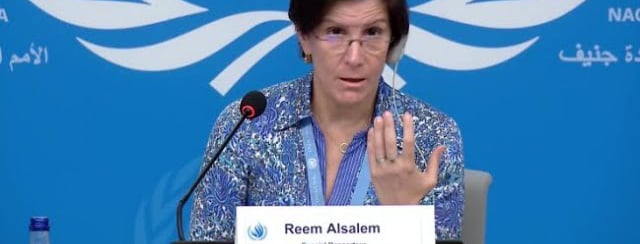
Current UN Special Rapporteur on Violence against Women and Girls Reem Alsalem (pictured) has stated that surrogacy is a form of violence against women.
In Melbourne last August, a conference discussed the social, ethical, and human-rights consequences of surrogacy for women and children.
Delegates issued a statement, known as the Melbourne Declaration, which calls on governments to abolish all forms of surrogacy, recognising that no woman should be recruited, induced, pressured, coerced, or enabled to carry a child for transfer to others.
The statement adds that no person should be permitted to commission or acquire a child through a surrogacy arrangement.
Moratorium
Conference delegates also urged the Australian federal government to join international efforts led by Italy, Chile, Argentina, Cameroon, and the Holy See to adopt immediate interim measures, such as a moratorium on new surrogacy arrangements.
Delegates also called for work towards an international legal instrument prohibiting surrogacy, while recognising and upholding the legal rights of women and individuals already affected by surrogacy arrangements.