Societal knock-on of 10,000 EU regulations in decade
The development of EU law and its institutions is creating problems for the very principles on which the Union rests, the Ireland’s Enduring Place in Europe and Why It Matters conference (13 November) has heard.
Hosted at the Law Society by the Irish Centre for European Law (ICEL) the event was held in conjunction with the Chief State Solicitor's Office.
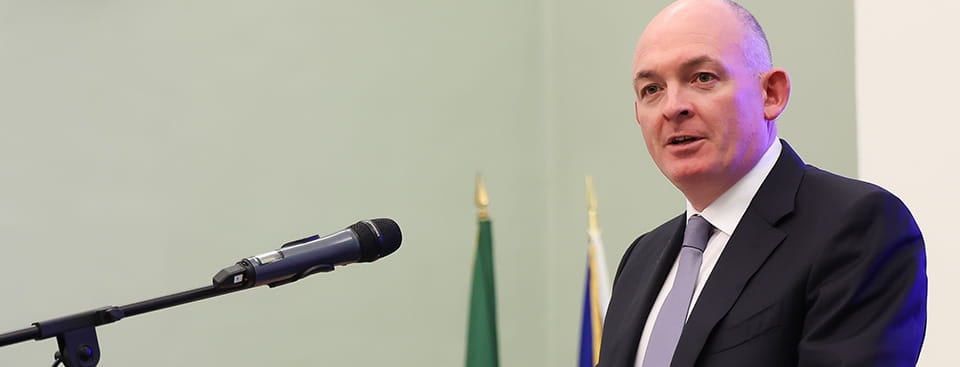
In his keynote speech, Attorney General Rossa Fanning SC traced Ireland’s evolution from one of the poorest members of the EU to one of the most prosperous.
“The scale of the change is neatly summed up by the fact that we now export more by way of value in legal services, €1.4 billion euro, than we do in whiskey.
This is fitting, since clients sometimes need one after receiving a bill for the other," he quipped.
However the benefits of EU membership extend beyond the financial he said.
They are embedded in our laws, and EU support during Brexit “offers a different and perhaps even more striking example."
Nonetheless, he said, “the Union can become its own worst enemy if, in seeking to legislate for every legitimate objective, it weakens its practical capacity to attain and achieve those objectives."
More than 10,000 EU regulations were adopted between 2016-26, each of them directly applicable in Irish law without further enactment or action by the Oireachtas or government.
Methods of tally differ, the AG said, but it can be argued that “about 70% of all directly applicable legal instruments over the last decade that may be relied upon in an Irish court are either EU law itself or the transposition of EU law.”
Load
Volume is not evidence of overregulation, he stated, but it affects assessment of whether the resulting framework remains coherent, intelligible, and workable.
The regulatory load can affect not only businesses and citizens through, for example, delays to the delivery of infrastructure, but also national governments which are required to transpose, implement, and enforce EU law.
The AG noted that the work required in his own office to give effect to EU obligations is considerable and “inevitably reducing the resources and the bandwidth available to advance domestic priorities.”
The theme of over-regulation reoccurred in a discussion between former Attorneys General, Paul Gallagher SC and Senator Michael McDowell SC, which was moderated by Marion Berry, director general of the Office of the Attorney General.
Over-interpretation
Both former AGs agreed that Ireland's membership has been transformative and largely beneficial, and both expressed concerns about the way the legal system is developing.
Paul Gallagher SC said he had great respect for the CJEU and its teleological approach to interpretation had a function in the early days of the EU and sometimes still, in a union of 27 separate states.
However, the former AG questioned whether its approach is now being applied too expansively.
Gallagher said this is exacerbated by the “partly horizontal” use of the Charter of Fundamental Rights to extend the reach of EU law.
“Regulations and directives that are agreed to by member states on a particular basis and understanding have been overinterpreted in ways very few member states anticipated when they agreed to them,” he commented.
Law that develops in such a way loses its legitimacy, he said.
Legitimate debate
Michael McDowell said there was no question about the need for the court, adding that criticism of European institutions is too readily characterised as Euroscepticism which closes legitimate debate.
Citing as an example the Dwyer case, McDowell said the CJEU had become “overly greedy” in its desire to impose its own views and extend its jurisdiction.
“One of the big things in Europe, stressed in the preamble to nearly every directive, is that it respects the principle of subsidiarity,” McDowell said.
“They mainly don't,” he commented.
He also criticised the CJEU’s single-judgment approach.
In the Apple case, McDowell commented: “The Irish people were entitled to see, in the judgment of that court, precisely what was wrong with the arguments that had triumphed at first instance, rather than just simply a broad-brush dismissal of our opposition.”
From the floor, Mr Justice Anthony Collins, president of ICEL, estimated that in about 85% of cases the CJEU was simply interpreting the legislation before it, and reaching reasonable conclusions.
But, he said, the remaining 15% matters.
CJEU 'doesn't respect its own rules'
Judge Collins raised a question about the composition of the CJEU and the extent of practical legal experience among its members.
He also suggested that judges serving renewable six-year terms does not match the standards of judicial independence expected of national courts.
“So, it doesn't respect its own rules concerning the rule of law,” he said.
Collins proposed that Ireland should consider advocating institutional reforms and there was broad consensus that the State should be more involved in policymaking, and from an earlier stage.
Challenge of implementation
Marion Berry said that the AG’s Office is frequently presented with a challenge at implementation stage when it would be far more productive to be involved earlier in the policy-making process.
Common-law perspectives
Paul Gallagher said that historically the State benefited from British expertise in identifying potential problems with proposed European measures and advancing common-law perspectives during negotiations.
Much of that support has disappeared since Brexit, leaving Ireland needing to develop its own capacity.
Adequate resources are key to this, he said.
“There doesn't seem to be a healthy debate among Irish lawyers about European law,” Senator McDowell said.
'Lazy' media
He added that the “extremely lazy” Irish media does not educate public opinion.
The speed of change is outpacing the law, Paul Gallagher said, and how we are going to deal with that is “a critical and fundamental decision but we don't even talk about it in this country”.