Education gaps shrink lawyer-linguist pool
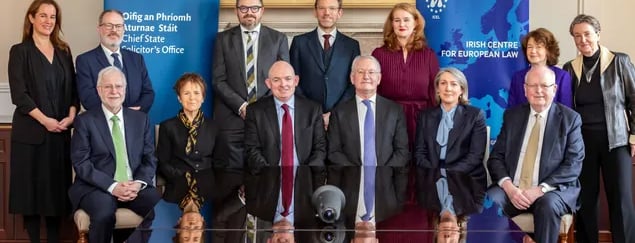
Legal education in Ireland has not kept pace with the country's growing role within the EU, a Blackhall Place conference on Ireland’s Enduring Place in Europe and Why it Matters (13 Nov), has heard.
Since Brexit, Ireland is the EU's largest common-law jurisdiction, and its principal English-speaking member state.
Disproportionate responsibilities
This left a small country with two disproportionate responsibilities, the Chief State Solicitor’s Office and Irish Centre for European Law (ICEL) co-hosted conference heard.
The common-law tradition had a lot to offer, Professor Tobias Lock, head of the School of Law and Criminology at Maynooth University, told the conference.
An important aim for Ireland should be to ensure it is properly represented in EU law-making.
Noting that English was the lingua franca of the EU, the academic said that the demand for native English-language lawyer-linguists was mostly to be satisfied from this jurisdiction.
Prof Lock also pointed out that, since 2022, the Irish language had become an official working language of the EU, which created a demand for competent Irish-language lawyer-linguists too.
Tension
Added to the context of a greatly increased number of EU laws and regulations, there is a tension between the increasing demand for Irish EU expertise, both here and in the EU institutions, and the practical limitations.
Small member states must put in the same effort as larger ones in making and applying EU decisions, he said.
“The work is the same,” Lock said.
“It just has to be done by far fewer individuals.”
The EU operated largely through law, which made legal capacity particularly crucial, he stated, adding that “maintaining sufficient legal capacity is not only of importance for the member states but for the EU system as a whole”..
However, in Irish legal education, neither the EU-law curriculum, nor language training, wawas preparing lawyers for these challenges, Professo Lock said.
He pointed to five areas where the issue might be addressed.
The first is in the structure of legal education.
Because Irish law degrees last three years, with shorter semesters, there are fewer contact hours between teachers and students than in many continental European equivalents.
Prof Lock also noted that EU criminal law, asylum law, and data protection and privacy were missing from the FE1 syllabus.
These areas generated significant practical legal work, he said, yet students received little exposure to them at undergraduate level.
'Alien legal order'
His second point was that EU law should be removed from its ‘silo’.
He described the tendency to treat EU law as an alien legal order, imposed on the national legal order, as an EU-wide problem.
“Most students will leave university with a basic EU-law education, but obviously that is not a realistic picture of what EU law is,” he said.
“As everyone knows, it's deeply intertwined in many everyday fields of law: labour law, environmental law, consumer law, planning law, company law, fundamental rights law.”
Broadening the legal minds of students was Lock’s third suggestion.
He recommended greater exposure to global law, and distinct but related, to comparative law.
The academic gave examples of legal concepts travelling between jurisdictions, including the influence of American economic thinking on EU competition law and the Brussels effect, whereby EU legal standards influenced practices elsewhere.
'Proportionality principle'
He noted too that, while the proportionality principle was frequently cited as an example of civil law effecting change on common law, the traffic went both ways.
“The idea of the right to a fair trial as a stand-alone concept is virtually unknown in civil law and legal orders, so much so that there is no translation for fair trial in German,” Lock said, quipping: “There's no word for fair in German, which maybe tells us something about our country as well.”
He added that Irish law students needed a better understanding of the differences between common-law and civil-law systems, particularly in relation to procedure and the role of judges.
Integrate law and language learning
The professor’s fourth recommendation was for more degrees that integrate law and language learning.
As well as the need for Irish-speaking lawyer-linguists, other European languages remain important for working in EU institutions and functioning effectively in Brussels.
The academic’s final recommendation was for more international study opportunities such as Erasmus.
This was particularly relevant for personal growth in a time when more students lived at home, he remarked.
Greater development of joint masters’ programmes and more generous state funding for Irish students attending the College of Europe in Bruges, where only six places were currently available each year, would also help, the professor said.
Pointy end
From the floor, Director General of the Office of the Attorney General Marion Berry spoke about her years working in the DPP’s office.
She described EU criminal law as “the pointy end of the challenge for common-law jurisdictions to interact with the union legal order”.
Therefore, teaching it in universities would be of huge benefit, Berry added.