US death penalty ‘primarily a political institution’
The death penalty in the United States is “primarily a political institution”, a Law Society event has heard.
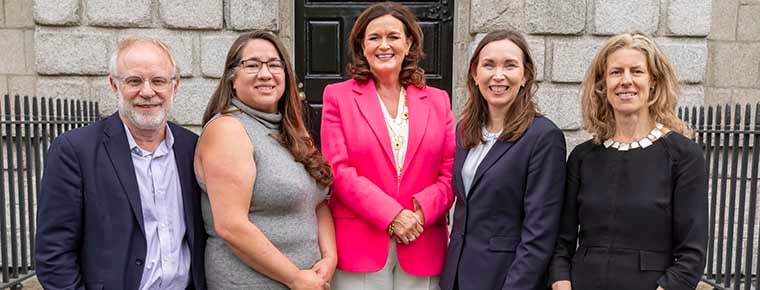
Professor Raoul Schonemann was speaking at ‘The power of pro-bono: Justice and the fight against the death penalty’ at Blackhall Place (April 22), which was presented by Amicus and Arthur Cox and hosted by Law Society Solicitor Services.
Human rights problem
Professor Schonemann acknowledged that the death penalty was a US “human rights problem”, but he stressed the important role pro bono work by lawyers around the world plays in saving the lives of death row prisoners.
Carolann Minnock, pro bono of counsel at Arthur Cox, chaired the panel discussion which began with Margot Ravenscroft, executive director at Amicus, the British-based organisation dedicated to supporting death penalty defence in the United States.
Ravenscroft outlined the organisation's growth since 1992 when Jane Officer, a retired Birmingham schoolteacher, flew to New Orleans to speak at the clemency hearing of death row inmate, Andrew Lee Jones, with whom she had been corresponding.
Lee Jones was a young Black man whose trial, in front of an all-white jury, lasted one day.
Clemency hearing
His clemency hearing was unsuccessful and Ravenscroft explained that when Jane Officer asked the appellate lawyer what she could do to change the system, he said “You need to send us lawyers".
The Andrew Lee Jones Fund became Amicus in 1996.
The organisation initially funded British lawyers to take the US Bar exam and spend a year doing capital defence work in the United States.
Today, Amicus provides comprehensive training in death penalty law, runs a casework programme supported on a pro bono basis by thousands of lawyers, publishes an academic journal, and engages in broader education about human rights and the rule of law.
“Pro bono work should never replace properly funded legal services”, Ravenscroft said.
However, without it, cases cannot be prepared to the standard required.
Describing what pro bono work for Amicus looks like today, she explained that as US capital defence teams are small and under-resourced, Amicus breaks down hundreds of thousands of documents into manageable sections so that they can be analysed by lawyers across firms of all sizes.
The impact can reach far beyond individual cases: she described one case which a British lawyer carried over decades, eventually arguing it before the US Supreme Court twice.
Incarcerated
The client, who had spent 44 years incarcerated, is now free, and moreover, the case “really clarified the constitutional position on intellectual disability, and the way that we deal with mitigation as well”.
Covering a story about displaced Iraqi asylum-seekers in Estonia inspired Samantha Knights KC to move from journalism into law.
Knights almost lost faith in legal practice after a particularly long trial but decided instead to do the Amicus internship, even though, “I wasn't sure how useful I would be”.
However, she said, her experience on a US death penalty case involving a young defendant “changed my life” and led to continued engagement with the case over many years.
Post-conviction cases
Professor Raoul Schonemann, clinical professor and co-director of the Capital Punishment Clinic, has represented people facing the death penalty in trials, appeals, and post-conviction cases for more than 30 years.
He described how most of his capital defence work has started at the “back end” of cases, often starting with an execution date and “a very short timeframe” to prepare.
However, he said “It has become increasingly difficult to save clients' lives the further the case has advanced through the process of post-conviction review.”
He has now concluded that effective representation at trial was “the best way to protect our clients”.
He added: “It's also the path toward abolition in my view.”
In an overview of the current position of capital punishment in the US, Professor Schonemann said that although 27 states retain the death penalty, active use is concentrated in just five to seven.
Inequitable
A total of 80% of executions are carried out in the former Confederate states where there is a long history of racially inequitable criminal justice, the event heard.
He outlined how, from a peak in the late 1990s, death sentences and executions declined steadily until around 2016, with a dozen states abolishing the penalty over that period.
Noting a strong correlation between death penalty states and Republican-leaning ones, Prof Schonemann said there is now “a reverse trend” in the death penalty.
The Trump administration has issued executive orders pledging federal assistance to states seeking lethal injection drugs and moving to expedite post-conviction review procedures — steps designed to ensure executions are "carried out more frequently and in shorter periods of time."
The three Supreme Court justices appointed by President Trump have already shifted the court in a markedly more conservative direction, the event heard.
Fealty
And, noting that Supreme Court appointments are for life, the attorney said the justices are “chosen for two basic attributes; their fealty … and their youth.”
He added that there is speculation that Justices Alito and Thomas will retire shortly, “because they want to make sure that they are replaced by a justice who is nominated by President Trump”.
Against this backdrop, Prof Schonemann returned to the question of representation: "the only way that we can make sure that people facing the death penalty are adequately represented is with your help."
Unfamiliarity
And he was emphatic that those considering involvement should not be deterred by unfamiliarity with US jurisdiction.
Margot Ravenscroft explained that while Amicus mostly works with teams within firms rather than with individual practitioners, there are various ways to contribute.
Since 2018, Arthur Cox has supported Amicus by undertaking document review work which is then provided to US attorneys representing death row clients.
Speaking of the work, Carolann Minnock said, “Sometimes, when it's late in the evening and you're reviewing pages and pages of information and populating Excel sheets, you think, but does this really make a difference?
“But it does. It really does.”