ECtHR project ‘remains vital’, say judges
The difference between working as a judge in Ireland and in the European Court of Human Rights (ECtHR) is “fundamental”, according to Ms Justice Úna Ní Raifeartaigh.
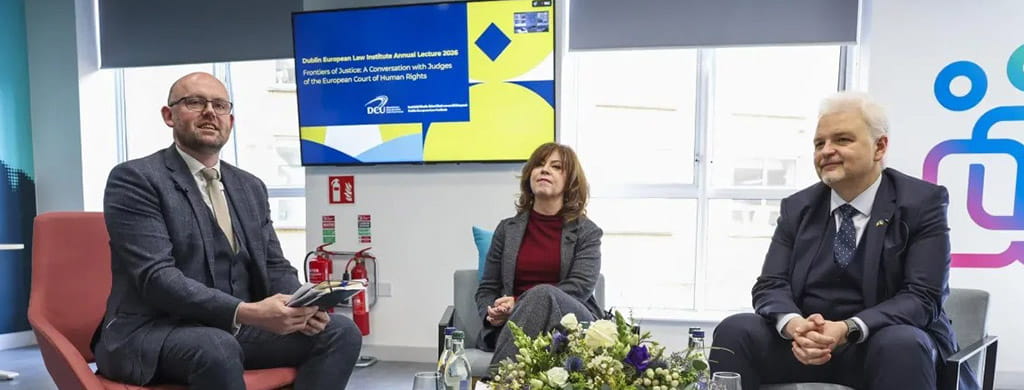
Ms Justice Ní Raifeartaigh and her Ukrainian colleague at the ECtHR, Judge Mykola Gnatovskyy, were guests of honour at the Dublin European Law Institute’s (DELI) Annual Lecture on 2 April.
Held at the Irish Human Rights and Equality Commission (IHREC) in Dublin, the judges addressed the continuing relevance and practical operation of the ECtHR in the current geo-political climate.
They also reflected on the practicalities, scope, and complexity of adjudicating across 46 member states, each with its own language, culture, legal system, political environment, and human-rights issues.
‘New skill set’
In conversation with Dr Andrew Forde (Assistant Professor of European Human Rights Law and Commissioner, IHREC), they agreed that the day-to-day working life of a judge at the ECtHR was markedly different from domestic judging.
Ms Justice Ní Raifeartaigh said: “The skill-set that I have developed here in Ireland doesn't serve me all that well. I’ve had to really learn a whole new skill-set, and it's still in development.”
The court processes approximately 30,000 cases annually, each run to a deadline, and judges work with registry lawyers.
“It's like being a district judge and a Supreme Court judge and everything in between every day of the week,” Ní Raifeartaigh explained, because cases are handled at multiple levels simultaneously – from single-judge decisions to committee, chamber, and Grand Chamber formations.
She said that there was a misconception that ECtHR judges had a cabinet, but this was not the case. With the exception of Anna Austin, the ECtHR Deputy Jurisconsult, “there’s no Irish team there. In fact, there's no Irish case lawyer working in the court.”
She added that apart from “a third of a secretary who prints and maintains the professional diary”, judges did not have an administrative team.
Ireland benefits
Judge Ní Raifeartaigh observed that Ireland’s relative absence of cases before Strasbourg served a supportive role, allowing it to contribute to the cohesion of the convention system while benefiting from the experiences of other countries.
She noted that, although the Constitution absorbed a significant volume of potential litigation, the ECtHR provided additional layers of protection and comparative analysis.
Strasbourg case law also provides deep insight into complex human-rights issues that arise only occasionally in Ireland.
All countries had legal “blind spots”, she said, which could benefit from the external perspective of ECtHR case law. Irish cases before the court – though sometimes controversial – have influenced domestic law, but so too have decisions from other countries like Winterwerp v Netherlands.
Court’s work ‘very live’
Ms Justice Ní Raifeartaigh explained that being in Strasbourg heightened the immediacy of global crises.
War on the continent, territorial disputes, and the movement of populations rendered the court’s work “very live and very menacing” compared with the more distant perspective of reading about such events in Ireland.
Judge Gnatovskyy emphasised that maintaining faith in international law was essential, despite ongoing aggression, citing the invasion of Ukraine and atrocities such as the Bucha massacre.
He noted that the court was designed as part of a broader peace project, linking human-rights enforcement with the maintenance of international order.
Gnatovskyy described the court’s recent handling of cases arising from the occupation of Crimea and the Ukraine-Netherlands case concerning the downing of flight MH17 as demonstrating its capacity to operate effectively even in complex, high-profile matters.
Reliance on political pressure
Both judges stressed that ECtHR’s enforcement was dependent on political pressure rather than coercive measures.
Ní Raifeartaigh noted that, while national courts could compel compliance through direct enforcement, the ECtHR relied on the Council of Europe’s Committee of Ministers to supervise execution of judgments.
“It’s a different timeline,” she noted, citing the ten-year supervision of Louise O’Keeffe v Ireland, “however there have been huge successes, and we have the perfect example of Mr Norris.”
Judge Gnatovsky noted that decades of relative peace and the enlargement of the Council of Europe and the European Union had, in many states, shifted ECtHR focus toward granular questions of democratic governance and civil liberties.
However, full-scale invasions such as Russia’s attack on Ukraine reminded observers that the original project, set up in the aftermath of WW2, remained vital.
‘Credible and competent’ forum
Judge Gnatovskyy affirmed that the court remained a credible and competent forum for adjudicating disputes, even amid ongoing conflict.
And, despite the absence of physical means of enforcement, the court’s judgments provide a legal framework and a historical record that can influence states and societies over time.
Gnatovskyy stressed that states participated in the ECtHR to uphold collective human-rights protections, noting that withdrawal undermined both the domestic and broader European legal order.
Judge Gnatovskyy concluded by underscoring the ECtHR’s continuing relevance. Despite external pressures and current geopolitical instability, he said, “there is no alternative. International law and common sense will prevail.”