Extra judges ‘leading to court efficiencies’
Courts Service Chief Executive Angela Denning has said that new legislation provides particular challenges for the courts system, particularly when demand is strong from the start.
Writing in the service’s annual report for 2024, she cited the example of Civil Orders against Relevant Conduct (stalking or restraining orders), introduced in September 2024.
The District Court received 314 applications for such orders in the first four months of operation, granting 133 full restraining orders and 107 interim orders.
The annual report expressed concerns that Government departments were not considering the impact of new legislation on courts’ resources.
“Engagement took place with the Department of Justice during 2024 to develop an enhanced Regulatory Impact Analysis for all new legislation and policy across departments, insofar as they related to courts,” the report stated.
Waiting times
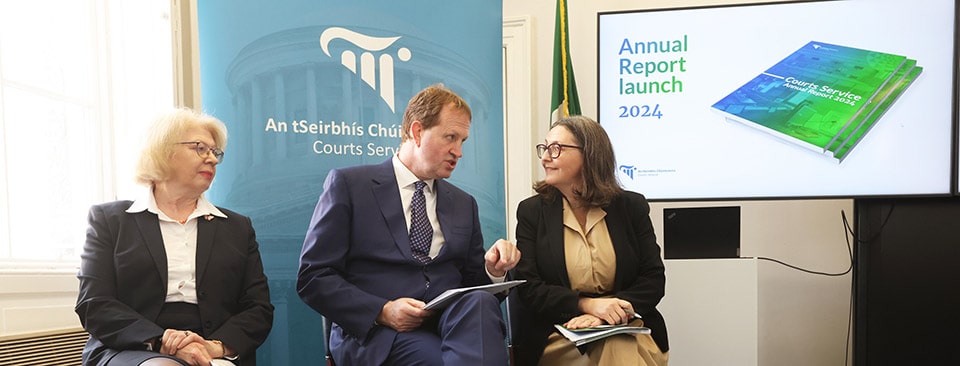
At the report’s launch (7 July), chair of the Courts Service board Ms Justice Elizabeth Dunne said that it provided further evidence of efficiencies resulting from the appointment of additional judges – including a reduction in the number of courts cancelled due to insufficient judicial resources.
The report said that the appointment of additional High Court judges in recent years had cut waiting times in several areas, particularly in the judicial-review lists for asylum and non-asylum matters, as well as for the chancery lists.
While the 736 judicial-review asylum cases last year represented a slight drop from 2023, they remain at almost double the levels recorded in the previous four years.
The courts body added that the extra judges had also enabled a year-long case in the Commercial Court to continue with “minimal” disruption to other cases on the list.
Ms Justice Dunne also said that the increased availability of video technology – now in 165 courtrooms across the country – had also given judges, practitioners, and users more options “to enable cases to get on and be heard”.
She pointed out that 95% of charge sheets were now processed electronically, with almost 121,000 sheets handled in 2024
PI awards down 45%
There were 12,989 new personal-injury cases last year across the courts – down 3% from 13,434 in the previous year and more than 40% lower than the 2019 pre-COVID figure of 21,981.
Across the courts system, the total level of awards for personal injuries fell by 45% compared with 2023, with the High Court figure dropping from €256 million to €135 million.
The Courts Service said that 390,158 new criminal matters were presented to the courts last year – an increase of 6.3 % on the previous year. The courts finalised 356,045 cases – up 5.2% from 2023.
The Court of Appeal had 341 new criminal appeals last year – up from 308 in 2023.
Cases on hand at the Central Criminal Court fell by 16%, while new cases were down 10%. Matters disposed of increased by 24%.
The courts body said that this continued a positive pattern of reducing numbers of cases waiting to be dealt with by the court, coming after a 10% drop in 2023.
It pointed out, however, that cases on hand remained 35% higher than pre-pandemic levels, and the volume of new cases is 40% higher – even with last year’s reduction.
Nine life sentences for rape
The report said that progress was also being made in reducing the backlog in the Circuit Criminal Court, where cases on hand fell by 3% and new cases were down 1%.
Cases disposed of increased by 10%.
The number of less serious criminal cases coming before the District Court increased by 6.5% to 350,852.
The court disposed of 4% more cases than in 2023.
A breakdown of cases at the Central Criminal Court showed that 62% of the 434 sentences that it handed down for rape – including attempted rape – ranged from ten years to life imprisonment. There were nine life sentences for rape last year.
District Court drugs cases down
The Circuit Court issued 14,858 sentences for more serious crime last year – up from 14,002 the previous year. The number of more serious offences sent to the court by the District Court increased by 18% to 19,944.
A breakdown of District Court cases showed a continuing downward trend in drugs cases – last year’s total 27,783 was down more than 2,000 compared with 2023 and has fallen by 16.5% compared with 2019.
There were significant increases, however, in larceny/fraud and robbery (15.3%), public order and assault (9.6%), and sexual offences (13.7%). While road-traffic cases were up 8.6% year-on-year, they remained 18% below pre-COVID levels.
Jump in planning-and-environment cases
New civil cases across all courts increased to almost 184,000 last year – up 2% from 180,000 in 2023.
The High Court accounted for most of the increases and has seen a 33% jump in new civil cases over the past two years.
The courts completed 148,120 civil cases last year, compared with 143,644 in 2023 and 137,000 in 2022.
Among the biggest increases in civil cases was in the planning-and-environment list, where cases increased to 241 from the previous year’s 108.
The court resolved and finalised 253 cases last year – almost double the 2023 figure.
The number of applications to wind up companies also doubled to 89.
Other big increases in civil cases were recorded for execution orders after judgments in debt cases (91%), recovery of debt (31%), proceeds of crime (40%), and regulation of professions (23%).
Divorce cases fell, however, and were down 10% in the last two years.
Domestic violence
The District Court received 25,270 new applications for protections under domestic-violence legislation last year. While this figure was little changed from 2023, it was 23% higher than the pre-pandemic 2019 level.
Applications for supervision and care orders for children continued to increase last year, when 21,684 new applications were made. This represented increases of 23% and 45%, respectively, compared with 2023 and 2022.
These figures include multiple applications and orders in cases and not the number of children or cases.
The report says that processing times for grants of probate at the Dublin Probate Office were reduced from 20 weeks to five weeks by the end of 2024, adding that work to maintain this will continue in advance of the introduction of e-probate later this year.
year-end.