The permanent paradox of tech regulation
The central question is not simply how to regulate technology, but what should be regulated, and why, a Law Society seminar has heard.
AI regulation in Europe is a “permanently paradoxical situation”, the Law Society EU & International Affairs Committee seminar (22 September) heard at Blackhall Place.
Professor Teresa Rodríguez de las Heras Ballell (small picture, with Niamh Hodnett) said that given that creating technological independence requires innovation, innovation requires the removal of obstacles and regulatory simplification.
Vertically integrated
This in turn means that established players can continue to grow in a market that “is not only monopolistic, but vertically integrated”.
The president of the European Law Institute, said the central question therefore was not simply how to regulate technology, but what should be regulated and why.
With artificial intelligence, she said, that could mean regulating the technology itself, its effects and uses, or the market structures and companies behind it.
Power and ideology
She pointed to the concentration of the AI market and its value chain, arguing that technology was also a question of economics, power and ideology.
The Professor of Commercial Law at Universidad Carlos III in Madrid was giving a keynote speech at Ireland and the EU – an opportunity for influence: Threats to the rule of law and adopting a commonplace approach to tech regulation, organised by the Law Society EU & International Affairs Committee.
The academic discussed the balance between promoting innovation, competitiveness and business while protecting rights, values and the public interest.
Simplification could be useful where it removed bureaucracy and unnecessary paperwork, the professor said, but risked becoming deregulation if it weakened the substantive protections that regulation was intended to provide.
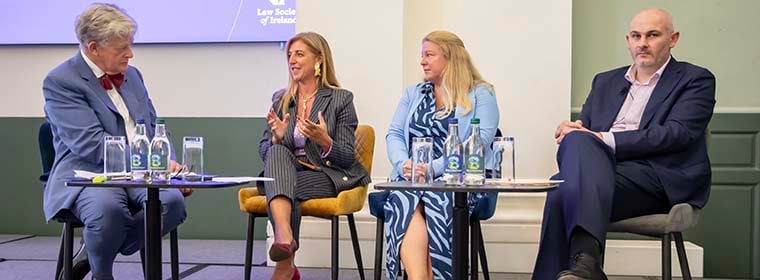
The panel discussion that followed, chaired by Paul Keane (consultant, Reddy Charlton LLP) debated the question of balancing the rights of the individual with freedom of business.
ComReg Commissioner Niamh Hodnett said that several regulators have responsibilities that overlap in areas including the AI Act, the Digital Services Act and the EU Data Act, requiring coordination to ensure regulation is applied proportionately and coherently.
Clarity and certainty were important for regulated entities, she said, but regulators also had to apply the law as it stood.
Inherent challenge
Mark Cockerill (President of the American Chamber of Commerce in Ireland) said the phrase “permanently paradoxical” illustrated the inherent challenge for Europe.
He commended the way Ireland, and ComReg, apply regulation but argued that this is not the case in all of the EU.
Competitiveness undermined
Multiple layers of legislation and different approaches across EU member states have undermined both compliance and competitiveness he said.
“Most of Europe is fundamentally broken,” he stated.
“The European Union as a project is broken because we've added that layer of craziness to trying to do business.”
He also questioned whether an emphasis on European technological sovereignty could become counterproductive if it meant prioritising where technology came from over whether it provided the best security or service.
“I'm not saying these comments to be inflammatory. I'm just being realistic,” he said, adding, “I want Europe to win”.
Professor Rodríguez de las Heras Ballell argued that regulation as it currently stands is “missing the point of law which is based on very clear principles and standards.”
Regulation should reflect society, she said, with clear values, rights, obligations and red lines.
Treating legislation as a detailed manual, however, could turn it into a compliance exercise and make interpretation and application more difficult.
She questioned compliance versus liability and whether it was enough for a company to comply with a checklist designed to protect minors, for example.
Accepted value to protect minors
She asked whether the objective should be for the protection of minors to become a value that the company itself accepted.
The focus, she said, should be on what the law is trying to protect rather than whether a particular technological solution has met a prescribed checklist.
Niamh Hodnett added that detailed compliance rules can quickly become outdated as technology develops whereas a principles-based regulatory regime can evolve as technologies change.
Enforcement of the rules is key, Professor Rodríguez de las Heras Ballell said.
Without it “regulation is just an aspiration without teeth”.
She concluded that the challenge was not simply to regulate, but to understand what regulation was actually for.