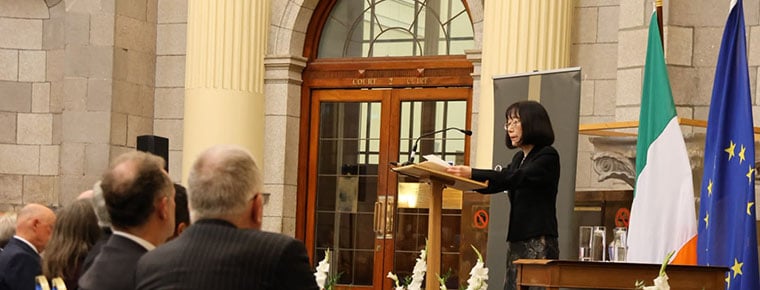
Intensifying attacks on ICC part of ‘wider assault’
The President of the International Criminal Court (ICC) says that the obstacles facing the court have “intensified significantly” during the past few years.
Judge Tomoko Akane was speaking at a ceremony in Dublin’s Four Courts to mark the opening of the new legal year (5 October).
Akane is among several ICC judges and prosecutors whom the US has sanctioned.
US Secretary of State Marco Rubio earlier this year describing the court as a “threat” to its national sovereignty.
Russian convictions
Judge Akane also told members of the Irish judiciary and legal profession this morning that Russia had also convicted and sentenced several current and former ICC officials in absentia – including Akane herself – for their activities in relation to the situation in Ukraine.
“At this moment, 12 of the 18 ICC judges are the subject of at least one of these coercive measures,” she stated.
The ICC president also noted that the institution also faced cyberattacks and other measures that she said were aimed at "interfering with judicial proceedings and changing our course”.
Rule of law
The Japanese judge told the ceremony that, while such attacks were couched in narratives that were specific to the ICC and its activities, they were also part of “a broader assault against the rule of law”.
“It is of vital importance that courts, whether that is the ICC or any other court, remain independent and free from political pressure or any kind of coercion,” she said.
“But at times, it feels to me that this very foundational notion is corroding before our eyes,” she warned.
Judge Akane highlighted that the ICC was continuing to fulfil its mandate in fighting impunity for “the gravest of crimes”, without allowing “coercive” measures to have any bearing on judicial proceedings.
‘Court of last resort’
The ICC president told the Four Courts ceremony that the institution was a “court of last resort” and was complementary to national judicial institutions.
“If states have the capacity and the will, the court will not proceed with investigations or prosecutions,” she stated.
Judge Akane said that Ireland upheld the rule of law to “a remarkably high standard”, adding that it had always been among the strongest supporters of the ICC since its inception in 2002.
She noted that Ireland had incorporated crimes under the ICC’s founding Rome Statute into its domestic legislation, through the International Criminal Court Act 2006.
The ICC president also described contribution of Irish judges to the field of international criminal law as “immense”, highlighting Judge Maureen Harding Clark, one of the first judges at the court.