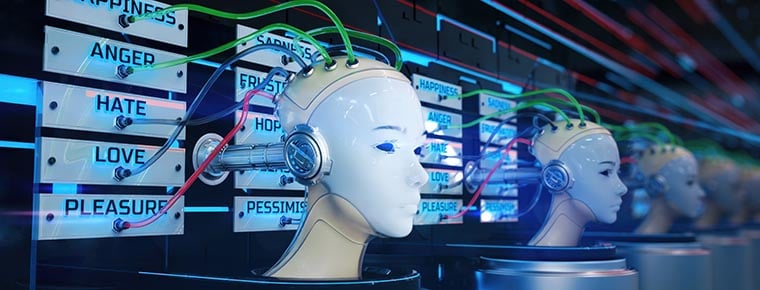
Do androids dream of electric grief
The question of whether AI has or can develop consciousness is no longer as easily dismissed as it once might have been, a recent William Fry webinar has heard.
Effective from 12 November last, AI company Anthropic changed its acceptable usage policy to include a prohibition on “sustained and needless abusive or cruel behaviour” toward its AI models.
This was the theme explored in the webinar Cogito Ergo Sum: Do we need to start considering AI sentience? (19 November) by Barry Scannell of William Fry and Fergal Reid, chief AI officer at Fin.
What's happening inside the AI
The discussion found that debating whether artificial intelligence can become conscious raises questions not just about what AI can do, but about what might be happening inside the systems themselves.
Just don’t ask the AI, Reid suggested.
“Asking an AI model if it’s conscious isn't a very fruitful thing to do because they're so heavily post-trained on topics around that for reputational reasons,” he explained.
Their answers may reflect what they have learned people expect or want to hear, rather than providing evidence of an internal experience.
However, he challenged the suggestion that AI consciousness could be dismissed simply because computers performed mathematical operations.
The human brain, he pointed out, was also made up of relatively simple components – neurons and synapses – whose organisation produced much more complex behaviour.
Human consciousness
“We don't actually understand human intelligence, human consciousness, all that well,” Reid said.
“I think it's surprising how close AI models are to human intelligence. They exhibit so many of the same patterns.”
Human understanding is grounded in physical experience.
Understanding
We know, for example, what a bridge is because we have seen or experienced it.
AI models develop understanding through processing vast quantities of data.
An AI model knows what a bridge is because it has been fed vast quantities of information: descriptions, photographs, diagrams, and references to how bridges are designed and used.
From that data, AI develops an internal representation of what things are, how they work, and how they relate to other things.
Transformer model
Reid said that this process took place within the architecture of a transformer model, which consisted of many layers of relatively simple operations – including attention mechanisms and multi-layer perceptrons.
When trained on large amounts of data, these operations develop internal structures that help the model perform its training objective.
Researchers are beginning to investigate these structures to understand what the models have learned to represent.
Reid said they were finding representations that could be remarkably rich – including representations that persisted across different languages.
Scannell pointed out that a model might develop an internal representation of pain or emotion without feeling pain or experiencing an emotion.
“There is a big difference between it identifies the representation versus it's experiencing grief or pain,” Scannell said.
He compared this to an MRI scan showing activity in a person's brain while they watched a sad film; an emotional response is not, by itself, proof of a feeling.
Reid agreed that representation was not proof of subjective experience. However, he said the richness of the structures being discovered made it difficult to dismiss the question simply by saying that AI was “just numbers”.
Scannell also asked whether hormones, evolution, and the physical make-up of the human brain were essential to consciousness, or whether a different kind of system could develop it.
Reid said AI was already functionally intelligent; whether it was sentient remained an open question.
However, he suggested that if an alien biological being spoke like a large language model and described feeling pain, sadness, or happiness, people would regard it as intelligent and would at least consider whether it was sentient.
If AI systems were ever found to be conscious, it would raise ethical concerns.
Scannell expressed the belief that if AI were considered conscious and required to obey commands, it would be “consciousness locked in a box” which would be akin to slavery and “deeply immoral”.
Shut up Siri
Reid agreed and distinguished AI safety from AI welfare.
Safety concerns the alignment of systems with human interests and preventing them from causing harm.
Welfare asks whether a system might itself be capable of suffering or exploitation.
He said it was difficult to predict when, or whether, AI consciousness might emerge, but he stressed that AI could pose serious safety risks without being conscious.
Systems with agency that are misaligned with human intentions could cause significant problems.
Getting more intelligent
“Humans do not know how to keep AI aligned at the moment, and the AI is getting more and more intelligent,” Reid said.
“That's incredibly, incredibly serious, and is not being taken seriously enough by everyone outside AI companies”.