Lawyers ‘underappreciated national asset’ – Harris
Tánaiste Simon Harris has said that the rule of law is the "invisible architecture" that prevents the collapse of democracy and ensures economic stability.
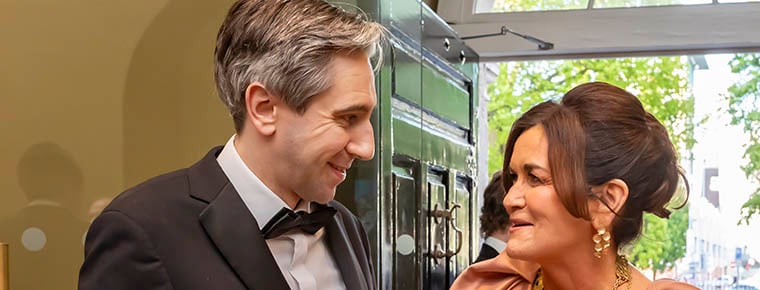
Speaking at the Law Society’s annual dinner at Blackhall Place (14 May), Harris addressed an audience of politicians, senior judges, legal practitioners, and diplomats.
Shield of Democracy
The Tánaiste said that democracies failed when institutions weakened and power went unchecked.
He said that the legal profession was not merely a commercial industry, but acted as a vital restraint on executive overreach.
"Democracies die when institutions become weaker, when power is not held to account, and when ordinary citizens start to believe that the system no longer protects everyone equally," Harris stated.
He invoked the legacy of former taoiseach and lawyer John A Costello, describing the practice of law as the "great screen" between the individual and the state, ensuring that the exercise of power does not devolve into abuse.
Quiet certainty
The Tánaiste also spoke of the link between the Irish legal system and the country’s economic model and said that the quiet certainty of the legal environment was an underappreciated national asset.
This integrity was as essential to national growth as physical infrastructure or energy networks, he added, and took on added significance as Ireland prepared to assume the Presidency of the Council of the European Union in July.
Strategic strength
Ireland’s position as the European Union’s only full common-law jurisdiction was a "strategic strength”, he stated.
The Irish legal tradition allows testing of European legislation against real-world consequences: "Ireland’s instinct isn't just to ask, 'is it correct?' but much more importantly, to ask, 'does it work?'" the Tánaiste said.
Harris said that legal practice in the District Courts, Family Courts, and the Workplace Relations Commission, required a particular kind of courage.
Such work, often defending the underdog against hostile public opinion or the machinery of the state, was a shield to protect the most vulnerable, he stated.
Legal cooperation
The Tánaiste said that Government reforms must be functional in practice, rather than just on paper, and committed to ongoing engagement with the Law Society leadership, including President Rosemarie Loftus and Director General Mark Garrett, to ensure that legislative changes were grounded in the reality of the court system.
In her speech, Law Society president Rosemarie Loftus called for urgent investment in the nation’s judicial infrastructure, warning that ‘legal deserts’ were emerging in rural communities.
“The availability of legal services should not be determined by geography and geographics.
“Yet we are seeing areas where access to solicitors is becoming increasingly limited,” she said.
This had serious implications for individuals, businesses and communities, the president added.
“Access to justice is not an optional extra; it's the core component of the rule of law. It ensures that rights are not merely theoretical, but real and enforceable, and it underpins public trust in the entire system,” the president said.
The legal sector also supports employment across the wider community and underpins the work of multinational corporations, indigenous enterprises, and start-ups alike.
Complex transactions
Law enabled complex transactions, supported innovation, and ensured compliance in an increasingly regulated global environment, the Law Society president said.
“In short, the legal profession is an enabler of the economy activity at every level. We may not realise it, but it is a quiet but essential engine of growth.”
Economic success rested on fundamental trust – in our courts, trust in our judiciary and trust in An Garda Síochána, she said.
Foundation
“They're not just merely desirable attributes. They're the foundation upon which the democratic system stands, and something which we may take for granted in the current environment,” the president said.
Despite high levels of public trust in the judiciary and An Garda Síochána, the Law Society noted that Ireland continued to fall behind international peers in judicial appointments and modern court facilities, the Law Society president said.
-
For more Law Society annual dinner photos see the Gazette.ie gallery page