Legal institutions ‘are ultimately human ones’
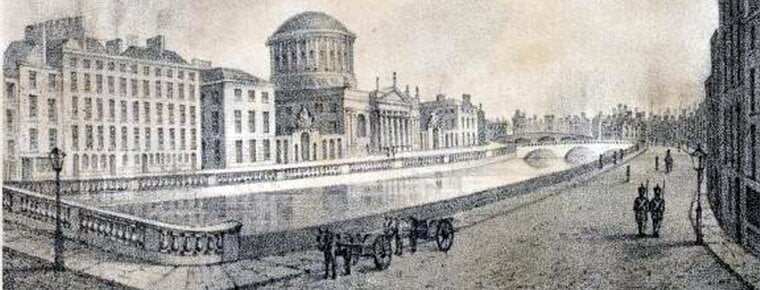
In the final event of the 2026 Hardiman lecture series at the Supreme Court (1 July), Ruth Cannon BL invited the audience to consider ‘Where Old Ghosts Meet: What We Can Learn from the History of the Four Courts”.
Cannon presented the Four Courts as "a layered archive of Irish public life, legal memory, institutional survival, private catastrophe, professional ambition, public theatre, and occasional absurdity."
"Law is never only law," she said.
It is shaped by architecture, politics, religion, language, class, commerce, and memory.
Tracing the site's origins, Cannon explained that it formed part of medieval Oxmantown and was occupied by the Dominican Priory of St Saviour.
Former Dominican priory
Following the dissolution of the monasteries, Henry VIII granted the former priory to lawyers.
When he assumed the title King of Ireland in 1542, the society adopted the name King's Inns in honour of its royal patron.
Cannon described this as one of the great continuities of the site: "A Dominican priory became a legal inn, and a legal inn gave way to the courts."
The continuity of legal life on the site, she suggested, was one of the enduring themes of its history.
Details from accounts of the time, include medieval obligations requiring the Dominicans to present a lighted taper each Christmas, lost keys to the King's Inns pews in St Michan's Church, and ceremonial cushions provided for the Lord Chancellor's attendants.
These all serve to remind us, Cannon said, that legal institutions were ultimately human ones.
She went on to explain that the 18th century decision to locate the Four Courts on Inns Quay “was not a pure act of civic idealism”.
It was also because an MP who owned a large estate in Oxmantown believed the move would increase the value of his land.
Geography of justice
“This is a useful reminder that the geography of justice is rarely innocent,” she said.
Cannon explained that Thomas Cooley's original design had been intended for public offices and records rather than courts of justice, with James Gandon adapting and transforming the existing structure after Cooley's death.
Gandon's famous portico, she noted, survived only as a compromise, altered after objections from influential neighbours.
The building's most powerful metaphor was its dome, Ruth Cannon said, as it was a double dome with a void in between.
The void proved unsuitable for its first intended use, as a law library, so was then used for record storage.
But as the number of records grew, so did concern that their weight might threaten the lower dome.
She said the hidden void provided one of the strongest metaphors for the whole institution.
Public face of justice
“There is the public face of justice, ceremonial, symmetrical, and confident.
"Then there is the hidden space above it, filled over time with records, dust, anxieties, forgotten documents, pigeons, and ghosts”.
The Round Hall was once the social heart of legal Dublin, a bustling public space where barristers, litigants, booksellers, food vendors, and curious spectators mingled.
Broader themes were illustrated through individual lives. Daniel O'Connell was a Catholic barrister navigating a profession that had only recently opened its doors to Catholics.
The first women barristers, Frances Kyle and Averil Deverell, were called to the bar in 1921.
As with O’Connell, however, briefs were not quick to follow the rule change.
The lesson, Carron said, “is not only that prejudice can be overcome; it is that removing a formal barrier is only the beginning of changing profession”.
Pearse ‘a barrister without briefs’
Following his failure in the McGiolla Bhríde case, seeking recognition of Irish-language lettering, Patrick Pearse was dismissed by some contemporaries as "a barrister without briefs".
Today he is commemorated outside the Law Library.
The lecture also explored those whose contributions were less frequently remembered, such as women, who, before admission to the legal professions were present in the Four Courts as workers, lay litigants, and traders.
She included the story, from 1885, of when a bag lady called Bridget O'Shaughnessy, fell dead in the hall of the courts (near what is now court four).
“Her body lay on the floor for two hours among the sacks, and its removal coincided only with the rising of the courts for lunch."
There was also appreciation of the ordinary realities of professional life. The law library was once located in the air space of today’s Supreme Court and lit largely by its glass roof.
In April 1850, the glass was shattered by large hail, its fragments falling on the 60 or 70 barristers below.
“For once the wig had a practical use,” Cannon remarked.
Typhoid outbreak
By 1893, a more serious issue with that Law Library emerged when multiple members of the bar contracted typhoid due to “pungent earth closets with no ventilation and sanitary conditions”.
The second law library, which opened in the eastern wing in 1897, had modern sanitation and many other praised amenities, but not enough seats.
Such stories reinforced Cannon's central point that legal history was made not only through celebrated judgments and political crises, but also through the daily experiences of those who worked within legal institutions.
Attentive to history
Their stories, she suggested, continued to ask important questions about the kind of legal profession Ireland wished to cultivate – one conscious of its public role, attentive to its own history, and mindful of those whose contributions had gone unrecorded.
The building of the Four Courts mattered, Ruth Cannon concluded, not because it had ever been perfect, but because it continued to carry so much of Ireland's legal and human story.
The event was closed by chairman Mr Justice Gerard Hogan who said: “We have been extraordinarily fortunate to have had three really outstanding lectures in this Hardiman series”.