Constitution ‘may complicate Irish unity’
The Irish Constitution was conceived as an instrument capable of underpinning national unity, but may in fact complicate that objective, a Supreme Court judge has said.
Mr Justice Hogan said that this potential complication was not due to constitutional weakness or rigidity, but because of its strength, coherence, and deep embedment in the political identity of the State.
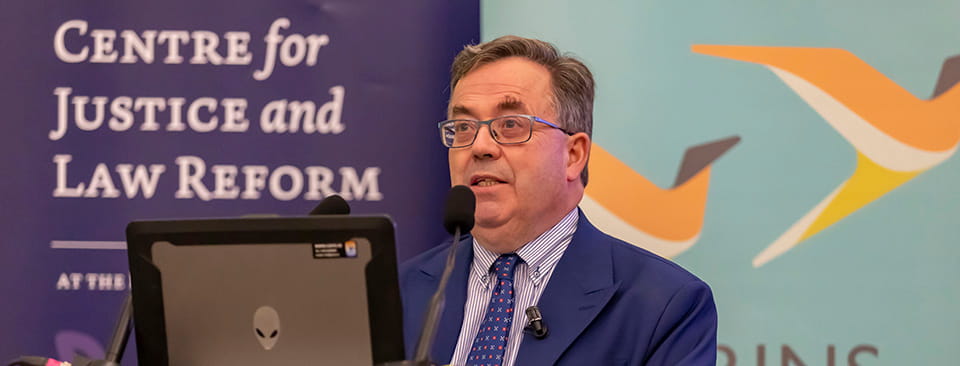
He was speaking at ‘Is the Constitution of Ireland (still) an obstacle to Irish reunification?' (February 5), which was presented by ARINS and the Law Society’s Centre for Justice and Law Reform.
‘Greatest legal achievement’
“The enactment of the Constitution was easily, I think, by some distance, the greatest legal achievement of the Irish State,” Mr Justice Hogan said.
He added that the Constitution was “very clever” and “highly democratic, all-encompassing and prescriptive”, citing as an example the comparison between the language of article 40, section 3 to the 14th amendment to the US constitution and article 8 of the European Convention on Human Rights.
“But the Constitution is, in many ways, a victim of its own success,” Mr Justice Hogan told the event.
The judge said that the success of the Constitution rendered it, simultaneously, admirable in comparative legal terms and estranged from those outside the tradition that produced it.
Boundary Commission ‘naivety’
In an historical and constitutional assessment of the Treaty settlement and its aftermath, he said that the Civil War debates of 1921–22 were not centrally concerned with the North, largely because political actors on both sides “naively” assumed that the Boundary Commission provided for in article 12 of the Anglo-Irish Treaty would deliver territorial unity.
The actual causes of the Civil War lay instead in objections to constitutional features incorporated into the Irish Free State Constitution pursuant to the Treaty: dominion status, the oath of allegiance, the office of Governor-General, the possibility of appeal to the Privy Council from the Supreme Court, and the provision for the Treaty Ports.
By the mid-to-late 1930s, these contested features had been dismantled through constitutional amendment or political agreement; dominion status was terminated by Bunreacht na hÉireann in 1937, and the Treaty Ports were returned in 1938.
These developments are often treated as inevitable progress. Mr Justice Hogan, however, posed a counterfactual: from the British perspective, the contested features were “safeguards” for a substantial Unionist minority and, had Ireland been territorially united in 1922, it is doubtful whether these changes could have been effected.
Partition, paradoxically, enabled constitutional consolidation.
The “almost complete fiasco” of the Boundary Commission in 1925 then entrenched the existing border, confirming a territorial settlement that left a large nationalist minority within the North.
Within the context that “there was never going to be a perfect border”, Mr Justice Hogan said that maintaining the border as it was, thus leaving a third of the population “disaffected and feeling that they are in the wrong state”, had a destabilising effect on the North, “and in a sense presaged what turned out to be a very long running civil conflict from 1969 until 1998 or possibly even a bit thereafter.”
‘Special position’
Against this background, the Supreme Court judge discussed the issue of the Constitution as obstacle to reunification.
He noted “the constant refrain of the reasons for objections to any potential unification were, among other things, the ban on divorce, the ban on contraception, and the ‘special position’ of the Catholic Church”.
He outlined how, contrary to common belief, the ‘special position’ clause of article 44 did not establish Catholicism as a state religion, but recognised multiple religious denominations and, far from being “a kind of Hibernian exceptionalism”, was broadly consistent with European constitutional practice in the 1930s – including Britain’s own established-church arrangements.
Given that the relevant sections of article 44 were deleted following a referendum in November 1972, and the bans on contraception and divorce were also long gone, the lecture asked if such changes had altered unionist attitudes towards political unity.
The judge also noted that the amendment of territorial claims to the North, as embodied in articles 2 and 3, pursuant to the Belfast/Good Friday Agreement, did not produce a qualitative shift in unionist engagement with the constitutional order of the State.
Unionist attitudes
Mr Justice Hogan said that his personal assessment was that changes to the Constitution had made “only a modest, if any, difference” to unionist attitudes to reunification and that “the heart of the entire debate” lay not in the content of the Constitution, but in its inspirational source.
He said that in 1996 he wrote an article (‘Reviewing the Constitution’, Irish Times) that expressed the view that even if certain clauses of the Constitution reflected Catholic social teaching, it was not grounds to reject it because “it is the content of the Constitution that matters, not its inspirational source.”
He added, however, that he now agreed with Professor Arthur Aughey’s argument that, while valid for nationalists, it was mistaken when applied to unionism: “Because the common good it seeks may be admirable in itself, but it is estranged from unionists.”
This, rather than specific doctrinal provisions, is identified as the enduring obstacle.
Sacrifices
Therefore, the Constitution becomes a victim of its own success: strong enough to sustain the State, flexible enough to evolve, yet insufficiently shared to serve as a unifying constitutional foundation.
“If there is going to be a united Ireland,” the Mr Justice Hogan said, “there are going to have to be sacrifices – and I don’t simply mean economic sacrifices. We may have to do something to reach out to the other community.”
In constitutional terms he posited two possibilities: the implicit acknowledgement, validity and status of the Protestant/Unionist tradition; or the recognition of Ulster Scots along with Irish and English.