The Irish RM
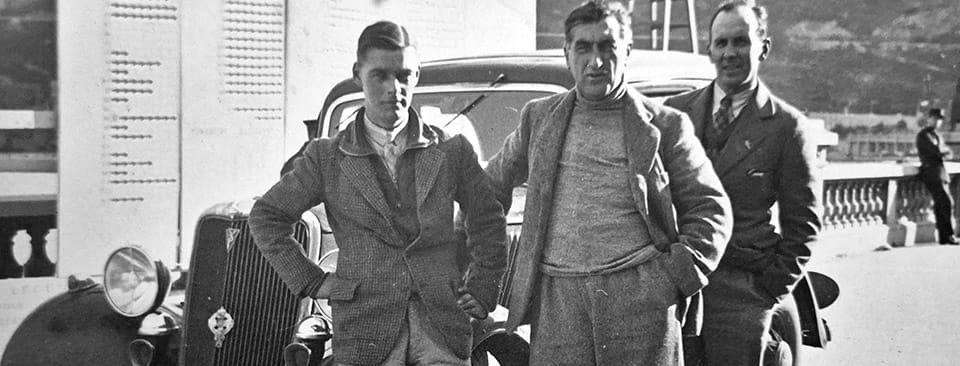
Resident Magistrate Patrick Sarsfield Brady's life mirrored that of a rally driver - he navigated varied and challenging terrain through twists and turns. Barry Whelan brings down the chequered flag
Patrick Sarsfield Brady was born in Belfast on 14 March 1877 to parents James and Mary Brady. His father was a successful publican and landlord, with the net result that the Brady family was quite wealthy and could afford to provide a good education for Patrick – first at St Malachy’s College, Belfast, and then at Blackrock College, Dublin.
Politically, the family was nationalist in outlook and Irish speaking. At a time when Whitehall was eager to put some ‘greening’ on the establishment in Ireland, Patrick became a firm supporter and ally of nationalist politician Joseph Devlin.
Together, they worked for the Belfast branch of the United Irish League, a party that championed land reform and redistribution of acreage to smaller tenant farmers.
Professionally, Patrick embarked on a career as a solicitor and was placed on the Roll on 11 January 1901. Despite his heroic middle name and nationalist inclinations, he accepted an appointment to be the resident magistrate for Clare on 6 June 1910.
This action would blight his reputation among nationalist supporters, who were critical that a Catholic would accept a position on the judicial bench:
‘Patrick Sarsfield Brady sits upon the bench today
And being a strictly honest man intends to earn his pay
Alas our patriot was made of very common clay!’
Minor infractions
His cases were tried in petty session courts and revolved around minor infractions, such as land disputes, debts, theft, and farmers charged with allowing “cattle to wander on the public road”.
The most common judgment he gave was a fine and, in time, he would be moved to other counties, such as Galway and Leitrim.
His life seemed to be an easy jaunt – married, with two children, a steady career, and with the possibility of being called to the bar in the process. When the War of Independence began in 1919, however, he had to make a dramatic volte-face.
Brady was working in Cork, probably the most challenging county to be posted to, as the IRA and British forces were engaged in continual and deadly combat throughout the county. His life would have been in danger, as witnessed by the murder of a colleague RM, Alan Bell, in March 1920.
In the summer assizes that year, which were frequently targeted by the IRA, Brady was hearing cases near Dunmanway, where he was commuting to work from his home at Ballylickey House in Bantry.
On 15 December 1920, his car broke down at the side of the road. A short time later, around 1.45pm, a convoy of cadets from the Auxiliary Division of the Royal Irish Constabulary (RIC) drove by, on their way to a funeral for a colleague killed in a recent ambush by the IRA.
The section’s commander, Cadet Sergeant Vernon Anwell Hart, ordered the convoy to stop to investigate Brady and his car.
As Hart was doing so, he noticed two men walking towards them further down the road. One of the men could clearly be identified as a priest from his clothing. Hart approached the younger man first to inspect his pockets before then “knocking him about with one hand while he presented the revolver with the other”.
Double murder
Brady rushed over to intervene, imploring Hart to stop, as he was a “principal government official in the district”. Undeterred, Hart shot the young man, 23-year-old Tadhg Crowley, dead.
He then turned to the 73-year-old priest, who was Canon Thomas J Magner, parish priest of Dunmanway, and “threw his hat on the ground, and he made the priest kneel. He then fired his revolver and wounded the priest; he fired again and killed him”.
Fearing for his life as a witness to the double murders, Brady ran to the remaining troops seeking protection and “narrowly escaped a similar fate”.
The murders, particularly of a priest, shocked the local community. The Inspector-General of the RIC expressed his sympathies to the families of the dead, which drew a stinging response from the Bishop of Cork, Daniel Cohalan: “The verbal sympathy of the Inspector-General whose men are murdering my people and have burned my city I cannot accept or convey to the relatives of the murdered Canon Magner.”
Witnessing the killings and recalling that the rest of the military convoy did nothing to intervene changed Brady’s political outlook from pro-establishment to supporter of Irish independence.
He wrote directly to the Chief Secretary for Ireland, Sir Hamar Greenwood. “A written statement by Mr Brady, setting out in full the circumstances of the murder, was fully considered in the course of the official investigation into the conduct of the cadets who were witnesses of the occurrence.”
No charges were brought against these cadets, while Brady’s home was ransacked by the military and he was forced to flee to France for his safety. At a court-martial convened on 5 January 1921, Hart was found ‘guilty but insane’ and was released afterwards.
Return to Cork
In March 1921, Brady returned to Cork. This was a risky manoeuvre, because his life was still in danger from Crown forces seeking revenge for his informing on them. He was still a resident magistrate, but his work had all but ceased, and his family were kept safely in Belfast.
Perhaps the ebb and flow of the conflict in Cork, with successful IRA ambushes at Crossbarry and Rathcoole, may have persuaded him that he was safe in Bantry, as the British were clearly unable to control the county or destroy the IRA brigades operating in the localities.
The next news that reached his family and the media was that he had been kidnapped by a group of eight men on 3 July: “I cannot tell you what a fearful shock I got when I read in the paper of Pat being kidnapped. I hope and trust in God that he will be alright,” a family friend said.
Within the family, the news was devastating: “I am trying to keep calm but sometimes feel it is too much for me,” Pat’s mother-in-law, Mrs Cullen commented.
He was actually in the custody of the Cork No 3 Brigade that operated in West Cork, encompassing the Bantry area. The brigade’s headquarters informed him he had nothing to fear: “To Mr PS Brady RM. Your letters to Mr John French and to Mr Michael Collins have been delivered here and have been forwarded. We have received a communication from Mr French regarding you pointing out some good services you rendered to the IRA. There is no need for you to be unduly alarmed, you will probably be released soon.”
Bargaining tool
The brigade’s headquarters had ordered his detention as a bargaining tool for captured IRA prisoners facing execution by the British. While he was a hostage, Brady could write censored letters – he reported: “I am still a prisoner, but am treated with every consideration and kindness.”
Behind the scenes, negotiations with both sides had already taken place and the truce of 11 July greatly helped Brady’s early release.
He successfully sought compensation from the British State for the original ransacking of his home by Crown forces. Incredibly, he then allowed his residence to become the operating headquarters for the IRA during the truce – a fact the latter politely conveyed to his wife in Belfast: “Dear Madam. We have arrived here this evening for the purpose of setting up our Head Quarters here for a Week. We were disappointed to find you out of home but having no other place to go for the night we leave our papers here and will call tomorrow and work in a room for a few hours. We would be very pleased if you would allow us to remain for a few days, as Mr Brady has already invited us.”
With the signing of the Anglo-Irish Treaty and the dissolution of the office of resident magistrate, Brady changed gear and resumed his career as a solicitor, operating from his offices in 19 Upper Merrion Street, Dublin.
Dunlop Cup Trial
A citizen of the Irish Free State, Brady kept up his practice, but his first love was for motorcycle racing. In his youth, he had founded the Irish Motor Cycling Club and, as an adult, was an avid motorcycle and motorcar rally driver.
His Free State passport is stamped with the countries where he competed in Europe and, in 1926, he was awarded a trophy at the Dunlop Cup Trial. He was a member of the Competitions and Technical Committee of the Royal Irish Automobile Club and owned many cars, including a Bugatti.
He applied for a job as the representative of Daimler Ireland to import their cars into the country, providing Daimler Ireland with a letter and a ringing endorsement from Patrick Hannon MP: “He is only 45 years of age, but has the energy and ability of a man of 20. He knows Ireland from North to South, and from East to West, as few men know it. He has been stationed in all the chief towns in the Counties of Galway, Clare, Limerick, Cork, Kerry, Leitrim and Roscommon, and, wherever he has gone, he has been a general favourite. His personal acquaintance with probable users of Daimler motor cars is, I believe, unique.”
Brady continued his solicitor practice, but was more often found working in his car-tyre garage, Joyce & Brady Ltd, on Lemon Street and Duke Lane Dublin. When not repairing cars, he was usually abroad competing at rallies.
Despite his frequent absences from home, his marriage to Ellie was a happy one, and they enjoyed a comfortable life in South County Dublin.
In many ways, Brady’s change in political outlook can be measured by his investments in Ireland as he sought to promote indigenous industries and provide employment, particularly to rural areas – something Fianna Fáil and the first inter-party government championed.
Miner’s song
He was chairman of Mianraí Teoranta, a mining consortium with operations in Avoca Wicklow (lead-zinc ore) and Slievardagh Tipperary (coal).
On 19 July 1948, Brady along with management, met at Government Buildings, where Minister for Industry and Commerce Daniel Morrissey discussed the potential value of this work to the country and economy: “The Minister stated that the Government looked upon the question of mineral exploration as a very serious one and, before making a decision, they were anxious to give it very serious consideration. On that account they had decided on the rather unusual course of inviting the representatives of the Company and their expert advisors to meet the Government and have a full discussion on the matter.”
Brady was also a director of Western Hats Ltd in Castlebar, Co Mayo, that exported to markets on the continent.
Patrick Sarsfield Brady’s life mirrored that of a rally driver – he had navigated over varied and challenging terrain but, through twists and turns, had finally found the finish line.
He passed away on 31 October 1948 and was buried in Deansgrange Cemetery, Dublin.
Dr Barry Whelan is a historian with the Law Society of Ireland, specialising in 20th century Irish legal history. The author sincerely thanks Dr Monica McWeeney for kindly permitting extracts from the collection of her grandfather, Patrick Sarsfield Brady, to be reproduced for this publication. If you have an interesting relative who practised as a solicitor and may merit an article, please contact the author at b.whelan@lawsociety.ie.
LOOK IT UP
LITERATURE:
- Eunan O’Halpin and Daithí Ó Corráin, The Dead of the Irish Revolution (Yale University Press, 2020)
- Law Society of Ireland, Council Minutes (9 February 1916-9 March 1926)
- National Archives (Kew) (WO 35/129, WO 35/155B, WO 35/162, WO 35/208) National Archives of Ireland (1911 census records)
- Penny Bonsall, The Irish RMs: The Resident Magistrates in the British Administration of Ireland (Four Courts Press, Dublin 1997