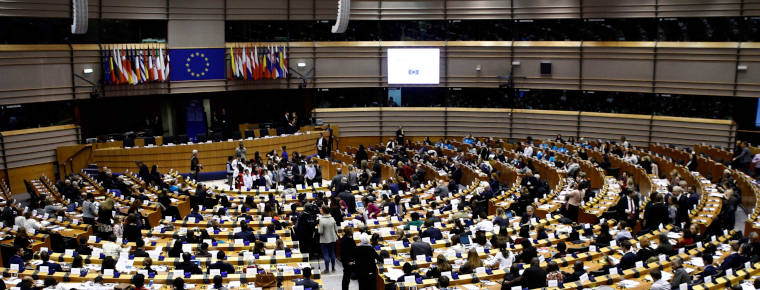
EU parliament recognises GenAI/copyright challenge
On 10 March this year, the European Parliament adopted a resolution titled ‘Copyright and Generative Artificial Intelligence – Opportunities and Challenges’ (P10_TA (2026)0066 - (2025/2058 (INI).
While a European Parliament resolution is not legally binding, its importance lies in the fact that it enables the parliament to express its political position on a particular issue, writes Dr Mark Hyland (small picure).
This resolution is also being used by the European Parliament to bring pressure to bear on the European Commission to consider new legislative measures in this complex and fast-evolving area of law.
Preamble
The preamble of the resolution refers to some salient themes pertinent to the copyright/GenAI interface.
These include:
- EU’s challenge of staying in touch with their principal global competitors in the field of artificial intelligence (AI),
- Importance of the creative and cultural sector (accounting for 6.9% of the EU’s GDP),
- Widespread violation of copyright law by GenAI providers,
- Current system of reservation of rights (opt-outs) in the EU,
- Real risk of human creators disengaging from the creative process due to the encroaching GenAI risk,
- Allied risk of an existential risk to European society and democracy,
- Relative lack of European case-law on the interplay between copyright law and GenAI, and,
- Possibility of the EU Intellectual Property Office (EUIPO) playing an important role in managing copyright-protected works that have been deliberately excluded from the text and data mining (TDM) exception by rightsholders.
Limitations of current EU copyright regime
At paragraph 2, the European Parliament states that current copyright law is “insufficient to address the challenge of licensing copyrighted material for GenAI”.
It calls for an additional legal framework to clarify licensing rules for GenAI and to address potential infringements of current copyright law.
The European Parliament also believes that this new legal framework should include provisions that ensure effective cooperation between GenAI providers and creators/other rightsholders and a functioning licensing market that restores the bargaining power of rightsholders and viable protection solutions (paragraph 2).
Press publishers, journalists, and news editors
Highlighting rightsholders from the press and news-media sector (to include press publishers, journalists, and news editors), the resolution states that they must have full control over the digital use of their content by AI systems and models for training purposes.
This control should be based on a robust and functioning possibility to exclude such use by AI systems and models.
These processes must be “underpinned by full transparency and source documentation over the use of third-party content” (paragraph 5).
Later, at paragraph 7, the European Parliament urges the European Commission to explore the possibility of safeguarding the press and news-media sector, where services are repeatedly and fully exploited by AI systems.
It further urges the European Commission to assess and propose mechanisms to ensure that providers of GenAI models or systems compensate press and news-media outlets where the former have “demonstrably diverted traffic and revenue” from the latter.
The compensation should be fair, proportionate, and non-discriminatory, with particular attention being paid to local and regional media, to safeguard media pluralism, diversity, and democratic discourse in the EU and its member states.
Key role for EUIPO
The European Parliament resolution calls on the European Commission to provide legal certainty for both rightsholders and AI providers and to assess the necessity and feasibility of tools that enable rightsholders to effectively exclude their works from AI training.
The European Parliament recommends that this process be managed by a trusted intermediary, and it proposes making the Alicante-based EUIPO that trusted intermediary.
The European Parliament envisages that the EUIPO’s role will be to manage and list the exclusions (reservations/opt-outs) made by rightsholders, in addition to taking cognisance of exclusions already in existence.
The European Parliament also recommends that the European Commission assigns to the EUIPO responsibility for supporting a sector-based, voluntary licensing process to streamline relations between GenAI providers and rightsholders.
A workable, innovation-friendly framework that supports EU competitiveness is envisaged, one that attempts to balance the interests of rightsholders with those of AI companies (paragraph 11).
Dovetailing
There is considerable dovetailing between the European Parliament Resolution and the start of the European Commission’s formal review of the Copyright and related rights in the Digital Single Market (CDSM) Directive.
As a preliminary step in the review process, the European Commission called for evidence and feedback from a long list of stakeholders.
The European Commission is hoping to use this evidence to gauge the impact of the directive on the various stakeholders and to assess the challenges associated with the use of copyright-protected content in the context of AI and research.
Stakeholders had until 25 June 2026 to submit their evidence.
What is envisaged is a targeted legislative initiative that will attempt to strike a balance between the interests of the creative industries and GenAI providers.
The new legislation is expected to strengthen the position of creators/creative industries in the online and AI environment and provide them with better means to control the use of their works, enforce their rights and recoup their financial investment.
It is also expected to enable GenAI providers to benefit from high-quality copyright-protected content in their deployment of new AI models, provided such content is obtained legally through the conclusion of licence agreements with the rightsholders.