Don’t surrender human judgement to AI – Letta
Human ingenuity is both powerful and dangerous, former Italian PM Professor Enrico Letta has said in a speech at Dublin’s Dublin City University (DCU).
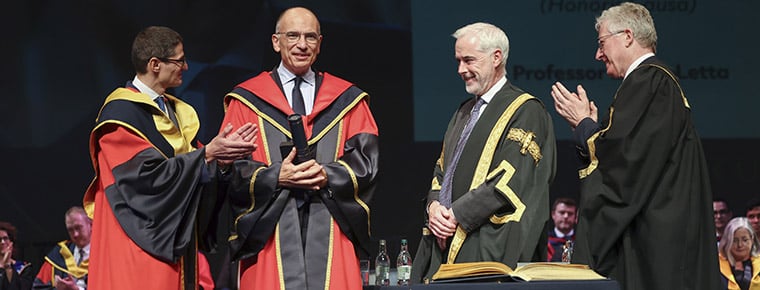
At the Dublin European Law Institute (DELI) event, which was officially associated with Ireland’s EU presidency, DCU awarded an honorary doctorate in law to Prof Letta (23 September).
The award honours his long-standing commitment to European integration, as captured in his report ‘Much More Than a Market’.
In a speech drawing on Sophocles’ Antigone and the Greek word deinón, Letta describes humanity as capable of extraordinary invention but also capable of causing terrible harm.
Technological capability did not automatically provide the wisdom to decide how that capability should be used, Letta said at the ceremony.
Letta said that the conferral invited reflection on the relationship between knowledge and public life, and what we owed to the institutions that preserved our capacity to think freely.
Wondrous and terrible
“Many things are wondrous and terrible, but none more so than the human being,” he said, in a line from the first choral ode of Sophocles’ Antigone.
AI intensified this problem, he said.
AI can transform areas such as language, learning, creativity, and decision-making.
It offers major potential benefits – including better research, personalised assistance, broader access to education, and less repetitive work.
Yet this inventiveness offered no guarantee of wisdom, Prof Letta said.
This distance between capability and judgement was where the discussion about AI must sit, Letta said.
The central danger is of humanity surrendering judgement.
Letta distinguished between using AI to assist human decisions and allowing it to replace human responsibility.
Opaque algorithmic decisions
In education, for example, fluent AI answers could become substitutes for genuine understanding.
In public life, opaque algorithmic decisions could weaken democratic accountability.
In his speech, Letta advocated for ‘measure’ rather than either enthusiasm, or fear.
“Measure requires judgement about proportion, purpose, and consequence. It asks us to distinguish between the exercise of a capacity and its proper use,” Prof Letta said.
“But judgement of this kind does not emerge automatically, It has to be cultivated,” he said.
This was where the humanities were indispensable, Letta added.
Drawing on the Greek mēdèn ágan (‘nothing in excess’) and Horace’s aurea mediocritas (‘golden mean’), Letta said that societies should assess AI according to its purpose, consequences, distribution of benefits and costs, and the possibility of challenging or correcting its decisions.
History and the humanities taught people to question sources, examine evidence, detect contradictions, and resist “the seduction of easy narratives,” he said.
Human dignity
These skills are particularly important when AI can produce convincing answers without making its underlying assumptions transparent.
With AI “confidence of expression can be mistaken for reliability of knowledge,” Letta pointed out.
The European traditions of human dignity, freedom of inquiry, criticism and accountability, could help ensure that AI strengthens rather than diminishes human agency, Letta continued.
But values require technological and scientific capabilities if they are to influence real-world choices.
Free society
Universities provided environments where claims could be challenged, evidence examined, and different disciplines brought together, Letta said.
“These practices are essential to a free society,” he added, and were especially important as technologies became more powerful, more complex, and more deeply embedded in everyday life.
“The encounter between scientific and humanistic inquiry therefore belongs at the centre of our response to artificial intelligence,” he said.
Letta stressed the need for collaboration between lawyers, scientists, engineers, philosophers, historians, economists, and others.
Fifth freedom
He linked this thought to his proposal for a European ‘fifth freedom’, centred on research, innovation and education.
In his report on the future of the European Single Market, Letta proposed building this fifth freedom on the EU’s existing four freedoms.
This would make it easier for researchers and universities across Europe to share infrastructure, expertise, and knowledge, while strengthening independent scrutiny of emerging technologies.
Letta concluded that, as humanity's technological power grew, its capacity for judgement and responsibility must grow alongside it.