No 'going rate' in costs awards – OLCA chief
Chief Legal Costs Adjudicator Barry Magee has told practitioners that costs awards from the courts are made to the client, not the legal practitioner.
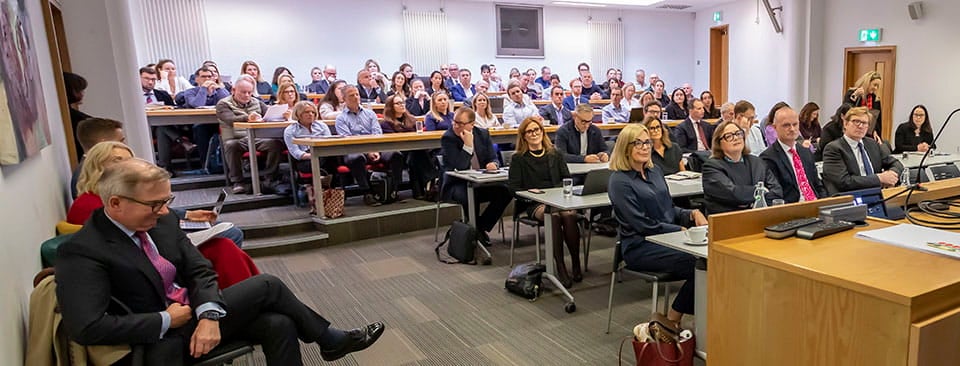
The head of the Office of the Legal Costs Adjudicator (OLCA) was speaking at the annual conference of the Law Society Litigation Committee in Blackhall Place (15 October).
The OLCA's remit covers party-and-party costs – the basis on which a successful party is awarded costs in civil matters – in the superior courts, as well as legal practitioner and client costs, arbitral awards, and receiver costs.
Last year, the office completed 826 cases with 153 decisions, as about 80% of the cases lodged with it settled without a hearing.
Reduced fees 'binding'
Magee told the event that practitioners could not seek more in party-and-party costs that the client was liable for, adding that, if a client had agreed reduced fees or had already paid, these were binding and could not be increased by the OLCA if the case was won.
He added that a solicitor whose client moved to another solicitor could not seek higher fees if the new solicitors settled the case for a larger than expected amount.
The OLCA chief explained that 'fair and reasonable' costs were determined on the basis of schedule 1 of the Legal Services Regulation Act 2015, which included factors such as the complexity of the case, skills or specialised knowledge needed, research costs, and expert witnesses.
Citing a 2017 Supreme Court ruling in Sheehan v Corr, which he said still applied to the current system, Magee said that a value did not have to be put on each individual item contained in a general-instruction fee, and there was no requirement for practitioners to keep contemporaneous time records.
Case file
The chief adjudicator said that his office did not allocate a figure for each individual factor, but took all of them into account to determine a 'fair and reasonable' fee.
Magee added that there was no 'going rate' for anything – the only fixed costs are listed in schedule W of order 99 in the Rules of the Superior Courts – and that all decisions on costs were based on a review of the case file.
"We take in the file, we read it, and then we make our decision; that's what we base our allowances on," he stated.
Magee also warned practitioners that his office complied with the court's order in a determination.
"It's too late to argue it before the adjudicator if it should be in the court order and should have been decided by the judge," he stated.
The OLCA chief also pointed out that, when the Supreme Court refused leave to appeal without an oral hearing, the court could award costs on application by letter to the registrar. He added that many people did not know about this provision.
'Limited grounds' for reviews
Magee said that there were currently no delays in the system, with six to seven weeks between the lodgement of a bill of costs and a hearing date, followed by an oral decision seven to ten days after the hearing.
Those who were dissatisified with an award could subsequently make an 'application for consideration', asking the OLCA to reconsider its decision. This is followed by an oral hearing and a written decision.
Magee told the event that written decisions were always given in such cases, as the issue could then go back to the High Court.
Referring to a recent High Court decision, however, the OLCA chief said the court could review an OLCA determination only on limited grounds – if the applicant could show that the adjudicator erred, and that that error led to injustice.