Hostile media ‘subverts judicial independence’
While judges should be open to legitimate public criticism that is balanced and informed, media pressure can create a hostile environment, an Irish judge has said.
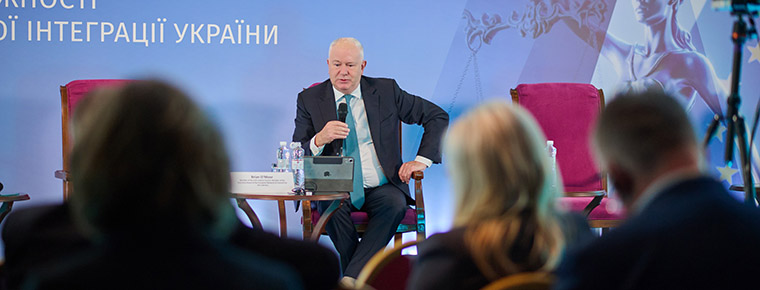
Mr Justice Brian O’Moore of the Court of Appeal was speaking at a conference in Ukraine on the topic of judicial independence across Europe.
Detached impartiality
Entitled ‘The Silent Pressures on the Bench’, his talk (24 October) said that judges were often pictured as robed figures of detached impartiality, operating above the fray of everyday political and social pressures.
“Their independence is a cornerstone of any functioning democracy, a guarantee that the rule of law applies equally to everyone, including the government itself.
“But what is the reality for the judges tasked with upholding this ideal?” he asked.
Mr Justice Brian O’Moore pointed to a large-scale recent survey that pointed to a system under increasing strain from “forces both subtle and overt”.
'Enemies of the People' effect
The survey reveals that a sizeable number of judges believe their actual decisions are being directly influenced by media pressure, creating a hostile environment that subverts judicial independence.
Mr Justice Brian O’Moore recounted how one Ukrainian judge aligned her own experience of online threats and abuse to the notorious ‘Enemies of the People’ headline used by Britain’s Daily Mail to attack three English judges.
The findings revealed surprising and growing challenges to justice that were not confined to emerging democracies or nations in crisis, the judge said.
“From the halls of power in established EU member states to the sandbagged courtrooms of Kyiv, the pressures on the judiciary are mounting, threatening European legal order,” he said.
The European Network of Councils for the Judiciary (ENCJ) surveyed 19,136 judges across 30 European countries – including, for the first time, judges in Ukraine – to assess the state of their own independence.
Not just an ‘Eastern Europe problem'
A common assumption was that significant challenges to judicial independence were concentrated in Europe’s newer democracies, the Irish Court of Appeal judge said.
The 2025 ENCJ survey, however, painted a far more complex and troubling picture, revealing that judicial independence faced serious threats across the continent, including within established EU member states, he continued.
The data showed that fundamental pillars of judicial authority were being challenged in multiple countries, he said.
“One of the most critical issues is the failure of governments to implement court judgments that go against their interests.
While the results on this metric were poor for Ukraine, the survey also revealed challenging results for Spain, Italy, Bulgaria and Belgium,” he said.
Worrying trend
This indicated a worrying trend where executive power disregarded judicial rulings in democracies across Europe, the judge added.
Similarly, while corruption within the judiciary remained a critical concern, the survey highlighted worrying results not only in observer nations such as Bosnia and Herzegovina, but also in EU members Bulgaria and Croatia, he said.
A perceived lack of respect for judicial independence from government and the media was a widespread issue, with judges in countries such as Spain, Hungary, France, and Italy reporting real issues in this area, he stated.
The foundations of the rule of law required constant vigilance everywhere, the judge said.
“The erosion of justice can also be a slow, grinding process driven by deteriorating working conditions,” Mr Justice O’Moore added.
The survey revealed that a growing number of judges across Europe feel that inadequate resources, overwhelming caseloads, and changes to their remuneration are directly undermining their autonomy.
While in Ukraine, Justice O’Moore had to seek shelter from an aerial attack at 4am.
The situation escalated rapidly over the next half-hour through a series of chilling security messages, he recalled.
First, there was a warning of four ballistic missiles heading for Kyiv.
Then came news that thermal power stations were being targeted.
High-risk threat
Finally, there was a message of a high-risk threat to the entire country, noting activity in Russia's Astrakhan region and the activation of the Oreshnik launch system, on the night on 24-25 October,
Judge O'Moore noted that he had to google the term from the hotel bomb shelter, to understand that the city was facing a potential attack from an intermediate-range ballistic missile system.
The message concluded with a stark warning:
"It can be training or combat use. Proceed to the shelters!"
That attack killed three people.
For the residents of Kyiv, this was "by no means unusual", O’Moore said.
Courage in adversity
“Upholding the rule of law under such conditions requires an extraordinary level of courage. While colleagues across Europe worry about budgets and media criticism, Ukrainian judges must contend with the life-or-death realities of war, demonstrating a profound commitment to justice in the face of unimaginable adversity,” he said.
Despite operating in an active war zone, Ukraine's participation in the survey was deemed "highly commendable" by the ENCJ, with results that were generally within EU boundaries.