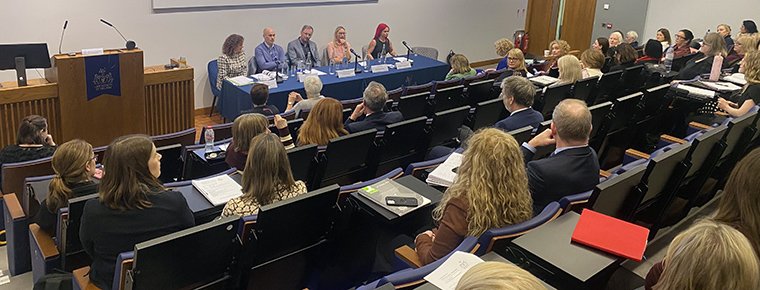
In-camera ‘inconsistently understood and applied’
Due to the absence of a clearly articulated statutory formulation and the complexity of its exceptions, the in camera rule is inconsistently understood and applied, the Law Society Family and Child Law Conference 2025 has heard.
However, the report The Operation of the In Camera Rule in Family Law Proceedings recommends retaining the rule, attendees heard.
Discussing their report at the event (14 November), Dr Aisling Parkes (UCC), Dr Kenneth Burns (UCC) and Dr Simone McCaughren (TCD) explained the importance of reforming the rule through:
- Clearer legislative drafting,
- Increased publication of anonymised judgments,
- More explicit guidance on handling and sanctioning breaches, and
- Enhanced support for responsible research and reporting.
Family-law applications have risen over 20% in five years, from 52,000 in 2019 to nearly 64,000 in 2024, attendees heard.
This is notwithstanding the pilot mediation schemes aimed at keeping family-law cases, particularly for guardianship and access custody, out of the District Court.
Restraint orders
In his presentation on developments in domestic violence and civil restraining orders, Keith Walsh SC noted that sustained growth in “usually contentious and usually protracted” domestic-violence and childcare cases is not the only factor contributing to the significant pressures under which the District Court system is operating.
The SC noted that in the 13 months since its introduction under the Criminal Law Miscellaneous Act 2023, there were 1500 applications for civil restraint orders.
Describing them as “very helpful but not perfect,” or yet fully tested, he said that clarity and precision were vital.
“My strong advice is: draft the order you want yourself, or you won't get the order,” he said.
Citing a recent case where a civil restraint order was applied for when a shotgun was fired in a dispute between neighbours, the SC expressed concern, echoed by practitioners in the audience, that in certain cases, gardaí appear to be encouraging complainants to pursue civil avenues rather than initiating criminal prosecutions.
Overwhelmed
He also raised the issue of the Family Courts Act, not commenced, which allows for the transfer of divorce proceedings, up to the jurisdiction of €1 million, to the District Court.
The Law Society campaigned against this.
“Our concern,” the SC said, “was that the District Court is already overwhelmed with family law matters.”
Family Law podcast
Referencing the in camera report, in her introduction to ‘Divorce Law in Ireland; A Retrospective’, Ms Justice Marie Baker said: “Open justice is about education, and a practitioner or a litigant is in a much better position to do a good case, to run a good case, if the law is available, accessible and comprehensible.”
The retired Supreme Court judge said: “Practitioners in family law have to know an awful lot.”
It was in that context that the judge and Claire Collins SC began the recently launched six-part podcast that explores interesting cases and precedents in family law.
The retrospective overview explained that, despite the resounding defeat of the 1986 divorce referendum, it led to the legal framework that would support the implementation of the successful 1996 referendum.
Speaking about the ‘proper provision’ principle in Irish divorce, Ms Justice Baker said: “There is a recognition by the Supreme Court that, while the judgment of the High Court on Circuit is final, it's not legal, and the Supreme Court will accept an application for an appeal from the High Court on Circuit judgment if the point is one of general public importance."
Psychologically attuned
Antoinette Moriarty (Law Society Solicitor Services Director), said: “I don't think there's ever been a more important moment in time for lawyers to really own your own value and the contribution that you can make to your communities, and also globally.”
The interpretative psychotherapist said: “Having a psychologically attuned practitioner enhances outcomes at a fundamental level.”
The aim of the service was to build and maintain a dynamic profession of high-impact professionals within a healthy and sustainable culture, she added.
Law Society Psychological Services executive Ruth O’Sullivan hosted the panel discussion ‘Family Law Practitioner: Psychological Safety and Wellbeing’.
“Professionals increasingly are becoming more and more stressed,” said Sinead Kearney, head of health services at Byrne Wallace Shields.
“And the content of what we deal with can sometimes be quite traumatic.”
Sole practitioner Peter Doyle said: “I often find the client will want to offload things that I really can't deal with.”
He added that putting boundaries in place could cause issues with client confidence.
Doyle said that the District Court workload meant that “rather than trying to get the client to the next stage, I'm spending time explaining to them why we're not to the next stage”.
Dual front
Sole practitioner Joan O’Mahony said: “Managing expectations has a dual front, because I find that people say, ‘I'm entitled to’ or ‘I want ‘in a system where proper provision and the child's best interest is paramount.”
The panel agreed that in high-pressure environments with complex client needs, the broader legal ecosystem – including the importance of collegiality and community culture – was an important part of practitioner well-being.
They also stressed the need to balance personal and professional lives.
Subsidised psychotherapeutic support is available via the Legal Mind programme.