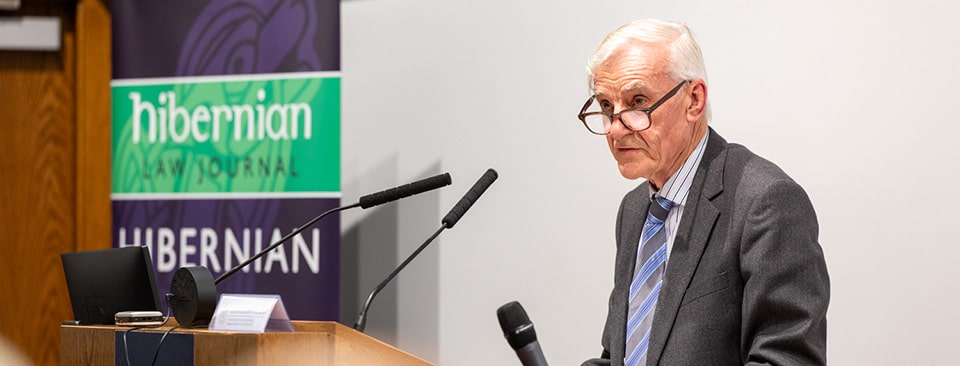
Judge expresses fears of ‘post-democratic’ era in US
Mr Justice Bryan McMahon was awarded the Hibernian Law Medal at a ceremony in the Law Society last night (16 July), where attendees heard that he had “transformed legal education” during his time as head of UCC’s Law School.
Since 2018, the Hibernian Law Medal has been awarded annually to individuals who have made outstanding contributions to the advancement of justice, the integrity of the rule of law, as well as to the independence of the judiciary both in Ireland and abroad.
Recipients include former presidents Mary Robinson and Mary McAleese, as well as former Chief Justice Frank Clarke and former Chief Justice Mrs Susan Denham.
‘Model textbook’
Mr Justice McMahon taught at UCC for 20 years, before moving into private practice.
He became a Circuit Court judge in 1999 and moved to the High Court in 2007, before retiring in 2011.
A Kerryman, he is the son of the late playwright and author Bryan McMahon.
Speaking at the event, Ms Justice Marie Baker said that he would probably be most remembered for being the co-author, with William Binchy, of Law of Torts, which was published in 1981.
She described the book as “hugely important”, adding that it became a model textbook on private law in Ireland.
Ms Justice Baker also reminded attendees that Mr Justice McMahon was also the first person to represent an Irish client in an application for a preliminary reference to the Court of Justice in Luxembourg.
Language and story
Ms Justice Baker, who was taught by Mr Justice McMahon at UCC, described him as “a great lecturer”, recalling how his lectures on defamation would be filled by students from all faculties “because his stories were so good”.
She noted the importance that Mr Justice McMahon placed on language and on story, and on “incorporating life and story into the teaching and thinking about law”.
Accepting the award, Mr Justice McMahon said that it was appropriate that the event was taking place in the Law Society, where his legal career began 65 years ago.
During his speech, he expressed concern about the US, saying that recent events had convinced him that democracy in that country was “fast-fading, if not irretrievably gone”.
In a reference to WB Yeats’s poem The Second Coming, he said: “The rough beasts have trampled on it, and I fear for its recovery; we may now be in a post-democratic era in America, where the only hope we have is the commitment to human rights,” he told the ceremony.