Conference hears ‘culture of lawlessness’ concerns
A human-rights lawyer has expressed concern about the potential for the spread of a “culture of lawlessness” in public bodies, whereby people are still denied rights despite courts finding in their favour.
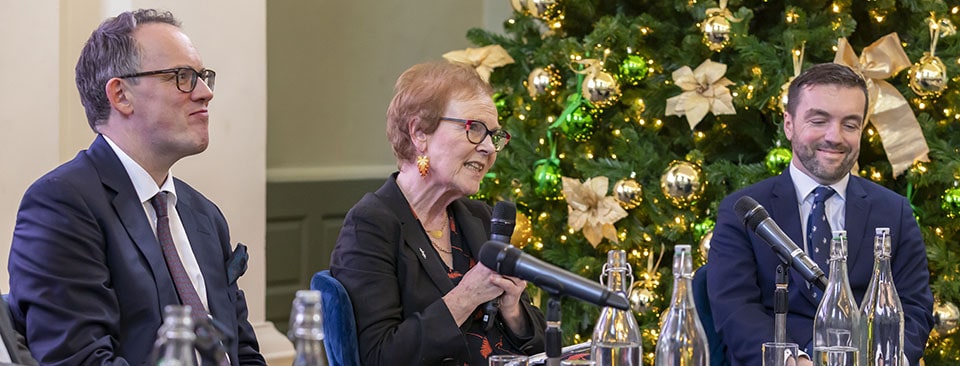
Colin Smith SC was speaking during a panel discussion on ‘law, policy, and accountability’ at the annual conference of the Law Society’s Human Rights Committee in Blackhall Place (28 November).
The barrister cited what he described as the Child and Family Agency’s “pattern of non-compliance" with statutory duties and court orders on the provision of care to vulnerable children as an example.
He also referred to an EU court’s finding earlier this year that Ireland could not use an unexpected influx of asylum-seekers as justification for evading its obligation to cover their basic needs.
Strategic litigation
“The case law is moving in the right direction, but the problem hasn't been solved, notwithstanding that litigation,” he stated.
Smith told the conference, however, that strategic litigation could be a “strong mechanism” for confronting such a culture.
The SC agreed with a suggestion that having more human-rights lawyers in the public sector could make a big difference, but he added that there were “bad actors in the system that have to be defeated”.
‘Improvements’ in sexual-offences area
Former head of the Dublin Rape Crisis Centre Noeline Blackwell said that, when she took up her role at the centre, she was “ashamed” of the fear and contempt in which the law and lawyers were held by victims of sexual violence, as they felt that the law did not respect their rights.
She added, however, that there had been “significant improvements” over the past ten years, due not only to new legislation, but also to actors within the justice system, such as the gardaí and the Director of Public Prosecutions, putting systems in place to comply with the law.
She added, however, that more needed to be done with the legal profession, particularly on issues such as understanding the effects of trauma on memory.
Diego Gallagher, solicitor at the Child and Family Agency, said that good human-rights lawyers working in the public sector could have a positive influence, adding that such lawyers could give advice and formulate policies that would prevent cases coming anywhere near the courts.
He told the panel, however, that access to justice needed to be resourced properly, describing the current allocation as “breadcrumbs”.
‘Bias’ on disability remains
Earlier, a well-attended conference heard from Sofiya Kalinova BL, who told the chair of the Human Rights Committee Cristina Stamatescu about the “phenomenally frustrating” barriers she had faced on her journey to become a barrister.
The barrister, originally from Bulgaria, said that she had had to take cases to the Workplace Relations Commission to secure her rights to education as a deaf person.
Kalinova, who became a general-practice barrister in 2023, said that the legal system was willing to support change, and things were moving forward.
She praised King’s Inns for its “collaborative” approach, as the institution ensured that she had all the access she needed.
Kalinova added, however, that there was still a bias in the system, telling the conference that people with a disability represented only 6% of those in the legal profession.
“Without diverse people in these spaces, nothing would change,” she told the conference.
Kalinova added that, outside her barrister practice, she was leading a separate project entitled Know Your Rights!, which will launch in 2026.
The initiative will create an ISL-accessible hub offering general legal information, educational videos, and specialised training for ISL interpreters.
It is also planned to include a voluntary directory of solicitors who have confirmed their commitment to providing ISL (Irish Sign Language) interpreting for potential deaf clients, with those firms listed on the website.
She emphasised that the project was a community resource rather than a legal service, designed to empower deaf people in Ireland to better understand their rights. The barrister is asking anyone interested in supporting or finding out about the project to contact her.
Habeas corpus cases
A discussion on human rights across borders heard a presentation on habeas corpus cases – which require authorities to show that an individual is being lawfully detained – from Matthew Holmes BL.
He said the suspension of habeas corpus had now become a live issue in the US, as Immigration and Customs Enforcement (ICE) detained people “with little or no due process that I can see”.
The barrister cited figures showing a sharp rise in such cases being taken in the US because of ICE activities, with just one cases each month in the Southern District of California in January, February, and March of this year, rising to 38 in September and 75 in October.
Council of Europe ‘crucial actor’
Dr Andrew Forde, who has just returned from a trip to Ukraine, said that the system comprising the Council of Europe and the European Convention on Human Rights should be seen as a “conflict actor”, with a function at all stages of conflict – including negotiating peace and post-conflict justice.
He said the council was a “crucial actor” in resolving conflicts in Europe, citing its of monitoring mechanisms and the “enormously flexible” mandate of its Commissioner for Human Rights Michael O’Flaherty.
While he said that the institution had “failed” to prevent conflict in Ukraine, he added that it was now reasserting its role, citing the potential for the establishment of special tribunals on the crime of aggression.
Natalia Brady, who previously worked at the European Court of Human Rights (ECtHR) told the conference that the institution was facing two main challenges.
While one set of “healthy” issues were associated with expansion and subsequent growth in its caseload, she stated, there were also challenges associated with political and institutional pressure from member states.
Brady told the event that reducing membership was not the answer, as this would affect compliant, as well as non-compliant countries.
The conference heard that there had been “backsliding” on the rule of law across the world.
Oxfam Ireland chief executive Jim Clarken told the event that the political “pushback” against rights often came about as a result of “gross inequality” and people’s subsequent search for alternatives in the political system and had resulted in political capture by wealthy elites, a hollowing out of objective media, and a real threat to democratic institutions.