Payments progress ‘unsatisfactory’ – Central Bank
The deputy governor of the Central Bank has said that Ireland’s retail-payments landscape legs behind other parts of Europe in some areas, describing the situation as “unsatisfactory” for consumers and businesses.
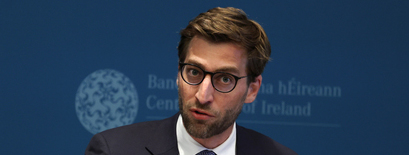
Vasileios Madouros (pictured) said that the forthcoming National Payments Strategy offered “a vital opportunity” to move forward.
Speaking at the BPFI’s National Payments Conference, Madouros said that, for consumers to have greater access to payment solutions, the market had to grasp the opportunities available.
“Despite the instant-payments infrastructure being available since 2017, material providers of payment accounts in Ireland have not implemented it. For consumers and businesses, this is an unsatisfactory outcome,” he told the conference.
Recommendations
Madouros added that many of the payment benefits for consumers remained “untapped”, despite the presence of a “growing and innovative” payments sector in Ireland, and the willingness of consumers to embrace new technology.
He was speaking as the Central Bank published its recommendations in response to a public consultation on the Department of Finance’s National Payments Strategy.
The bank has proposed four key objectives to the end of 2030:
- Ensuring that operators of payment accounts allow businesses and consumers to benefit from payment innovations that exist elsewhere in Europe,
- Safeguarding cash as a means of payment,
- Collective engagement to ensure the security and resilience of the payments eco-system, and
- Research and analysis to enhance the capacity for better-informed policy decisions on payments.
“Like any societal transition, the technology-driven evolution in the payments landscape needs to be managed carefully from a public policy perspective,” Madouros concluded, adding that a healthy economy relied on “an innovative, inclusive, and resilient payments eco-system".
A2A ‘gap’ in market
The Central Bank submission points to the lack of A2A (account-to-account) payment solutions, built on instant-payment functionality, as a “major gap” in the Irish market.
The paper also says that the roll-out of instant payments for credit transfers will require investment by Irish service providers, whose starting point is behind operators elsewhere in Europe.
The payments strategy comes as a bill on access to cash goes through pre-legislative scrutiny in the Oireachtas. The BPFI, which represents the main banks, recently outlined “significant concerns” about the bill.