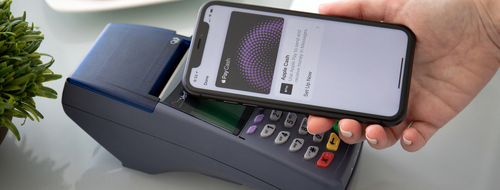
EU accepts fresh Apple wallet pledges
The European Commission has accepted a revised set of commitments from Apple aimed at addressing competition concerns over its position in the market for mobile-phone payments.
In 2022, the commission gave Apple its preliminary view that, by limiting access to a standard technology used for contactless payments, known as ‘near-field communication (NFC)' or ‘tap-and-go', Apple was restricting competition in the mobile-wallets market on its iOS operating system.
The EU body found that Apple Pay was the only mobile-wallet system that could access the necessary hardware and software on iOS to enable mobile payments in physical stores.
Earlier this year, the commission asked for feedback on Apple’s initial proposals to address the competition concerns.
Move ‘opens up competition’
Today (11 July), the EU body decided that Apple’s final commitments would address its concerns and has made them legally binding for ten years.
Margrethe Vestager (commission in charge of competition policy) said that Apple had committed to allowing rivals to access the 'tap-and-go’ technology of iPhones.
“Today’s decision makes Apple’ commitments binding. It opens up competition in this crucial sector, by preventing Apple from excluding other mobile wallets from the iPhone’s ecosystem,” she added.
Apple had initially committed to allowing third-party wallet providers access to the NFC technology on iOS devices free of charge, without having to use Apple Pay or Apple Wallet.
It had also pledged to enable access to NFC in Host Card Emulation (HCE) mode, which allows the secure storage of payment credentials and the completion of transactions using NFC, without relying on an in-device secure element.
Access for developers
Among the new commitments are:
- To extend the possibility to initiate payments with HCE payment apps at other industry-certified terminals, such as merchant phones or devices used as terminal (so called SoftPOS), if this is enabled,
- To explicitly acknowledge that HCE developers are not prevented from combining the HCE payment function with other NFC functionalities or use cases, and
- To remove the requirement for developers to have a licence as a Payment Service Provider (PSP) or a binding agreement with a PSP to access NFC.
Apple has also agreed to allow NFC access for developers to pre-build payment apps for third-party mobile-wallet providers, while it will also shorten deadlines for resolving disputes about access decisions.