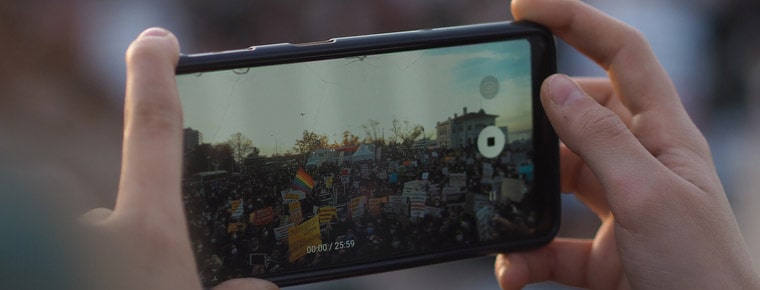
IBA-backed app helps document war crimes
An app developed to help victims of atrocities to document war crimes has so far delivered 22 dossiers to support investigations by international and domestic agencies across the world.
The eyeWitness to Atrocities app, launched in 2015, was developed by the International Bar Association (IBA), in partnership with technology company LexisNexis Legal & Professional. The IBA founded the charity of the same name, which is registered in the UK.
The app collects, verifies, catalogues and protects images so that they can be used as evidence in court, while also helping to protect the individuals who have taken the photos or videos.
The IBA says footage from app users is helping the investigations and analyses of organisations such as the United Nations and the International Criminal Court, as well as European war crimes units, domestic courts, and international police forces.
‘Meticulous’ testing
The original idea for the app was inspired by a request to the IBA from Channel 4 News to provide analysis of footage showing the killing of civilians by government forces in Sri Lanka. The country’s government subsequently denied the incident, and claimed that the video was doctored.
Research and development of the app was conducted over four years, and included conversations with activists and what the developers described as “meticulous” testing.
The tests resulted in a number of innovations:
- Images are not saved in a phone’s photo gallery, but in a password-protected area within the app,
- Content can be deleted quickly and easily, as can the app itself, should the need arise,
- Icons unrelated to human rights can be used to disguise the app on the user’s phone.
Witnesses decide whether to upload the images to the eyeWitness database, which is hosted by LexisNexis & Professional.
Digital fingerprint
The app creates a digital fingerprint to ensure the authenticity of images, and also creates a record of who has had access to the captured images.
Uploaded images are encrypted and kept in a secure repository. The IBA says questions can be answered with certainty about location, date, time, authenticity, and the chain of custody, which must be unbroken to stand up as evidence in a court of law.
Wendy Betts (director of eyeWitness) said that the app was empowering those on the ground who were taking risks, and helping them to transform information into something that had greater reach.
“Everyone recognised the long-term impact this innovative tool could have in aiding victims of atrocities in their quest for justice in a court of law,” said IBA President Sternford Moyo, who added that he was proud to continue his predecessors’ support for what he described as a “pioneering tool”.