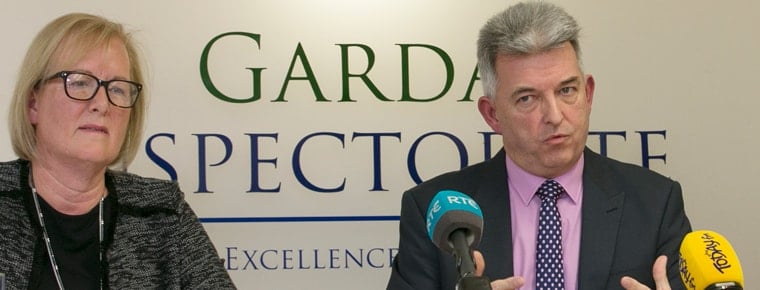
Rural districts left without policing – Inspectorate
The Garda Inspectorate 13th report says that rural communities are being failed by rostering inefficiencies in An Garda Siochána.
Policing with Local Communities, published in December, scrutinises the use of Garda resources and sets out a number of critical actions that would provide a more effective and visible policing service.
The inflexible Garda roster system is failing to make the best use of finite resources, the Garda Inspectorate says.
Strategic planning absent
The report criticises the absence of an intelligence-led strategic planning process on the demand for policing services.
It is, therefore, unclear what the optimum number and mix of members, Garda staff and reserves should be to police Ireland, the report says.
An Garda Síochána is well behind other comparable services in how it uses technology and data to help it measure and manage demand, allocate resources and improve its service to the public, according to the report.
Urban/rural divide
This results in insufficient gardaí on duty at the right times. Compared with urban areas, there are often fewer gardaí available each day in more rural locations as those communities observe a decrease in visibility.
In many divisions, the number of community policing members has reduced by up to 50%, with large reductions in rural areas. Some districts have no dedicated community policing members in place.
The slow pace of civilianisation is also slated in the report because of the resulting failure to maximise front-line resources.
The district model of policing currently operating is too small in scale and leads to inefficient and inconsistent services for victims and the public, the report says.
The Inspectorate previously recommended moving to a divisional rather than district model, whereby particular senior management responsibilities are allocated on a functional rather than geographical basis.
However, the report laments the slow pace of change and says that the new model is still only at pilot level in four divisions (Galway, Cork City, Mayo and DMR South Central).
Pilot
The pilot also differs from the Inspectorate’s recommendation, in that it retains a district-based structure for responding to calls from the public, investigating less serious crime and managing all community policing and stakeholder engagement.
In July 2016, the Government endorsed the decision of the Garda Commissioner to replace the current district model of policing with a divisional model, on a phased basis.
Non-core prisoner escort duties also eat into frontline policing work, affecting the victims of crimes, the report complains.
It also critiques the organisational risks associated with arrangements for custody management, front-line supervision, response driving and deployment of district detectives to firearms incidents.
Critical actions
This report contains several critical actions that provide a road map to modernise and improve local policing services:
- Local policing should be managed within a divisional structure that does not retain district constraints, barriers or boundaries that affect the delivery of local policing services,
- Development of a new resource allocation process that assigns resources to Garda units based on policing needs,
- Recognising concerns about crime in rural communities, development of a multi-agency rural crime prevention and reassurance partnership,
- Development of a community policing model, with personnel in all divisions trained in problem solving and partnership working to tackle issues that matter to local communities,
- Development of an organisational strategy that maximises resources for enhanced visibility and accessibility,
- Take policing to the public through the use of garda clinics, kiosks and shop fronts, as well as enhanced online services,
- Development of a new ICT strategy that prioritises mobile technology to local policing units to transform the capability of front-line gardaí,
- Recruitment of a critical mass of garda staff to release garda members from non-operational posts,
- Use of tools such as strategic assessments, business-process mapping, academic research and priority-based budgeting to develop a new workforce plan,
- Patrol sergeants and inspectors to go on duty in all divisions on a 24/7 basis,
- Further development of Joint Policing Committees and local community forums,
- Development of multiple rosters that put resources on duty when needed, and
- A review of the organisation’s firearms requirements.
Chief Inspector Mark Toland said: “Visibility, accessibility and reassurance are critically important to local communities, particularly those most vulnerable.”
The Garda Síochána Inspectorate report can be found on the website of the Department of Justice and Equality.
The Garda Síochána Inspectorate is an independent statutory body established in 2005.