
Thrive to survive
The Irish legal sector is thriving, with practitioner numbers at record highs and demand surging across key industries – and now the profession has a real opportunity to extend that success to every corner of the country. Mark McDermott reports
Ireland’s legal profession entered 2026 in robust health, with the latest data from the Annual Report on Admission Policies of Legal Professions 2025 painting a picture of a sector that has not only weathered economic uncertainty, but is actively driving growth across the country.
With more than 12,000 solicitors now on the Roll and a burgeoning pipeline of new talent, the figures confirm what many practitioners already sensed: demand for legal services in Ireland has never been stronger.
The milestone is more than symbolic. Independent analysis, jointly commissioned by the Law Society and the Bar of Ireland, places the legal sector’s contribution to Ireland’s economy at €6.7 billion, a figure that underscores just how deeply embedded legal expertise has become in the fabric of Irish commercial and civic life.
The sector supports over 52,000 jobs, a number that stretches well beyond the courtroom, encompassing paralegals, legal executives, administrative professionals, and the wider ecosystem of firms and institutions that depend on legal services to function.
Ireland’s position as a hub for global business continues to attract multinational investment, with the legal profession playing a central – if sometimes underappreciated – role in enabling that success.
Shaping the modern economy
The sectors driving legal demand in 2025 are indicative of Ireland’s contemporary economy.
Financial services, manufacturing, technology, and life sciences are all generating substantial legal work, with practitioners increasingly called upon to navigate complex regulatory compliance requirements, commercial contracts, mergers and acquisitions, and dispute resolution.
It’s a far cry from the profession of a generation ago, and it speaks to the adaptability of Irish lawyers in meeting the needs of an economy in constant flux.
Law Society survey data reinforces this picture of an evolving profession. In 2025, 50% of private-sector in-house solicitors reported working on commercial matters, up markedly from 41% in 2023.
That shift reflects both the rising complexity of corporate Ireland and the growing confidence of legal teams operating within businesses, rather than merely advising them from the outside.
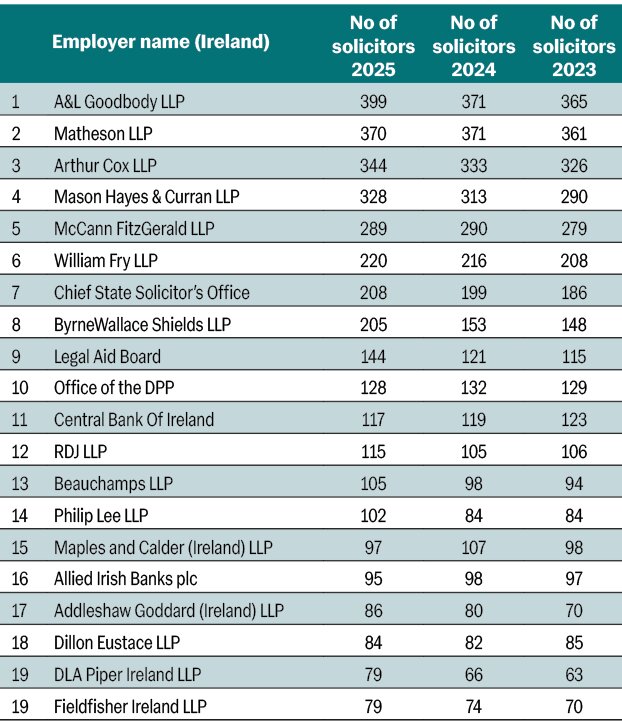
Breakdown of the number of practising certificates held by each of the top 20 largest employers of solicitors, as of 31 December 2025 (incorporating firm principal offices and branches in Ireland)
New frontiers
New frontiers in data protection, AI, and cybersecurity are also opening up rich seams of legal work, as businesses grapple with a regulatory landscape that is expanding faster than many compliance departments can keep up with.
The result is rising demand for highly specialised expertise – and a profession responding to that challenge.
Some 86% of private-sector solicitors and 92% of their public-sector in-house counterparts reported seeking more professional training in 2025 – a statistic that speaks to a culture of continuous learning rather than complacency.
Confidence runs high
Perhaps the most striking feature of the 2025 data is the mood within the profession itself.
Some 65% of private-sector solicitors and 53% of those working in the public sector reported a positive outlook for the future of the profession.
While the proportion expecting significant growth in their own specific field over the next five years has softened somewhat compared with 2023, the majority still anticipates an expansion in work opportunities, reflecting a level of forward-looking confidence that many sectors would envy.
Trainee solicitor admissions remained high, with an intake of 581 trainees at year-end.
This suggests that the profession continues to attract ambitious graduates who regard legal work as a meaningful and sustainable career.
Geography lesson
Yet for all the sector’s evident strengths, the data contains a note of caution. The geographic distribution of legal services remains strikingly uneven, and that imbalance has real consequences for communities across Ireland.
Of the 12,961 practising certificates held by solicitors at year-end 2025, a total of 8,827 – roughly two-thirds – were held by solicitors based in Dublin. Just 4,134 certificates were held by practitioners outside the capital.
The contrast is sharp, and it raises legitimate questions about whether the growth and dynamism so visible in urban legal markets is being felt equally in rural Ireland.
Smaller firms outside the major urban centres face measurably greater challenges in recruiting and retaining qualified solicitors.
The competitive pull of Dublin – with its higher salaries, greater career variety, and concentration of large commercial clients – makes it difficult for regional practices to match what the capital can offer.
The result is a profession that, despite its national reach, risks becoming increasingly concentrated in a handful of urban centres. This is not merely a professional problem – it’s a public-access problem.
Rural communities depend on local solicitors for everything from conveyancing and family law to probate and personal-injury claims.
When those practitioners are difficult to recruit or retain, it is ordinary people – often those least able to travel long distances or pay premium fees – who bear the consequences.
Proactive measures
To address the shortage of solicitors in regional areas, the Law Society is exploring several proactive measures.
A solicitor apprenticeship model is currently being examined as a new qualification route for school leavers, aimed at lowering entry barriers for those without access to traditional academic pathways.
The PPC Hybrid model offers another alternative – a flexible, part-time professional practice course allowing trainees to work within their own communities while studying. This reduces the financial pressures for those with family or other commitments.
Additionally, six Small Practice Traineeship Grants were awarded in 2025, supporting small regional firms of five or fewer solicitors outside major urban centres.
The scheme provides €18,000 to the training firm over a two-year contract, with trainees receiving a €7,000 discount on their PPC fees.
With smaller practices present in almost every Irish town, these grants offer trainees a genuine opportunity to build their careers locally, without the need to relocate to larger urban centres.
Pipeline pressures
There are early signs that the future supply of legal professionals may not keep pace with demand. Enrolments in the Law Society’s PPC fell by 3% in 2024, first-time practising certificates dropped by 9%, and new entrants to the barrister-at-law degree declined by 8%.
These are not alarming figures – practitioner numbers remain at historic highs – but they suggest the pipeline that has sustained the profession’s growth may be beginning to narrow.
The Law Society has been clear in its advocacy for reform of both civil and criminal legal aid, recognising that access to justice is not simply a matter of having enough lawyers, but of ensuring those lawyers are accessible and affordable to all.
Only 1.1% of complaints to the Legal Services Regulatory Authority in 2025 related solely to excessive costs – evidence that most clients see legal fees as reflecting the professional service on offer – but the picture is more complicated for those reliant on legal aid, where funding constraints and regional shortages continue to create real barriers.
Ireland’s legal profession stands at an impressive juncture. Its economic contribution is vast, its practitioners are highly trained and broadly optimistic, and its engagement with the cutting edge of commercial and regulatory life is deeper than ever.
The challenge now is to ensure that the prosperity and dynamism visible in our urban legal quarters expand to solicitors’ offices in every town in Ireland – because justice, to mean anything at all, must be available to everyone.
Mark McDermott is editor of the Law Society Gazette.