
Opening doors
From flexible training routes to financial scholarships, the Law Society is dismantling barriers to entry to the legal profession. Mark McDermott reports
For much of its history, the path to becoming a solicitor in Ireland has followed a well-worn route: university degree, professional exams, a training contract in a firm and, for many, a relocation to Dublin.
It was a pathway that worked well for those with the means, the mobility, and the time. For everyone else, it was frequently a door that never fully opened. That is beginning to change.
The Law Society has been quietly and, in some respects quite decisively, restructuring the way it admits new solicitors, with a series of initiatives designed to widen access, reduce financial barriers, and ensure that the profession more closely reflects the society it serves.
The picture that emerges is not one of radical transformation overnight, but of a system that is changing in a measured way.
New route opens
The most visible sign of that shift is the Professional Practice Course (PPC) Hybrid, a flexible, part-time training route that allows prospective solicitors to continue working and remain in their communities, while completing the academic component of their qualification.
Combining online lectures with in-person weekend sessions, it removes the requirement that has long functioned as a silent filter – the ability to relocate to the capital for months at a time.
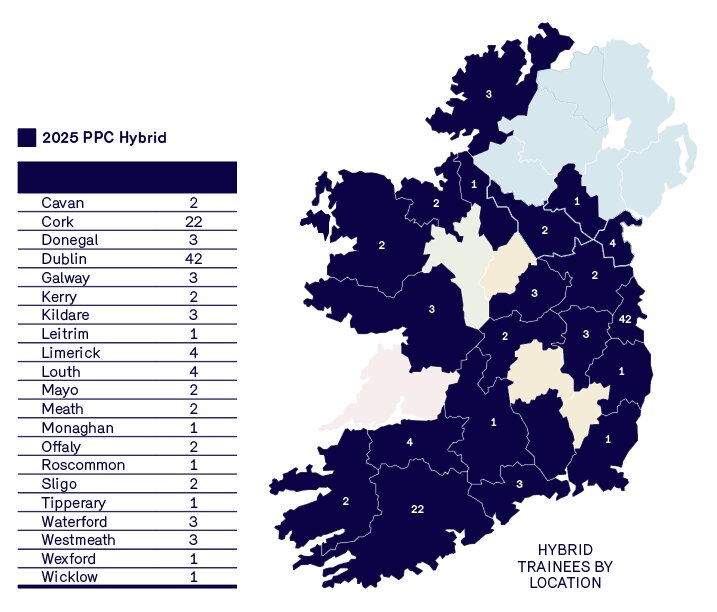
The latest cohort, which began the course in December 2025 with 105 trainees, offers a striking snapshot of how the profession is changing.
Around 60% of those trainees are training outside Dublin – a figure that would have been almost unthinkable a decade ago.
More than one-third are aged 30 or over, suggesting that the route is drawing in mature students and career-changers for whom the traditional full-time model was simply not viable.
In total, approximately 22% of all new solicitor trainees in 2025 opted for the part-time hybrid route – a proportion that has grown steadily since the programme’s introduction and shows every sign of continuing to do so.
From 2027, a new form of PPC (Hybrid) will also be offered on a modular basis, allowing students to spread the course over a longer timeframe tailored to their individual circumstances. For those juggling caring responsibilities, part-time employment, or financial pressures, this represents a significant further step.
Apprenticeships pathway
Beyond the hybrid model, the Law Society is now examining what could prove to be its most structurally significant reform yet – a solicitor apprenticeship pathway for school leavers and legal executives who do not follow the conventional university route.
The Law Society’s Education Committee has approved, in principle, the introduction of a Professional Solicitor Apprenticeship programme under the Solicitors Acts 1954-2015, with new regulations currently being drafted.
Once approved internally by the committee and Council, the regulations will require ultimate sign-off from the Minister for Justice.
If approved, the apprenticeship model would represent a genuine break with tradition.
The existing traineeship route is primarily graduate-led. Apprenticeships would open the profession to those for whom full-time, third-level study is financially untenable, or who simply never had the opportunity to take that path.
The regional dimension is also significant – by allowing trainees to qualify while remaining in their home communities, apprenticeships could help address what has become a persistent and serious problem – the chronic undersupply of solicitors outside the capital, in what have become ‘legal deserts’.
A helping hand
While structural reform of training routes is welcome, the Law Society has also maintained and expanded a range of financial supports designed to ensure that money alone does not determine who gets to qualify.
The Access Scholarship Programme, which has been running since 2001, provides financial and practical assistance to socio-economically disadvantaged students from the FE1 exam stage all the way through to qualification.
There are currently 212 people participating in the scheme: 126 are receiving support to sit their FE exams, while 86 are progressing through their PPC.
Since the programme began, 267 Access participants have qualified as solicitors – a figure that represents not just individual achievement, but a cumulative shift in the composition of the profession.
In 2025, the Law Society introduced a member contribution as part of the annual practising certificate fee specifically to fund access programmes. The measure generated an additional €170,000, which has been used to fund five additional PPC places and 20 additional FE1 places.
The signal is clear: the profession’s existing members are now directly subsidising the entry of those who might find the financial challenge a step too far.
The annual Law Society Bursary Fund of €175,000 provides maintenance grants to trainees on both the full-time and part-time PPC where personal or family resources fall short. In 2025, a total of 25 trainees received bursaries.
Five Scott Scholarships, covering the full PPC fees, have been awarded – a sixth will follow in 2026.
The Small Practice Traineeship Grant, which provides €18,000 to training firms and a €7,000 PPC fee discount to trainees, is specifically designed to support smaller practices in rural areas.
In all, 32 such grants have been awarded since the scheme’s introduction – six of those in 2025 alone. The logic is simple: sole practitioners and small firms exist in almost every town in Ireland and, if they can afford to take on trainees, those trainees can stay local.
A new Independent Law Centre Traineeship Grant, worth €25,000 annually, will begin in 2026, supporting training contracts with independent law centres.
Reaching into schools
The Law Society’s ambitions do not just begin at university level. A range of outreach initiatives aims to reach potential solicitors much earlier, in some cases before they have sat their Leaving Certificate.
The Street Law programme places trainee solicitors into schools and community settings to teach legal literacy in practical, accessible ways. Over 3,000 transition-year (TY) students have taken part since 2013.
The Solicitors of the Future programme offers an in-person, week-long experience for TY students, with around 360 participants since 2017. Approximately 20% in recent years have come from DEIS (Delivering Equality of Opportunity in Schools) colleges.
A free online TY law module, covering topics from criminal law to climate justice and human rights, attracted over 2,000 students in 2024 and early 2025.
Student feedback suggests that the content is not only engaging, but has actively influenced many to consider a legal career.
At third level, the annual ‘Becoming a Solicitor’ Symposium offers online presentations, panel discussions, and direct interaction with Law Society staff, practising solicitors, and trainees. This is helping to demystify a profession that can still seem opaque to those without family connections to it.
A profession in transition
None of this amounts to a solved problem, of course. The geographic concentration of solicitors in the capital remains a structural challenge, and the gap between aspiration and success for students from disadvantaged backgrounds is still significant.
The emphasis on specialisation in areas such as artificial intelligence, data protection, and environmental law – all of them growth areas – carries a risk of pushing up costs for clients and reinforcing existing barriers in new forms.
But the direction of travel is clear. The combination of flexible training routes, financial supports, and early outreach is beginning to reshape who enters the profession – not dramatically, but measurably.
In 2025, the Law Society moved further and faster than in most previous years: new cohorts, new grants, new modules, and new regulations in the pipeline.
The question of whether the legal profession reflects the society it serves has long been asked. The Law Society of Ireland is now, with deliberate intent, trying to answer it.
Mark McDermott is editor of the Law Society Gazette.