Justice league
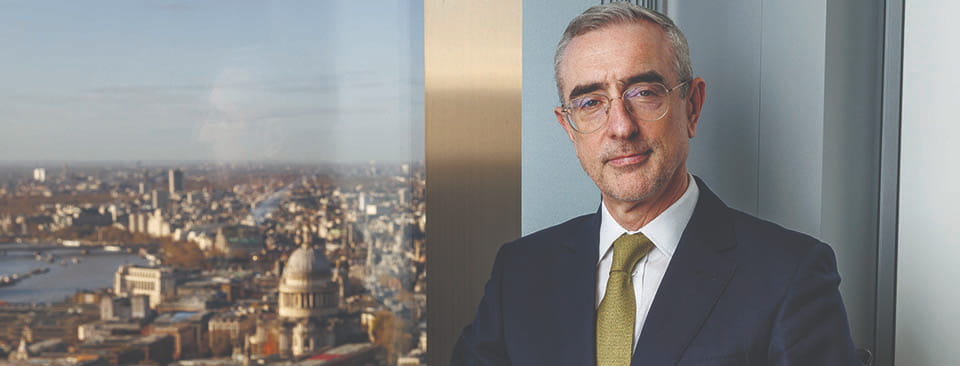
McCann FitzGerald is celebrating 40 years in London, where it was the first of the Irish law firms to establish a base, in 1986. For well over half of that time, it has been led by partner Hugh Beattie. Mary Hallissey speaks to ‘our man in London'
Hugh Beattie recounts interviewing for a sought-after traineeship with McCann FitzGerald in early 1990s Dublin. One of the interviewers, ex-chair Catherine Deane, seized on the ‘books and comics’ detail mentioned in his CV. The dialogue became an interrogation about comics.
“I didn’t realise that interviewers are always looking for something different,” says Hugh. “They zoned in on it. I felt that this was going terribly, and they must have been thinking I was a regressive child!
"In hindsight, it may well have been what swung the interview for me when I thought it was a car-crash! They were checking to see whether I could engage and answer questions and be articulate, and defend my position.”
Hugh obviously held his own because he’s been with the law firm ever since. After joining in October 1994, he became a partner at the age of 30 in 2004. He has been full-time in London for 21 years, running the office there since January 2005.
Is it a bird, is it a plane?
The London opening was propelled by the presence of client aircraft-leasing firm GPA – a significant 1980s Irish business success story.
Partner William Earley made the initial foray, and set about establishing the London office. Late in that decade, GPA did a bond issue, raising an astonishing US$5 billion.
When Hugh arrived in 1995 as part of his training contract, it was led by future managing partner John Cronin, with aviation-focused work. It was already a thriving office with a dozen staff. Hugh had no inkling that London was where he would spend most of his professional life.
He grew up in Donegal’s Inishowen, where locals still call 26 December ‘Boxing Day’ – a linguistic souvenir of older times and a strong BBC radio signal!
Carndonagh Community School, which Hugh attended, was then the largest in Ireland. His father, noted Donegal historian Dr Seán Beattie, was the careers-guidance teacher, and his mother also taught there before her untimely death.
“The only school-careers tour I got was a visit to the local Fruit of the Loom factory in Malin,” Hugh recalls. “Despite everything, there was no lack of aspiration. People went everywhere and were quite successful.” One classmate became the Abbey Theatre’s artistic director; another led the Irish Congress of Trade Unions.
Batman begins
Hugh himself loved English. While classmates drifted towards commerce degrees, he felt unmoved by balance sheets. Law seemed a good compromise. “I absolutely loved English with a passion, but I was quite a practical kid,” he muses.
His childhood holidays were never abroad, always in Dublin, where his parents had studied. Stephen’s Green ducks, Mrs Murtagh’s Clontarf guesthouse, the beautiful St Anne’s Park – all left their imprint.
“I then oriented towards studying law in Dublin, where I really had a fabulous time and made wonderful friends.”
He spent one J1 summer ‘barbacking’ in Chicago with Mexican immigrants for the minimum wage. He valued the freedom: “I knew I’d be doing law for the rest of my career – this was my chance to do something different,” he says.
Other summers were spent working on a BMW assembly line in Munich, producing front seats for 1990s models.
Hugh even tried, with youthful optimism, to convince the Arts Faculty dean, Prof Gus Martin, to let him pursue an English degree simultaneously.
Up, up and away!
If Dublin in the early ’90s promised intellectual possibility, it did not promise employment: “There was very little sense of opportunity then – there were no jobs in law really,” he recalls.
The legal sphere was a tightly controlled market in scarcity. Hugh assumed he would do some interviews, just for the experience, and study for a master’s, perhaps abroad, and move into academia.
In the background, his father had his own ideas. Quietly, Hugh’s father obtained a master list of solicitors’ practices nationwide and sent applications on his son’s behalf, and without his son’s knowledge.
One hundred rejections duly arrived at Hugh’s Dublin address: “I got letters from firms I’d never heard of,” Hugh laughs, “telling me they didn’t want me – though I never knew they’d been asked. My father certainly wanted me to get a paid apprenticeship!”
Yet in the end, improbably, the door opened. McCann FitzGerald – a firm that offered paid apprenticeships but didn’t distribute them lightly – invited him to join.
He still sounds faintly surprised, as though the decision had been made by a benevolent committee behind a curtain. “I genuinely couldn’t believe my luck,” he says.
With great power…
Dublin was in recession and law firms were cautious, yet there he was, stepping into the polished atrium of a blue-chip firm. He settled into the work with the same disciplined enthusiasm that saw him listen to English lectures while pursuing a law degree.
Hugh learned boardroom etiquette, the legal language of memos, and the delicate choreography of hierarchy. His training included a stint at McCann FitzGerald’s London HQ, then in Holborn and led by partner John Cronin.
“Aviation was the big thing the firm did at the time. When I qualified, I had ideas about pursuing EU law, for which I had won a prize in UCD. In the end, I got sent to Roy Parker, a new finance-department partner – a very creative lawyer and a very patient teacher. I didn’t know what this stuff was – structured finance, securitisation, debt issues.”
What felt obscure in the mid-1990s would become the financial engine driving Ireland’s economy and, ultimately, a central component of the global financial crisis.
“I remember Roy saying, ‘It will be about three years before you are any use to me,’ but after six weeks, during which I felt he was sheltering me a bit, I said, ‘You are underestimating me … I think I can bring value here.’ Roy listened, and we took off from there.”
So, he got it quickly? “As a junior lawyer, yes. It’s a sector of law where there’s a lot of acronyms and technical terminology. What’s actually happening a lot of the time can be fairly straightforward, but it’s finance language, of a different world, or that was the way it seemed at the time.
“There is much more education for it now but, back then, there was almost nothing. It was absolutely a great time to be involved in that emerging area. Roy was an innovator and could make the most extraordinary observations.”
I can do this all day
In time, Hugh became one of the firm’s core structured-finance lawyers. He briefly toyed with the idea of joining friends in the US, sitting the New York Bar, joining a major American firm but, in a decisive display of self-knowledge, ultimately decided that he was happy where he was.
“I have worked for this firm for over 30 years. I’ve had the privilege of working with people with whom I started as a trainee. There are many genuine friendships, made over formative years, and colleagues that I know, trust, and respect.
“There’s a real value in having a career with people you have come up with, or who have worked alongside you as a junior lawyer. It’s hard to put a price on building your career alongside such people.
"We also have many great new joiners, who bring fresh ideas, and fresh perspectives.
“I liked my work and the firm – it was interesting, challenging, working for the biggest clients and on the most interesting mandates, and the culture was a strong one where people supported each other.”
It was a moment of clarity. He stayed.
My spider-sense is tingling
Over the course of the 1990s and early 2000s, Hugh was involved in the development of Ireland’s financial-services regime, and in particular, securitisation.
The Taxes Consolidation Act 1997 introduced Ireland’s modern securitisation regime, coinciding with the year of Hugh’s qualification.
“Over the next number of years, I worked with Roy on many of the Irish market ‘firsts’ – first residential mortgage-backed securitisation (First National Building Society’s ‘Celtic RMBS’ transactions), first commercial mortgage-backed securitisation, first asset-covered securities issue, and so on.
“I was also very involved in the growth of Ireland’s emerging position as the lead jurisdiction in Europe for locating special-purpose companies [SPVs] where all sorts of asset types, including an Italian media-mogul’s film library, forests in Finland, catastrophic insurance-risk premiums, were all structured through Irish SPVs.”
These sorts of transactions all seemed quite esoteric at the time compared with the work Hugh’s contemporaries were doing: “When I took over the London office in 2005, this was the new direction I took the office in, with strong connections into the London market.
“I was fortunate to arrive into a great, fully functioning office. At that point it had been going for close to 20 years. It was an extremely busy time initially – ‘Celtic Tiger’ and the booming global debt markets – but these deals all came to a shuddering halt with the financial crisis,” Hugh recalls.
“Now the mandate was no longer setting up new deals, but dealing with all the financial-crisis issues, which impacted on the market players behind these transactions and the transactions themselves across the board.
“Some major institutions vanished altogether, and others saw the mass layoffs of hundreds of lawyers and staff. I was in the thick of all of this on several fronts.
“I was the sole partner in the London office then. The work of the London office divided up to face into a number of markets – the US market – à la The Big Short, the EU market, and the Irish market.”
All of these involved very different sets of novel issues.
In brightest day, in blackest night
The Irish market-facing mandates were the most involved.
The Irish Government’s bank guarantee, the IMF intervention, and the creation of IBRC and NAMA utterly changed the landscape. Irish legal advice became highly sought after to navigate this new complexity, Hugh explains.
“Throughout my career up to that point, I had acted for a number of Irish financial institutions on their public-bond issues – several billions of euro-worth over the years.”
Those outstanding deals came to be covered by the Irish Government guarantee, and all that followed from it. “The work I did during this part of my career was, without question, the most challenging and consequential work I have undertaken,” Hugh says.
“There was no roadmap for it. Some of this took me to the Court of Appeal in Britain with one of my Irish financial-institution clients, as we fought off opportunistic operators.”
Hugh says that the Irish media often refers to certain financial institutions as ‘vulture funds’ when, in fact, they are ordinary highly-regulated investment firms.
“These [opportunistic operators] were genuine vulture funds. In the end we won out and saw them off – even after they tried to go after certain employees personally.
“I met one of the senior executives from that time at an industry event ten years later, and he told me the advice I gave was the best he had ever received. Given how important that time was to me professionally, it was nice to hear.”
Best there is at what he does
After the financial crisis, a new world of loan sales opened up, as NAMA and other institutions sold assets and Hugh’s expertise in securitisation and loan assets came to the fore.
“Ireland became a very significant jurisdiction relative to its size. In one year alone, I recall a statistic that Ireland represented 40% of the entire EU loan-sale market.
"This brought a huge number of international investors into Ireland, and to consider the jurisdiction. This was to prove significant, as it put the country on the map for all sorts of other investments,” he says.
Many international investors were so impressed with what they saw, they set up European operations here as a consequence, Hugh adds.
“In 2015, I decided also to pivot into the Irish investment-funds world. Now, I straddle both the structured finance/ debt-capital-markets practice area and the investment-funds practice area.”
It’s quite unusual to work in both areas, he comments, but it has proven very useful.
Today, the London McCann FitzGerald office has grown to almost 20 staff, including partners covering finance (Aidan Gleeson), corporate (Jack Kelly), and joint ventures (Stephen Tallon).
The office has become a conduit between Ireland and the world’s markets, particularly as US firms expand aggressively.
Flame on
Hugh Beattie lives in Hackney with his family, which has “great delicatessens and a thriving urban-crime scene,” he quips.
“London is the greatest city in the world – it’s 50 towns mashed together, each with its own personality.”
He walks to work in Tower 42, once the tallest building in Britain, and from which the band Level 42 took their name. Hugh delights in the fact that 10% of the British economy is generated in the Square Mile.
He views Brexit as an extraordinary act of self-harm and a handicap, but also recognises the nuance lost in some less informed-commentary from Ireland.
“I wouldn’t necessarily agree that, if there were another vote, they would change their mind. I think you’d get the same result again.”
Before the referendum, the London office hosted a major event at the Guildhall, featuring high-level advisors and policymakers. Of 300 attendees polled that day, only one predicted that ‘Leave’ would win. That position provoked laughter.
Hugh feels that such misreading reflected the disconnection of the London administrative bubble.
“People didn’t understand the different narrative outside the City – those whose aspirations weren’t being met. I spoke with an officer of the British/Irish Chamber of Commerce, responsible for the regions, after the vote. For him, the result was no surprise at all.”
While Brexit was damaging, London’s resilience has surprised many. For Ireland, Beattie argues, London’s success is essential: “Ireland benefits when London thrives, because it throws off so much work.
"If work leaves London, it doesn’t naturally land in Dublin – it goes to New York or the East. Ireland and Britain need to keep working together to secure both our futures.”
...comes great responsibility
Hugh credits McCann FitzGerald’s culture with sustaining its London presence and its people: “What we offer is interesting work, good pay, strong teams, and a professional life that’s more sustainable than what’s on offer in the big international firms, to my mind.
“There’s certainly a greater degree of balance to working in an Irish law firm. Working over a weekend is the exception, rather than the rule.”
McCann’s London office is also a base of operations for Dublin staff when they come to London, with its huge market, to see clients. London also accommodates Irish-based lawyers who want to stay with the firm, but wish to experience a stint abroad.
New ways of working have made geography largely irrelevant, and the office has attracted lawyers, all working seamlessly with Dublin partners.
“The quality of trainee coming through each year seems to get better and better,” he notes. “I’m very hopeful for the future.”